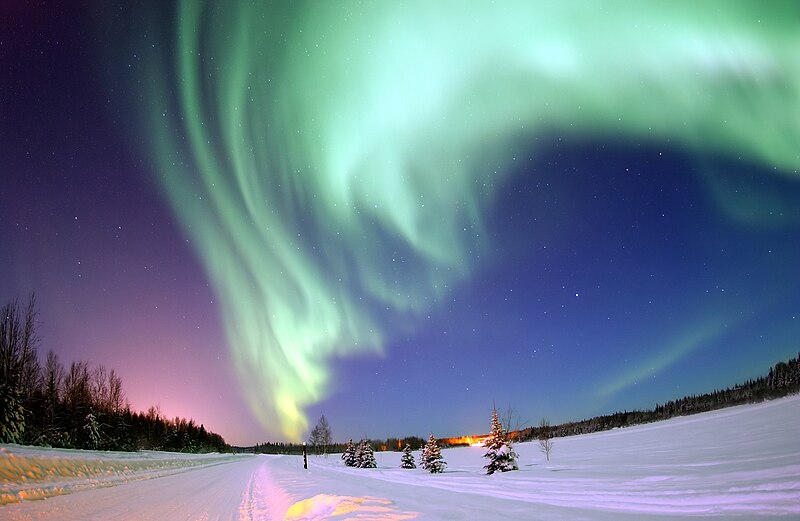
File:Aurora_borealis_over_Eielson_Air_Force_Base,_Alaska.jpg · Wikimedia Commons · See Wikimedia Commons
aurore polaire
Sign in to saveAlso known as aurora borealis, aurora australis, northern lights, southern lights, polar lights, polar aurora, aurora polaris
phénomène lumineux caractérisé par des voiles extrêmement colorés dans le ciel nocturne
An aurora is a natural light display in Earth's upper atmosphere created when charged particles from the Sun collide with oxygen and nitrogen atoms, causing them to emit colorful light such as green, red, and purple. These spectacular displays, known as northern lights in the Arctic and southern lights in the Antarctic, appear as dynamic patterns of radiant light and are most commonly seen in high-latitude regions.
AI-generated from the Wikipedia summary — may contain errors.
Wikidata facts
- Subclass of
- electrometeor
- Image
- Amundsen-Scott dome Aurora 1.jpg
Show 5 more facts
- Commons category
- Polar aurora
- Commons gallery
- Aurora
- hashtag
- Aurora
- different from
- Aurora
- on focus list of Wikimedia project
- Wikipedia:Vital articles/Level/4
Sources (3)
via Wikidata · CC0
Article · Français
Une aurore polaire, également appelée aurore boréale dans l'hémisphère nord et aurore australe dans l'hémisphère sud, autrefois « lumières du nord », est un phénomène lumineux atmosphérique caractérisé par des voiles extrêmement colorés dans le ciel nocturne, le vert étant prédominant. Provoquées par l'interaction entre les particules chargées du vent solaire et la haute atmosphère, les aurores se produisent principalement dans les régions proches des pôles magnétiques, dans une zone annulaire justement appelée « zone aurorale » (entre 65 et 75° de latitude). En cas d'activité magnétique solaire intense, l'arc auroral s'étend et commence à envahir des zones beaucoup plus proches de l'équateur. L'aurore polaire due à l'éruption solaire de 1859 est « descendue » jusqu'à Honolulu et jusqu'à Singapour en septembre 1909 atteignant ainsi l'équateur terrestre. En octobre et novembre 2003, une aurore boréale a pu être observée dans le sud de l'Europe. Un phénomène d'ampleur exceptionnelle s'est produit le 24 octobre 2014, visible en Amérique du Nord et en Europe du Nord. Les régions les plus concernées par ce phénomène restent le Groenland, l'Alaska, l'Antarctique, le nord du Canada, l'Islande, la Scandinavie, la Finlande, ainsi que dans les îles Shetlands au nord du Royaume-Uni.
Abstract from DBpedia / Wikipedia · CC BY-SA
Gallery (40)
Available in 104 languages
- Español
- Français
- Deutsch
- 中文
- 日本語
- Русский
- Português
- Italiano
- العربية
- हिन्दी
- Afrikaans
- Albanian
- Armenian
- Assamese
- Asturian
- azb
- Azerbaijani
- Bahasa Indonesia
Show 85 more
- Bangla
- Bashkir
- Basque
- be_x_old
- Belarusian
- Bikol
- Bosnian
- Breton
- Bulgarian
- Burmese
- Catalan
- Central Kurdish
- Chuvash
- Croatian
- Czech
- Danish
- Esperanto
- Estonian
- Faroese
- Finnish
- fiu_vro
- Galician
- Georgian
- Greek
- Hausa
- Hebrew
- Hungarian
- hyw
- Icelandic
- Ido
- Inari Sami
- Interlingua
- Irish
- Javanese
- Kannada
- Kazakh
- Latin
- Latvian
- Lithuanian
- Luxembourgish
- Macedonian
- Malay
- Malayalam
- Marathi
- Mongolian
- Nederlands
- Norwegian
- Norwegian Nynorsk
- Occitan
- Odia
- Pashto
- Piedmontese
- Polski
- ppl
- Romanian
- Saterland Frisian
- Scots
- Scottish Gaelic
- Serbian
- Serbian (Latin)
- Sicilian
- simple
- Slovak
- Slovenian
- Svenska
- Swahili
- Tamil
- Tatar
- Telugu
- Tiếng Việt
- Türkçe
- Ukrainian
- Urdu
- Uzbek
- Waray
- Welsh
- Western Frisian
- Wu Chinese
- Yakut
- zh_classical
- zh_min_nan
- zh_yue
- فارسی
- ไทย
- 한국어
via Wikidata sitelinks · CC0