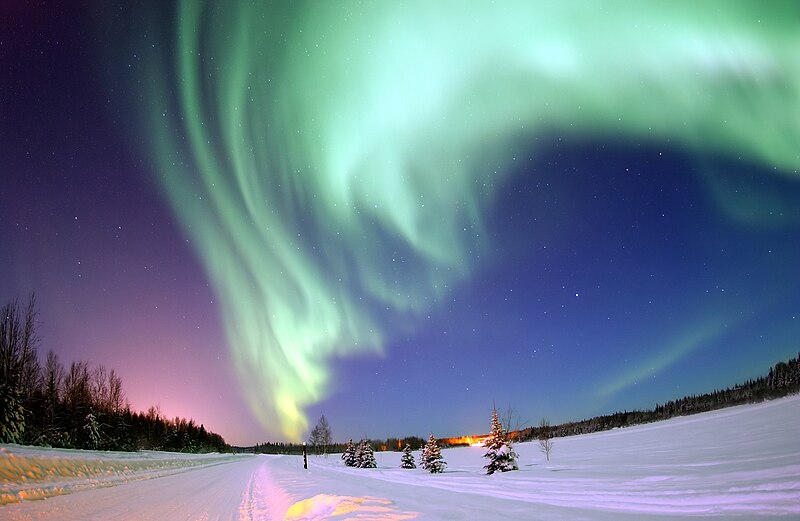
File:Aurora_borealis_over_Eielson_Air_Force_Base,_Alaska.jpg · Wikimedia Commons · See Wikimedia Commons
kutup ışığı
Sign in to saveAlso known as aurora borealis, aurora australis, northern lights, southern lights, polar lights, polar aurora, aurora polaris
An aurora ( aurorae or auroras) is a natural light display in Earth’s upper atmosphere caused by charged particles from the Sun colliding with atoms in the atmosphere. These collisions excite oxygen and nitrogen, which then emit light of different colors such as green, red, and purple. When observed in high-latitude regions they are called polar lights and aurora polaris. In the Arctic they are called northern lights (aurora borealis); in the Antarctic, the terms southern lights (aurora australis) are used. Auroras display dynamic patterns of radiant light that appear as curtains, rays, spiral
An aurora is a natural light display in Earth's upper atmosphere created when charged particles from the Sun collide with oxygen and nitrogen atoms, causing them to emit colorful light such as green, red, and purple. These spectacular displays, known as northern lights in the Arctic and southern lights in the Antarctic, appear as dynamic patterns of radiant light and are most commonly seen in high-latitude regions.
AI-generated from the Wikipedia summary — may contain errors.
Wikidata facts
- Subclass of
- electrometeor
- Image
- Amundsen-Scott dome Aurora 1.jpg
Show 5 more facts
- Commons category
- Polar aurora
- Commons gallery
- Aurora
- hashtag
- Aurora
- different from
- Aurora
- on focus list of Wikimedia project
- Wikipedia:Vital articles/Level/4
Sources (3)
via Wikidata · CC0
Gallery (40)
Available in 104 languages
- Español
- Français
- Deutsch
- 中文
- 日本語
- Русский
- Português
- Italiano
- العربية
- हिन्दी
- Afrikaans
- Albanian
- Armenian
- Assamese
- Asturian
- azb
- Azerbaijani
- Bahasa Indonesia
Show 85 more
- Bangla
- Bashkir
- Basque
- be_x_old
- Belarusian
- Bikol
- Bosnian
- Breton
- Bulgarian
- Burmese
- Catalan
- Central Kurdish
- Chuvash
- Croatian
- Czech
- Danish
- Esperanto
- Estonian
- Faroese
- Finnish
- fiu_vro
- Galician
- Georgian
- Greek
- Hausa
- Hebrew
- Hungarian
- hyw
- Icelandic
- Ido
- Inari Sami
- Interlingua
- Irish
- Javanese
- Kannada
- Kazakh
- Latin
- Latvian
- Lithuanian
- Luxembourgish
- Macedonian
- Malay
- Malayalam
- Marathi
- Mongolian
- Nederlands
- Norwegian
- Norwegian Nynorsk
- Occitan
- Odia
- Pashto
- Piedmontese
- Polski
- ppl
- Romanian
- Saterland Frisian
- Scots
- Scottish Gaelic
- Serbian
- Serbian (Latin)
- Sicilian
- simple
- Slovak
- Slovenian
- Svenska
- Swahili
- Tamil
- Tatar
- Telugu
- Tiếng Việt
- Türkçe
- Ukrainian
- Urdu
- Uzbek
- Waray
- Welsh
- Western Frisian
- Wu Chinese
- Yakut
- zh_classical
- zh_min_nan
- zh_yue
- فارسی
- ไทย
- 한국어
via Wikidata sitelinks · CC0