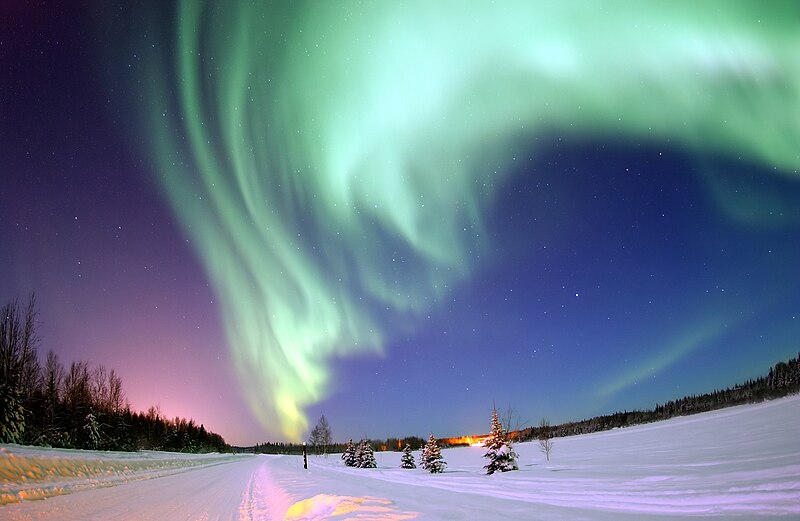
File:Aurora_borealis_over_Eielson_Air_Force_Base,_Alaska.jpg · Wikimedia Commons · See Wikimedia Commons
aurora polar
Sign in to saveAlso known as aurora borealis, aurora australis, northern lights, southern lights, polar lights, polar aurora, aurora polaris
exibição de luz natural que ocorre no céu, principalmente sobre o Ártico e a Antártida
An aurora is a natural light display in Earth's upper atmosphere created when charged particles from the Sun collide with oxygen and nitrogen atoms, causing them to emit colorful light such as green, red, and purple. These spectacular displays, known as northern lights in the Arctic and southern lights in the Antarctic, appear as dynamic patterns of radiant light and are most commonly seen in high-latitude regions.
AI-generated from the Wikipedia summary — may contain errors.
Wikidata facts
- Subclass of
- electrometeor
- Image
- Amundsen-Scott dome Aurora 1.jpg
Show 5 more facts
- Commons category
- Polar aurora
- Commons gallery
- Aurora
- hashtag
- Aurora
- different from
- Aurora
- on focus list of Wikimedia project
- Wikipedia:Vital articles/Level/4
Sources (3)
via Wikidata · CC0
Article · Português
A aurora polar é um fenômeno óptico composto de um brilho observado nos céus noturnos nas regiões polares, em decorrência do impacto de partículas de vento solar com a alta atmosfera da Terra, canalizadas pelo campo magnético terrestre. Em latitudes do hemisfério norte é conhecida como aurora boreal (nome batizado por Galileu Galilei em 1619, em referência à deusa romana do amanhecer, Aurora, e Bóreas, deus grego, representante dos ventos nortes). A ocorrência deste fenômeno depende da atividade das fulgurações solares. Em latitudes do hemisfério sul é conhecida como aurora austral, nome batizado por James Cook, uma referência direta ao fato de estar ao Sul. O fenômeno não é exclusivo somente ao planeta Terra, sendo também observável em outros planetas do sistema solar como Júpiter, Saturno, Marte e Vênus. Da mesma maneira, o fenômeno não é exclusivo da natureza, sendo também reproduzível artificialmente através de explosões nucleares ou em laboratório.
Abstract from DBpedia / Wikipedia · CC BY-SA
Gallery (40)
Available in 104 languages
- Español
- Français
- Deutsch
- 中文
- 日本語
- Русский
- Português
- Italiano
- العربية
- हिन्दी
- Afrikaans
- Albanian
- Armenian
- Assamese
- Asturian
- azb
- Azerbaijani
- Bahasa Indonesia
Show 85 more
- Bangla
- Bashkir
- Basque
- be_x_old
- Belarusian
- Bikol
- Bosnian
- Breton
- Bulgarian
- Burmese
- Catalan
- Central Kurdish
- Chuvash
- Croatian
- Czech
- Danish
- Esperanto
- Estonian
- Faroese
- Finnish
- fiu_vro
- Galician
- Georgian
- Greek
- Hausa
- Hebrew
- Hungarian
- hyw
- Icelandic
- Ido
- Inari Sami
- Interlingua
- Irish
- Javanese
- Kannada
- Kazakh
- Latin
- Latvian
- Lithuanian
- Luxembourgish
- Macedonian
- Malay
- Malayalam
- Marathi
- Mongolian
- Nederlands
- Norwegian
- Norwegian Nynorsk
- Occitan
- Odia
- Pashto
- Piedmontese
- Polski
- ppl
- Romanian
- Saterland Frisian
- Scots
- Scottish Gaelic
- Serbian
- Serbian (Latin)
- Sicilian
- simple
- Slovak
- Slovenian
- Svenska
- Swahili
- Tamil
- Tatar
- Telugu
- Tiếng Việt
- Türkçe
- Ukrainian
- Urdu
- Uzbek
- Waray
- Welsh
- Western Frisian
- Wu Chinese
- Yakut
- zh_classical
- zh_min_nan
- zh_yue
- فارسی
- ไทย
- 한국어
via Wikidata sitelinks · CC0