(c) Mogana Das Murtey and Patchamuthu Ramasamy, some rights reserved (CC BY-SA) · cc-by-sa
Species
SPECIES
- KingdomBacteria
- PhylumFirmicutes
- ClassBacilli
- OrderBacillales
- FamilyBacillaceae
蜡样芽孢杆菌(学名:Bacillus cereus),又稱仙人掌桿菌,是一種革兰氏阳性菌,β溶血性的杆状细菌 。經常在土壤和食物中被發現,有些菌株会引起食物中毒,例如"炒饭综合症"(Fried Rice Syndrome);另外一些菌株則對其他動物有益。蜡样芽孢杆菌是兼性厭氧性。与其他芽孢杆菌相同,它会产生防御性的内芽孢。它的致病因子包括施普善(cereolysin)和磷脂酶C(英语:Phospholipase C)(Phospholipase C)。
via GBIF
Research
13,726 papers- The Bacillus cereus Group: Bacillus Species with Pathogenic Potential.Microbiology spectrum · 2019
- From soil to gut: Bacillus cereus and its food poisoning toxins.FEMS microbiology reviews · 2008
- Bacillus cereus.Pediatrics in review · 2013
- Bacillus cereus toxins.Pharmacology & therapeutics · 1981
- Bacillus cereus and related species.Clinical microbiology reviews · 1993
via PubMed
Wikidata facts
- Instance of
- model organism
- Parent taxon
- Bacillus
- Image
- Bacillus cereus SEM-cr.jpg
Show 8 more facts
- Commons category
- Bacillus cereus
- taxon rank
- species
- taxon common name
- 臘樣芽孢桿菌
- Gram staining
- gram-positive bacteria
- taxon name
- Bacillus cereus
- short name
- B. cereus
- has effect
- foodborne illness
via Wikidata · CC0
~31 min read
Encyclopedic overview
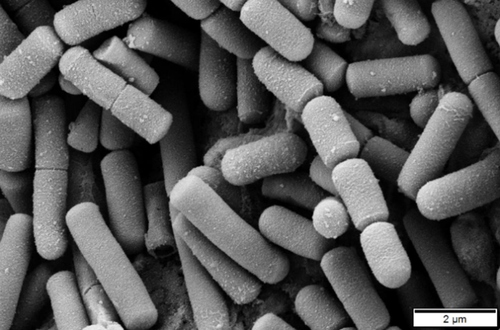
Electron micrograph of Bacillus cereus
Bacillus cereus is a Gram-positive rod-shaped bacterium commonly found in soil, food, and marine sponges. The specific name, cereus, meaning "waxy" in Latin, refers to the appearance of colonies grown on blood agar. Some strains are harmful to humans and cause foodborne illness due to their spore-forming nature, while other strains can be beneficial as probiotics for animals, and even exhibit mutualism with certain plants. B. cereus bacteria may be aerobes or facultative anaerobes, and like other members of the genus Bacillus, can produce protective endospores. They have a wide range of virulence factors, including phospholipase C, cereulide, sphingomyelinase, metalloproteases, and cytotoxin K, many of which are regulated via quorum sensing. B. cereus strains exhibit flagellar motility.
Excerpted from Wikipedia’s “Bacillus cereus” article, available under the CC BY-SA 4.0 licence.