File:Baleen.jpg · Wikimedia Commons · See Wikimedia Commons
baleen
Sign in to saveAlso known as whalebone
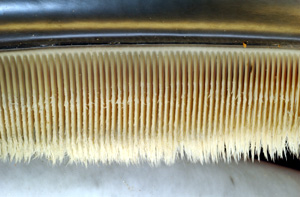
right|upright=0.75|frame|Baleen hair is attached to each baleen plate.|alt=Photo displaying dozens of baleen plates. The plates face each other, and are evenly spaced at approximately intervals. The plates are attached to the jaw at the top, and have hairs at the bottom end. upright=0.75|thumb|Appearance of baleen hair in a whale's open mouth upright=0.75|thumb|Cross-section of jaw showing bone a, gum b, rigid plate c and frayed baleen hairs d and e
Wikidata facts
- Subclass of
- animal product
- Image
- Baleen.jpg
Show 4 more facts
- Commons category
- Baleen
- Commons gallery
- Baleen
- natural product of taxon
- Mysticeti
- described by source
- New International Encyclopedia
via Wikidata · CC0
~9 min read
Encyclopedic overview
9 sectionsContents
- Etymology
- Evolution
- Filter feeding
- Mechanical properties
- Human uses
- See also
- References
- Further reading
- External links
right|upright=0.75|frame|Baleen hair is attached to each baleen plate.|alt=Photo displaying dozens of baleen plates. The plates face each other, and are evenly spaced at approximately intervals. The plates are attached to the jaw at the top, and have hairs at the bottom end. upright=0.75|thumb|Appearance of baleen hair in a whale's open mouth upright=0.75|thumb|Cross-section of jaw showing bone a, gum b, rigid plate c and frayed baleen hairs d and e
Baleens, also referred to as "Baleen plates", are triangular sheets of keratin that make up a filter-feeding system (the "Baleen rack") inside the mouth of baleen whales. The feeding process starts as the animal opens its mouth to take in water. The whale then pushes the water out through a rack of baleen plates, so as to retain (filter) what will serve as food for the whale. A baleen is similar to a bristle and consists of keratin, the same substance found in human fingernails, skin and hair. Some whales, such as the bowhead whale, have baleen of differing lengths. Other whales, such as the gray whale, only use one side of their baleen. These baleen bristles are arranged in plates across the upper jaw of whales.
Excerpted from Wikipedia’s “baleen” article, available under the CC BY-SA 4.0 licence.