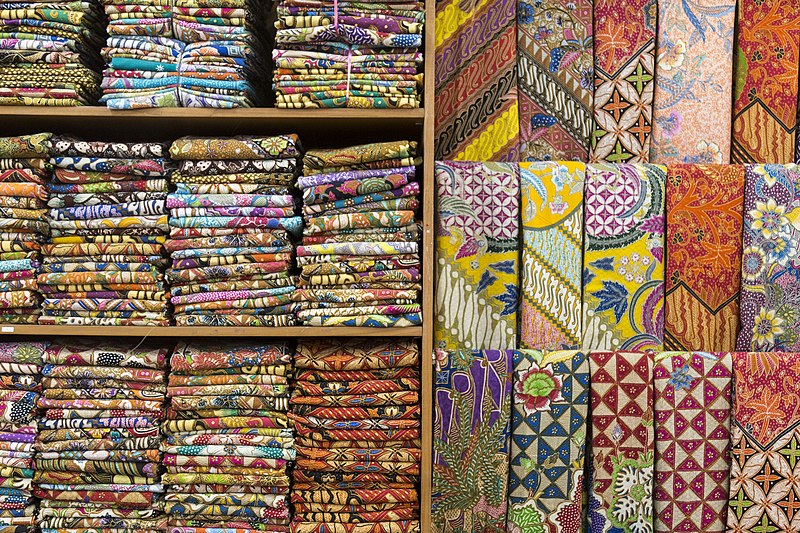
File:Batik_Trusmi_Cirebon_(23).jpg · Wikimedia Commons · See Wikimedia Commons
batik
Sign in to saveAlso known as Javanese fabric, Javanese dyeing technique, Javanese heritage cloth, bathik, royal Javanese cloth
Batik is a dyeing technique using wax resist. The term is also used to describe patterned textiles created with that technique. Batik is made by drawing or stamping wax on a cloth to prevent colour absorption during the dyeing process. This creates a patterned negative when the wax is removed from the dyed cloth. Artisans may create intricate coloured patterns with multiple cycles of wax application and dyeing. Patterns and motifs vary widely even within countries. Some patterns hold symbolic significance and are used only in certain occasions, while others were created to satisfy market deman
Batik is a textile dyeing technique where wax is applied to cloth to block dye from reaching certain areas, creating patterns when the wax is removed. Artisans can layer multiple cycles of wax application and dyeing to produce intricate designs, with some patterns holding cultural or symbolic significance while others developed to meet commercial demand.
AI-generated from the Wikipedia summary — may contain errors.
Key facts
- Textile.name
- Batik
- Textile.image
- Batik Trusmi Cirebon (23).jpg
- Textile.caption
- Cirebon-style batik at the Trusmi Batik Village, West Java
- Textile.type
- Art fabric
- Intangible heritage.ICH
- Indonesian Batik
- Intangible heritage.State Party
- Indonesia
- Intangible heritage.ID
- 00170
- Intangible heritage.Region
- APA
- Intangible heritage.Year
- 2009
- Intangible heritage.Session
- 4th
- Intangible heritage.List
- Representative
via Wikipedia infobox
Wikidata facts
- Instance of
- paint
- Subclass of
- painting
- Country
- Indonesia
- Country of origin
- Indonesia
- Material used
- cloth
- Location
- Banyuwangi
- Image
- Batik Indonesia.jpg
Show 8 more facts
- Commons category
- Batik
- topic's main category
- Category:Batik
- different from
- Apache Batik
- culture
- Javanese culture
- intangible cultural heritage status
- Representative List of the Intangible Cultural Heritage of Humanity
- native label
- ꦧꦛꦶꦏ꧀
- indigenous to
- Indonesia
- described at URL
- ich.unesco.org/es/RL/00170
via Wikidata · CC0
~23 min read
Encyclopedic overview
22 sectionsContents
- Etymology
- History
- Ancient to early modern periods
- Modern period
- Techniques
- Written batik
- Stamped batik
- Painted batik
- Dyeing
- Patterns and motifs
- Cultures
- Africa
- China
- India
- Indonesia
- Malaysia
- Sri Lanka
- See also
- Notes
- References
- Sources
- External links
Batik is a dyeing technique using wax resist. The term is also used to describe patterned textiles created with that technique. Batik is made by drawing or stamping wax on a cloth to prevent colour absorption during the dyeing process. This creates a patterned negative when the wax is removed from the dyed cloth. Artisans may create intricate coloured patterns with multiple cycles of wax application and dyeing. Patterns and motifs vary widely even within countries. Some patterns hold symbolic significance and are used only in certain occasions, while others were created to satisfy market demand and fashion trends.
Resist dyeing using wax has been practised since ancient times, and it is attested in several world cultures, such as Egypt, southern China (especially among hilltribes like the Miao, Bouyei, and Gejia peoples), India, Indonesia, Malaysia, Nigeria, and Sri Lanka. The technique developed in Indonesia (especially in Java) is among the most sophisticated, although its antiquity is difficult to determine. It first became widely known outside of Southeast Asia when it was described in the 1817 History of Java, leading to significant collecting efforts and scholarly studies of the tradition and crafts. Javanese batik was subject to several innovations in the 19th to early-20th centuries, such as the use of stamp printing of wax to increase productivity. Many workshops and artisans are active today, creating a wide range of products and influencing other textile traditions and artists.
Excerpted from Wikipedia’s “batik” article, available under the CC BY-SA 4.0 licence.
Gallery (36)
Available in 66 languages
- Español
- Français
- Deutsch
- 中文
- 日本語
- Русский
- Português
- Italiano
- العربية
- Afrikaans
- Armenian
- Asturian
- Azerbaijani
- Bahasa Indonesia
- Balinese
- Bashkir
- Basque
- Belarusian
Show 47 more
- Bulgarian
- Catalan
- Croatian
- Czech
- eml
- Esperanto
- Estonian
- Filipino
- Finnish
- Hausa
- Hebrew
- Hungarian
- Javanese
- Kazakh
- kge
- Latin
- Lombard
- Low German
- Macedonian
- Madurese
- Malay
- map_bms
- Marathi
- Minangkabau
- Nederlands
- Norwegian Nynorsk
- Polski
- Romanian
- Serbian
- Serbian (Latin)
- simple
- Slovenian
- Sundanese
- Svenska
- Swahili
- Tajik
- Tamil
- Tiếng Việt
- Türkçe
- Ukrainian
- Uzbek
- Wu Chinese
- zh_min_nan
- zh_yue
- فارسی
- ไทย
- 한국어
via Wikidata sitelinks · CC0