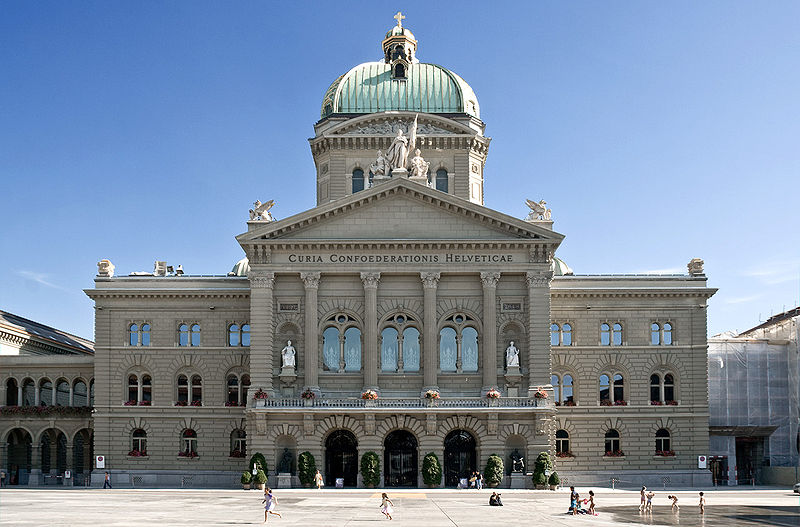
File:Bundeshaus_Bern_2009,_Flooffy.jpg · Wikimedia Commons · See Wikimedia Commons
Bern
Sign in to saveAlso known as Berne, city of Bern, Berna
Bern (), or Berne (), is the de facto capital of Switzerland, referred to as the "federal city". With a population of about 146,000 (), Bern is the fifth-most populous city in Switzerland, behind Zurich, Geneva, Basel and Lausanne. The Bern agglomeration, which includes 36 municipalities, had a population of 406,900 in 2014. The metropolitan area had a population of 660,000 in 2000.
Bern is the de facto capital of Switzerland and the fifth-largest city in the country, with a population of about 146,000 people. It matters as the seat of Swiss federal government, serving as the political center where the nation's major decisions are made.
AI-generated from the Wikipedia summary — may contain errors.
Key facts
- Switzerland municipality.places
- Altenberg, Aaregg, Bümpliz, Bethlehem, Beundenfeld, Bottigen, Breitenrain, Breitfeld, Brunnadern, Dählhölzli, Engeried, Gäbelbach, Grosser Bremgartenwald, Gryphenhübeli, Felsenau, Holligen, Innere Stadt, Kirchenfeld, Könizbergwald, Länggasse, Lorraine, Muesmatt, Murifeld, Neufeld, Sandrain, Schosshalde, Spitalacker, Stöckacker, Tiefenau, Wankdorf, Weissenbühl, Weissenstein
- Switzerland municipality.neighboring_municipalities
- Bremgarten bei Bern, Frauenkappelen, Ittigen, Kirchlindach, Köniz, Mühleberg, Muri bei Bern, Neuenegg, Ostermundigen, Wohlen bei Bern, Zollikofen
- Switzerland municipality.website
- www.bern.ch
- Switzerland municipality.subject_name
- Bern
- Switzerland municipality.other_name
- Berne
- Switzerland municipality.municipality_type
- municipality and city
- Switzerland municipality.image_caption
- Aerial view of the Old City and the Aare
- Switzerland municipality.imagepath_flag
- CHE Bern BE Flag.svg
- Switzerland municipality.imagepath_coa
- CHE Bern BE COA.svg
- Switzerland municipality.canton
- Bern
- Switzerland municipality.iso code region
- CH-BE
- Switzerland municipality.district
- Bern-Mittelland administrative district
- Switzerland municipality.postal_code
- 3000–3030
- Switzerland municipality.municipality_code
- 0351
- Switzerland municipality.area
- 51.6
- Switzerland municipality.elevation
- 540
- Switzerland municipality.elevation_description
- Bahnhofplatz
- Switzerland municipality.highest
- Könizberg
via Wikipedia infobox
Wikidata facts
- Instance of
- federal capital
- Part of
- Üechtland
- Official name
- Berne
- Demonym
- Bernerin
- Country
- Switzerland
- Located in
- Bern District
- Continent
- Europe
- Official language
- German
- Population
- 201800
- Area
- 51.62
- Elevation
- 542
- Time zone
- UTC+02:00
- Body of water
- Aare
- Capital of
- Canton of Berne
- Shares border with
- Köniz
- Official website
- www.bern.ch/en
- Image
- Bern luftaufnahme.png
- Unemployment rate
- 1.9
- Dialing code
- 031
- Licence plate code
- BE
- Work location
- workplace
Show 24 more facts
- topic's main category
- Category:Bern
- category of associated people
- Category:People from Bern
- category for people who died here
- Category:Deaths in Bern
- Commons category
- Bern
- category for people born here
- Category:Births in Bern
- inception
- 1191-00-00
- Commons gallery
- Bern
- IPv4 routing prefix
- 138.190.0.0/16
- twinned administrative body
- Dnipro
- social media followers
- 12733
- native label
- Berna
- different from
- Brno
- contains the statistical territorial entity
- Bümpliz-Oberbottigen
- Wikimedia Incubator URL
- incubator.wikimedia.org/wiki/Wy/hbs/Bern
- postal code
- 3004
- P12749
- Domitian
- phone number
- +41-313216111
- contact page URL
- www.bern.ch/@@contact
- external data available at URL
- geo.ld.admin.ch/boundaries/municipality/351
- number of houses
- 14897
- time of earliest written record
- 1208-12-01
- number of viewers/listeners
- 299041
Sources (15)
via Wikidata · CC0
~49 min read
Encyclopedic overview
49 sectionsContents
- Etymology
- History
- Early history
- Old Swiss Confederacy
- Modern history
- Geography and climate
- Topography
- Climate
- Politics
- Subdivisions
- Government
- Parliament
- National elections
- National Council
- International relations
- Twin and sister cities
- Demographics
- Historical population
- Religion
- Main sights
- Heritage sites of national significance
- Culture
- Theatres
- Cinemas
- Film festivals
- Festivals
- Music events
- Fairs
- Sports
- Economy
- Education
- Transport
- Public transport
- Road traffic
- Airport
- Bicycle transport
- Notable people
- Public servants, the military and the church
- Politicians and the landed gentry
- Science and academia
- Writing and acting
- Artists, painters and musicians
- Business
- Sport
- See also
- Notes and references
- Notes
- References
- External links
Bern (), or Berne (), is the de facto capital of Switzerland, referred to as the "federal city". With a population of about 146,000 (), Bern is the fifth-most populous city in Switzerland, behind Zurich, Geneva, Basel and Lausanne. The Bern agglomeration, which includes 36 municipalities, had a population of 406,900 in 2014. The metropolitan area had a population of 660,000 in 2000.
Bern is also the capital of the canton of Bern, the second-most populous of Switzerland's cantons. The city's official language is German. The main spoken language is the local variant of the Alemannic Swiss German dialect, Bernese German. In 1983, the historic old town (in ) in the centre of Bern became a UNESCO World Heritage Site. It is notably surrounded by the Aare, a major river of the Swiss Plateau.
Excerpted from Wikipedia’s “Bern” article, available under the CC BY-SA 4.0 licence.
Gallery (52)
On the map
6 mapped locations
Available in 177 languages
- Español
- Français
- Deutsch
- 中文
- 日本語
- Русский
- Português
- Italiano
- العربية
- हिन्दी
- Achinese
- Afrikaans
- Albanian
- Albanian
- Amharic
- Aragonese
- Aramaic
- Armenian
Show 158 more
- Arpitan
- Asturian
- Avaric
- azb
- Azerbaijani
- Bahasa Indonesia
- Balinese
- Bangla
- Bashkir
- Basque
- be_x_old
- Belarusian
- Betawi
- Bikol
- Bosnian
- Breton
- Bulgarian
- Catalan
- cbk_zam
- cdo
- Cebuano
- Central Kurdish
- Chechen
- Church Slavic
- Chuvash
- Cornish
- Croatian
- Czech
- Danish
- dty
- Egyptian Arabic
- Erzya
- Esperanto
- Estonian
- Extremaduran
- Faroese
- Filipino
- Finnish
- fiu_vro
- Friulian
- Galician
- Georgian
- Greek
- Haitian Creole
- Hakka Chinese
- Hebrew
- Hungarian
- Icelandic
- Ido
- Iloko
- Interlingua
- Interlingue
- Irish
- Javanese
- Kabyle
- Kashubian
- Kazakh
- Kotava
- Kurdish
- Latin
- Latvian
- Ligurian
- Lingala
- Lingua Franca Nova
- Lithuanian
- lld
- Lombard
- Low German
- Lower Sorbian
- Luxembourgish
- Macedonian
- Malagasy
- Malay
- Malayalam
- Maltese
- Manx
- Māori
- Marathi
- Mazanderani
- Minangkabau
- Mingrelian
- Moksha
- Mongolian
- Moroccan Arabic
- Navajo
- Neapolitan
- Nederlands
- Nepali
- Northern Frisian
- Northern Sami
- Norwegian
- Norwegian Nynorsk
- Novial
- Occitan
- Old English
- olo
- Ossetic
- Papiamento
- Pashto
- Pennsylvania German
- Piedmontese
- Polski
- Punjabi
- Quechua
- Romanian
- Romansh
- Rundi
- Rusyn
- Sardinian
- Scots
- Scottish Gaelic
- Serbian
- Serbian (Latin)
- Shona
- Sicilian
- Silesian
- simple
- Sindhi
- Slovak
- Slovenian
- Svenska
- Swahili
- szy
- Tajik
- Talysh
- Tamil
- Tatar
- Tibetan
- Tiếng Việt
- Tok Pisin
- Toki Pona
- Türkçe
- Udmurt
- Ukrainian
- Upper Sorbian
- Urdu
- Uyghur
- Uzbek
- Venetian
- Veps
- Volapük
- Waray
- Welsh
- West Flemish
- Western Frisian
- Western Panjabi
- Wolof
- Wu Chinese
- Yakut
- Yiddish
- Yoruba
- Zaza
- zh_classical
- zh_min_nan
- zh_yue
- فارسی
- ไทย
- 한국어
via Wikidata sitelinks · CC0