Also known as Kingdom of Bhutan, bt, BHU
государство в Гималаях
Bhutan is a small, mountainous country nestled in the Eastern Himalayas between China and India, with a population of over 727,000 people. It operates as a democratic constitutional monarchy guided by Vajrayana Buddhism as its state religion, and while modest in size and population, it represents a unique approach to governance and development in South Asia.
AI-generated from the Wikipedia summary — may contain errors.
via Open-Meteo
Perched high in the Himalayas, Bhutan is the world's only Vajrayana Buddhist country. Furthermore, as an initiative of the fourth king, it has developed the philosophy of Gross National Happiness, whereby development is measured using a holistic approach of well-being, not just based on gross domestic product. As part of this philosophy, all citizens receive free education and medical care.
thumb|Dzongkhag dancers during a tshechu (religious festival) in Jakar
Major sources of income for the kingdom are tourism, hydroelectric power, and agriculture.
Culturally, Bhutan is predominantly Buddhist with Dzongkha as a national language (although there are regional variations - such as Sharchopkha, the predominant language in Eastern Bhutan), and a common dress code and architectural style. Bhutanese people primarily consist of the Ngalops and Sharchops, called the Western Bhutanese and Eastern Bhutanese, and Lhotshamphas (Southern Bhutanese), a people of Nepalese origin, respectively. The Ngalops primarily consist of Bhutanese living in the western part of the country. Their culture is closely related to that of their neighbour to the north, Tibet.
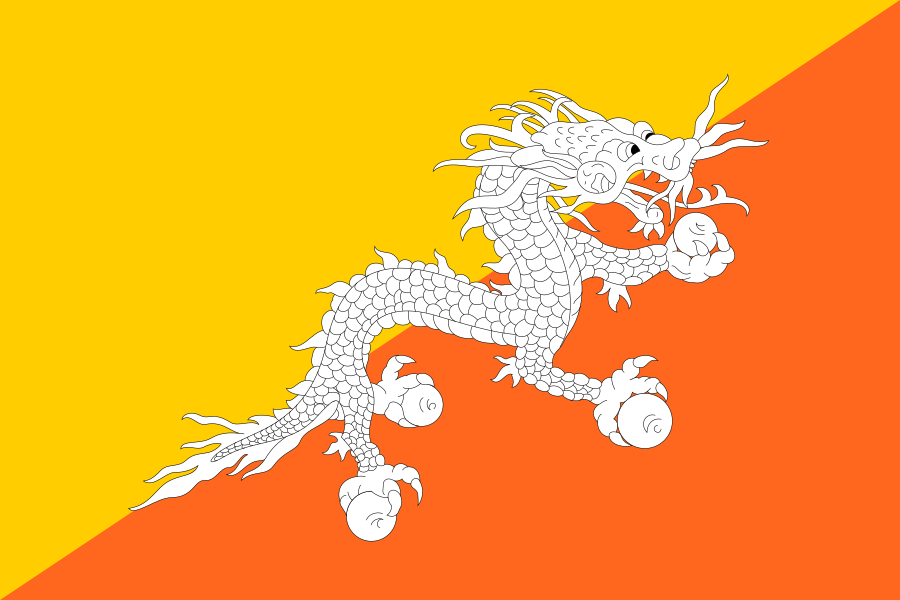
The Druk is the Thunder Dragon of Tibetan and Bhutanese mythology. As the national symbol of Bhutan, it appears on the national flag holding jewels in its claws. In Dzongkha, Bhutan is called Druk Yul ("Land of Druk"), and Bhutanese leaders are called Druk Gyalpo, "Thunder Dragon Kings".
Bhutan has one of the most restrictive visa policies in the world, and travel to the country is highly regulated under the government's "High Value, Low Impact Tourism" scheme. In accordance with this, virtually all nationalities require a visa to enter the country, except citizens of India, Bangladesh, and the Maldives.
The majority of tourists do "cultural tours" where they visit important destinations. Paro, Thimphu, Punakha, Phobjikha, and Jakar are popular destinations. Further afield, the unexplored region of Zhemgang (birders paradise, excellent wildlife viewing) and Eastern Bhutan have just been opened up to tourism. All foreigners are expected to pay a fee to enter certain religious sites or buildings of national significance, and the price can range from Nu500 to Nu1,000 - even foreigners who are working in Bhutan or who are paying the daily US$100 government sustainable development levy are subject to these fees.
Бута́н (дзонг-кэ འབྲུག་ཡུལ་, вайли ʼbrug-yul, лат. zhuk yü (инф.)), официальное название — Короле́вство Бута́н (дзонг-кэ འབྲུག་རྒྱལ་ཁབ་, вайли Druk Gyal Khap), — государство в Южной Азии, расположенное между Индией и КНР. Столица — город Тхимпху. Самоназвание — Друк-Юл — «Страна Дракона». Бутан — также историческое название сопредельной территории в Индии в штате Западная Бенгалия с центром в Калимпонге. Эта территория была отторгнута англичанами от Бутана в XIX веке в результате конфликтов. На севере граничит с КНР, на западе — с индийским штатом Сикким (до 1975 года — бывшим независимым королевством), на востоке — со штатом Аруначал-Прадеш, на юге — со штатом Ассам, в котором ведётся многолетняя гражданская война, на юго-западе — с Западной Бенгалией.
Abstract from DBpedia / Wikipedia · CC BY-SA
4 mapped locations
Discovered by embedding cosine similarity (sentence-transformers MiniLM, 384-dim).
via REST Countries
via World Bank Open Data · CC BY 4.0
via Wikimedia Pageviews API
via Wikipedia infobox
via PubMed
via Wikidata · CC0
thumb|Thimphu handicraft market thumb|250px|Bhutanese Archery
Archery is the national sport of Bhutan and competitions are held throughout the country at most weekends. Visitors are very welcome to watch and also to add voice to the boisterous cheering that accompanies these events.
Hot Stone Bath: The hot stone bath is a ritual in itself, riverside rocks are heated till red hot and gradually dropped into a wooden tub filled with water and scattered with Artemisia leaves. The burning rocks heat the water gradually and thus release minerals in to the water. Traditionally these bath are done near a river bed with plenty of supplies of stones and water and preferably after dark in the open air.
Week end Market in Thimphu: Every weekend, a market is held near the vegetable market (sabji bazaar), where artisans from all over the region come to sell their wares. On one side of the river, farmers sell their produce, while on the other, there is Bhutanese handcraft market selling colourful masks, religious artifacts, dresses, tools, swords and other curios.
Rice is a staple with every meal; traditionally red rice, but white rice is now common too. Vegetable or meat dishes cooked with chilli and/or cheese comprise the accompanying cuisine.
thumb|Rice with Ema datsi
Bhutanese food has one predominant flavour – chilli. This small red condiment is not only added to every dish but is also often eaten raw. So, if you don't like spicy-hot food, make this abundantly clear before ordering a meal. Otherwise, you'll be spending the next hour dousing your mouth with cold yoghurt or milk.
Bhutanese delicacies are rich with spicy chilli and cheese. All the hotels, resorts and restaurants will offer delicious Bhutanese food, Chinese, Continental, and Indian cuisines.
Rice forms the main body of most Bhutanese meals. It is accompanied by one or two side dishes consisting of meat or vegetables. Pork, beef and chicken are the meats that are eaten most often. Vegetables commonly eaten include Spinach, pumpkins, turnips, radishes, tomatoes, river weed, onions and green beans. Grains such as rice, buckwheat and barley are also cultivated in various regions of the country depending on the local climate.
The following is a list of some of the most popular Bhutanese dishes: Ema Datshi: This is the National Dish of Bhutan. A spicy mix of chillies and the delicious local cheese known as Datshi. This dish is a staple of nearly every meal and can be found throughout the country. Variations on Ema Datshi include adding green beans, ferns, potatoes, m…
Ara. A local spirit brewed from rice or corn. It is popular in rural areas, and often served in restaurants, particularly at the start of meals, poured from a special vessel. Ara is more commonly drunk in the east of the country, particularly in and around Lhuentse. Tea. Located next to the tea growing regions of Assam and Darjeeling, a steaming cuppa remains the popular drink in Bhutan, with both the butter variety (suja) and sweet milk kind (cha) readily available throughout the country. The butter tea is very traditional but has quite a strong flavor and is similar to Tibetan tea, while the sweet milk kind is very drinkable and is like Indian chai. Coffee. The coffee culture that has swept most of the planet has taken root in the country, and there are a number of good cafes in Thimphu, Paro, and Jakar. However, outside these three towns, coffee means the instant variety and it is served simply white or black. Beer. The main local beers are from Bhutan Brewery (founded 2006), part of the Tashi Group conglomerate, and are sold in 650 ml bottles: Druk 11000 (8%) is cheapest and high in alcohol; slightly higher quality and lower alcohol are Druk Lager Premium (5%) and Druk Supreme (6%); but none of these are particularly good. There is also sometimes Red Panda Weissbeer (wheat beer), which is rather good. Imported beers may not be available, as importing these is sometimes banned. Whisky. There is some "Bhutanese whisky", though it is neither Bhutanese nor straight whisky. Ra…
thumb|Night in Phuntsholing
All towns connected by motorable roads have hotels, though the standard varies considerably. International standard hotels are mostly found in tourist areas or major towns, while five star accommodation is only available in Paro, Jakar, Punakha, Gangtey and Thimphu.
The hotel rates shown on the city articles are only relevant to people who have residency, visa exemption (generally this only applies to Indian nationals) or who are visiting the country as an invited guest. Other visitors can only enter the country as part of a tour, for which the daily rates are set by the Bhutanese authorities irrespective of the hotel rates (except for very expensive hotels where a surcharge is added).
In addition, the tourism ministry has a list of homestays. These provide accommodation in areas without hotels.
While drug abuse is not uncommon in urban areas, it will not affect tourists, and Bhutan remains one of the safest places in the world for travellers. The majority of Bhutanese are honest, but there are reports of money and valuables being taken from vehicles at tourist sites. So, don't be lulled into a sense of false security by the peaceful environment, and refrain from leaving anything of value in a vehicle, especially at tourist sites. Police in Thimphu are visible, with uniformed patrols through the streets at all hours. The police speak English and are very trustworthy and helpful. The emergency number for police is 113. Bears are a threat in remote mountainous regions. Earthquakes are a major concern in Bhutan. Several parts of Bhutan lie on active fault zones in the Himalayas. Limited emergency vehicles, equipment and medical facilities are likely to increase the impact of an earthquake.
Hospitals and clinics are located throughout the country, even in the remotest areas. However, travellers should not expect hi-tech facilities, and at many of the Basic Health Units the resident doctor is often away. Indigenous medical facilities are located in all district capitals, with the largest being in Thimphu, so it is also possible to have ailments diagnosed and treated using natural herbal compounds while in Bhutan. Waterborne diseases such as diarrhea, dysentery, giardia and even typhoid are not uncommon in Bhutan, especially during the summer monsoon season. Tap water is not safe to drink. Therefore, ensure that all water has been thoroughly boiled or otherwise purified before consuming. In case of emergency, it is advisable to carry a first aid kit, which might include a few antibiotics and paracetamol. Altitude sickness can strike at altitudes as low as 2,500m. Be aware of this before embarking on expeditions in the mountains. If you suffer palpitations, shortness of breath or severe headaches, inform your guide and head to a lower altitude immediately. Take altitude sickness seriously. It can and does kill. The hygiene standard is acceptable in tourist areas. However, it is probably wise to bring medicine for stomach upsets. The Street dog population is very high in Thimphu (and to a lesser extent in many of the towns). Most of the animals are extremely docile and there are very few cases of tourists ever being bitten. Still, it is best to err on the side of sa…
thumb|Information board in a Thimphu park Much of what is considered good manners in South Asia is applicable to Bhutan.
The Bhutanese king and royal family enjoy a deserved high level of respect in Bhutan. Speaking ill of them is considered extremely disrespectful. As is the case in many countries in Asia, Bhutanese culture is hierarchical, which means that showing respect for the elderly is important. Try to conduct yourself appropriately when conversing with someone older than you or in a position of authority. Religion plays an important role in the lives of many Bhutanese people. Although Vajrayana Buddhism is the country's state religion, the Bhutanese constitution prohibits political activities and parties based on religion and allows people the right to freely practice the religion of their choice. This being said, proselytism is illegal and is punishable by imprisonment. Sacred objects. Always pass mani stones, stupas and other religious objects with your right side nearest to the object, and turn prayer wheels in a clockwise direction. Never sit on mani stones or stupas. Clothing. When visiting temples, remove shoes and headgear and wear clothing that expresses respect for the sacred nature of the site. Shorts and revealing clothes should be avoided. Dress respectfully when visiting temples and Dzongs (fortified buildings, like castles), so that you do not cause offence. Your tour guide will be able to advise. Donations. At monasteries, it is custom to make a smal…
Travel guide from Wikivoyage (CC BY-SA 4.0)
via Wikidata sitelinks · CC0