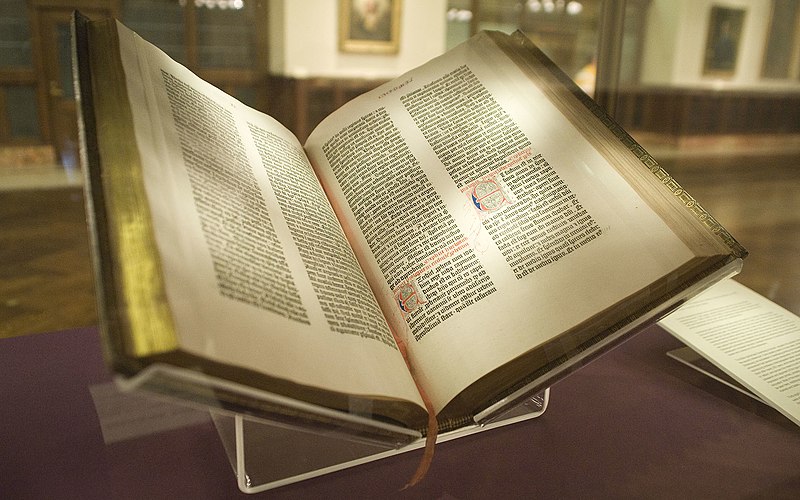
File:Gutenberg_Bible,_Lenox_Copy,_New_York_Public_Library,_2009._Pic_01.jpg · Wikimedia Commons · See Wikimedia Commons
Bibel
Sign in to saveAlso known as Holy Bible, Christian scriptures, The Bible, The Holy Bible, Holy Scriptures, God's Word, Judaeo-Christian Bible, Christian scripture
Sammlung von heiligen Schriften des Judentums und des Christentums
OverviewAI-generated
The Bible is a religious text and anthology classified as religious literature. It has biblical inspiration and is studied by biblical studies. The work is associated with Christianity and has a cause of revelation. Its narrative location is the Middle East. The Bible consists of parts including the Old Testament, New Testament, and Hebrew Bible. It has been translated into editions such as the Gustav Vasa Bible, Charles XII Bible, Wycliffe's Bible, and Tyndale Bible.
The text is written in Biblical Hebrew, Aramaic, Koine Greek, and Hebrew. It is also known by titles including The Holy Bible, Santa Biblia, Biblia, and Bíblia Sagrada. The Dewey Decimal Classification for the work is 220. It is described by sources such as the Bible Encyclopedia of Archimandrite Nicephorus, the Jewish Encyclopedia of Brockhaus and Efron, the Brockhaus and Efron Encyclopedic Dictionary, and the Encyclopædia Britannica 11th edition. The subject is referenced by 14,282 other encyclopedia articles.
Synthesized by Vinony from 25 facts across 3 sources: Wikidata, PubMed, Vinony graph. Generated from structured data (not the Wikipedia text) and checked against those facts — may still contain errors.
Key facts
- Religious text.name
- Bible
- Religious text.image
- Gutenberg Bible, Lenox Copy, New York Public Library, 2009. Pic 01.jpg
- Religious text.caption
- The Gutenberg Bible, published in the mid-15th century by Johannes Gutenberg, is the first published Bible.
- Religious text.period
- See Dating the Bible
- Religious text.language
- Hebrew, Aramaic, and Greek
- Religious text.wikisource
- Bible
via Wikipedia infobox
Research
2,593 papers- Bible Overclaiming and Intimate Partner Violence.Journal of interpersonal violence · 2024Lechuga J, Jones DNDOI: 10.1177/08862605231225518
- Applicability of the Hebrew Bible to Post-traumatic Stress Disorder and Post-traumatic Growth.ReviewJournal of religion and health · 2024Li XDOI: 10.1007/s10943-023-01987-1
- The bible and attitudes toward voluntary euthanasia.Death studies · 2019Sharp SDOI: 10.1080/07481187.2018.1450793
- Medicinal plants of the Bible-revisited.Journal of ethnobiology and ethnomedicine · 2019Dafni A, Böck BDOI: 10.1186/s13002-019-0338-8
- Genetics of infertility and "assisted fertilization" in the Bible: The case of Abraham and his family.ReviewAndrology · 2026Simoni M, Tüttelmann F, Casarini LDOI: 10.1111/andr.70103
- The Reformation.Progress in brain research · 2024Ganz JCDOI: 10.1016/bs.pbr.2024.02.012
- The inclination to evil and the punishment of crime - from the bible to behavioral genetics.ReviewThe Israel journal of psychiatry and related sciences · 2014Gold A, S Appelbaum P
- Phreatophytes in the Bible.Ground water · 2007Ross BDOI: 10.1111/j.1745-6584.2007.00352.x
via PubMed
Wikidata facts
- Subclass of
- sources of law
- Has part
- Hebrew Bible
- Religion
- Christianity
- Author
- group of authors
- Genre
- religious text
- Main subject
- Judaism
- Narrative location
- Middle East
- Image
- Gutenberg Bible, Lenox Copy, New York Public Library, 2009. Pic 01.jpg
Show 19 more facts
- Commons category
- Bible
- topic's main category
- Category:Bible
- described by source
- Wikitólica
- Commons gallery
- Bible
- topic's main Wikimedia portal
- Portal:Bible
- studied by
- biblical studies
- list of characters
- list of biblical characters
- language of work or name
- Hebrew
- title
- الكتاب المقدس
- Dewey Decimal Classification (works and editions)
- 220
- has characteristic
- biblical inspiration
- form of creative work
- anthology
- on focus list of Wikimedia project
- Wikipedia:Vital articles/Level/4
- name
- ꠀꠡꠝꠣꠘꠤ ꠇꠤꠔꠣꠛꠣꠁꠘ
- has cause
- revelation
- topic has template
- Template:Bible sidebar
- different from
- Scripture
- social media followers
- 791000
- P8168
- Rose Madder
Sources (10)
via Wikidata · CC0
Article · Deutsch
Als Bibel (altgriechisch βιβλία biblia ‚Bücher‘) oder (Die) Heilige Schrift bezeichnet man die wichtigste religiöse Textsammlung im Judentum wie auch im Christentum. Sie gilt Gläubigen als göttlich inspiriert, mindestens aber als orientierender Maßstab und wird darum im religiösen wie im kulturellen Leben immer wieder angeeignet. Die jüdische und die christliche Bibel haben sich im Lauf ihrer Entwicklung gegenseitig beeinflusst; sie sind parallel zueinander, teilweise in Abgrenzung voneinander entstanden. Die Bibel des Judentums ist der dreiteilige Tanach, der aus der Tora (Weisung), den Nevi’im (Propheten) und Ketuvim (Schriften) besteht. Während die Tora nach ihrem Selbstzeugnis von Gott dem Mose am Sinai gegeben wurde und einige ihrer Texte von Mose auch selbst niedergeschrieben wurden, stellt sich das aus historischer Sicht anders dar. Denn erst seit dem 9. oder 8. Jahrhundert v. Chr. entwickelte sich in Israel eine Schriftkultur aus einer vorausgehenden Kultur der mündlichen Überlieferung, und erst in hellenistischer und römischer Zeit hatten größere Teile der Bevölkerung die Möglichkeit, biblische Texte auch privat zu lesen und sich dadurch anzueignen. Ein Teil der frühjüdischen Literatur wurde in den jüdischen Bibelkanon aufgenommen, andere Schriften jedoch nicht. Während dieser Prozess noch im Gange war, entstand das Christentum und bezog sich von Anfang an auf die heiligen Schriften Israels. Jesus von Nazaret deutete sein Wirken im Licht dieser Texte, und die erste christliche Gemeinde sah diese Schriften durch die Auferstehung Jesu Christi als erfüllt an. Das Christentum eignete sich so die heiligen Schriften Israels und weitere frühjüdische Literatur (als Altes Testament) an, schuf aber auch eigene Texte, von denen einige verbindliche Bedeutung erlangten und schließlich als Neues Testament dem Alten Testament angefügt wurden. Die christliche Bibel ist das am häufigsten gedruckte und publizierte und in die meisten Sprachen übersetzte schriftliche Werk der Welt.
Abstract from DBpedia / Wikipedia · CC BY-SA
Gallery (601)
Available in 273 languages
- Español
- Français
- Deutsch
- 中文
- 日本語
- Русский
- Português
- Italiano
- العربية
- हिन्दी
- Abkhazian
- abstract
- Afrikaans
- Akan
- Albanian
- Albanian
- Amharic
- Angika
Show 254 more
- Aragonese
- Aramaic
- Armenian
- Arpitan
- Assamese
- Asturian
- Avaric
- Awadhi
- Aymara
- azb
- Azerbaijani
- Bahasa Indonesia
- Bambara
- Bangla
- Bashkir
- Basque
- bat_smg
- Batak Toba
- Bavarian
- be_x_old
- Belarusian
- Betawi
- Bhojpuri
- Bikol
- Bishnupriya
- Bislama
- Bosnian
- Breton
- Bulgarian
- Buriat
- Burmese
- Catalan
- cbk_zam
- cdo
- Cebuano
- Central Kurdish
- Chechen
- Cheyenne
- Church Slavic
- Chuvash
- Colognian
- Cornish
- Corsican
- Croatian
- Czech
- Danish
- dga
- Dinka
- Divehi
- dty
- Dzongkha
- Egyptian Arabic
- eml
- Esperanto
- Estonian
- Ewe
- Extremaduran
- Faroese
- Fiji Hindi
- Fijian
- Filipino
- Finnish
- fiu_vro
- Friulian
- Gagauz
- Galician
- Gan Chinese
- Ganda
- gcr
- Georgian
- Goan Konkani
- Greek
- Guarani
- Gujarati
- guw
- Haitian Creole
- Hakka Chinese
- Hausa
- Hawaiian
- Hebrew
- Hiri Motu
- Hungarian
- hyw
- Iban
- Icelandic
- Ido
- Igbo
- Iloko
- Interlingua
- Interlingue
- Irish
- Jamaican Creole English
- Javanese
- Kabyle
- Kalmyk
- Kannada
- Kanuri
- Kashubian
- Kazakh
- Khmer
- Kikuyu
- Kinyarwanda
- Komi
- Komi-Permyak
- Kongo
- Kuanyama
- Kurdish
- Kyrgyz
- Ladino
- Lao
- Latin
- Latvian
- Ligurian
- Limburgish
- Lingala
- Lingua Franca Nova
- Lithuanian
- lld
- Lombard
- Low German
- Lower Sorbian
- Luxembourgish
- Macedonian
- Maithili
- Malagasy
- Malay
- Malayalam
- Maltese
- Manx
- Māori
- Marathi
- Minangkabau
- Mingrelian
- Mirandese
- mnw
- Moksha
- Mongolian
- nah
- Ndonga
- nds_nl
- Neapolitan
- Nederlands
- Nepali
- Newari
- Nias
- Nigerian Pidgin
- Northern Frisian
- Northern Sami
- Northern Sotho
- Norwegian
- Norwegian Nynorsk
- Novial
- nrm
- Nyanja
- Obolo
- Occitan
- Old English
- olo
- Oromo
- Ossetic
- Palatine German
- Pangasinan
- Papiamento
- Pashto
- Pennsylvania German
- Picard
- Piedmontese
- Polski
- Punjabi
- pwn
- Quechua
- roa_rup
- Romanian
- Romansh
- Rundi
- Rusyn
- Samoan
- Sango
- Sardinian
- Saterland Frisian
- Scots
- Scottish Gaelic
- Serbian
- Serbian (Latin)
- Shona
- Sicilian
- Silesian
- simple
- Sindhi
- Sinhala
- Slovak
- Slovenian
- Somali
- South Ndebele
- Southern Sotho
- Sranan Tongo
- Sundanese
- Svenska
- Swahili
- Swati
- syl
- szy
- Tahitian
- Tajik
- Tamil
- Tatar
- tay
- Telugu
- Tetum
- Tibetan
- Tiếng Việt
- Tigrinya
- Tok Pisin
- Toki Pona
- Tongan
- Tsonga
- Tswana
- Tulu
- Tumbuka
- Türkçe
- Turkmen
- Tyap
- Ukrainian
- Upper Sorbian
- Urdu
- Uyghur
- Uzbek
- Venda
- Venetian
- Veps
- Volapük
- Walloon
- Waray
- Welsh
- West Flemish
- Western Frisian
- Western Mari
- Western Panjabi
- Wolof
- Wu Chinese
- Xhosa
- Yakut
- Yiddish
- Yoruba
- Zaza
- Zeelandic
- zh_classical
- zh_min_nan
- zh_yue
- Zhuang
- Zulu
- فارسی
- ไทย
- 한국어
via Wikidata sitelinks · CC0