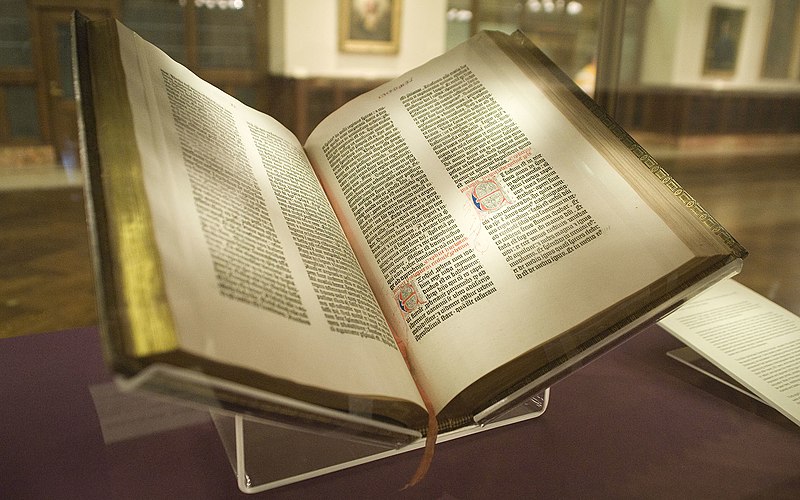
File:Gutenberg_Bible,_Lenox_Copy,_New_York_Public_Library,_2009._Pic_01.jpg · Wikimedia Commons · See Wikimedia Commons
Biblia
Sign in to saveAlso known as Holy Bible, Christian scriptures, The Bible, The Holy Bible, Holy Scriptures, God's Word, Judaeo-Christian Bible, Christian scripture
colección canónica de textos considerados escrituras religiosas en el judaísmo, el cristianismo, el islam y otras religiones
OverviewAI-generated
The Bible is a religious text and anthology classified as religious literature. It has biblical inspiration and is studied by biblical studies. The work is associated with Christianity and has a cause of revelation. Its narrative location is the Middle East. The Bible consists of parts including the Old Testament, New Testament, and Hebrew Bible. It has been translated into editions such as the Gustav Vasa Bible, Charles XII Bible, Wycliffe's Bible, and Tyndale Bible.
The text is written in Biblical Hebrew, Aramaic, Koine Greek, and Hebrew. It is also known by titles including The Holy Bible, Santa Biblia, Biblia, and Bíblia Sagrada. The Dewey Decimal Classification for the work is 220. It is described by sources such as the Bible Encyclopedia of Archimandrite Nicephorus, the Jewish Encyclopedia of Brockhaus and Efron, the Brockhaus and Efron Encyclopedic Dictionary, and the Encyclopædia Britannica 11th edition. The subject is referenced by 14,282 other encyclopedia articles.
Synthesized by Vinony from 25 facts across 3 sources: Wikidata, PubMed, Vinony graph. Generated from structured data (not the Wikipedia text) and checked against those facts — may still contain errors.
Key facts
- Religious text.name
- Bible
- Religious text.image
- Gutenberg Bible, Lenox Copy, New York Public Library, 2009. Pic 01.jpg
- Religious text.caption
- The Gutenberg Bible, published in the mid-15th century by Johannes Gutenberg, is the first published Bible.
- Religious text.period
- See Dating the Bible
- Religious text.language
- Hebrew, Aramaic, and Greek
- Religious text.wikisource
- Bible
via Wikipedia infobox
Research
2,593 papers- Bible Overclaiming and Intimate Partner Violence.Journal of interpersonal violence · 2024Lechuga J, Jones DNDOI: 10.1177/08862605231225518
- Applicability of the Hebrew Bible to Post-traumatic Stress Disorder and Post-traumatic Growth.ReviewJournal of religion and health · 2024Li XDOI: 10.1007/s10943-023-01987-1
- The bible and attitudes toward voluntary euthanasia.Death studies · 2019Sharp SDOI: 10.1080/07481187.2018.1450793
- Medicinal plants of the Bible-revisited.Journal of ethnobiology and ethnomedicine · 2019Dafni A, Böck BDOI: 10.1186/s13002-019-0338-8
- Genetics of infertility and "assisted fertilization" in the Bible: The case of Abraham and his family.ReviewAndrology · 2026Simoni M, Tüttelmann F, Casarini LDOI: 10.1111/andr.70103
- The Reformation.Progress in brain research · 2024Ganz JCDOI: 10.1016/bs.pbr.2024.02.012
- The inclination to evil and the punishment of crime - from the bible to behavioral genetics.ReviewThe Israel journal of psychiatry and related sciences · 2014Gold A, S Appelbaum P
- Phreatophytes in the Bible.Ground water · 2007Ross BDOI: 10.1111/j.1745-6584.2007.00352.x
via PubMed
Wikidata facts
- Subclass of
- sources of law
- Has part
- Hebrew Bible
- Religion
- Christianity
- Author
- group of authors
- Genre
- religious text
- Main subject
- Judaism
- Narrative location
- Middle East
- Image
- Gutenberg Bible, Lenox Copy, New York Public Library, 2009. Pic 01.jpg
Show 19 more facts
- Commons category
- Bible
- topic's main category
- Category:Bible
- described by source
- Wikitólica
- Commons gallery
- Bible
- topic's main Wikimedia portal
- Portal:Bible
- studied by
- biblical studies
- list of characters
- list of biblical characters
- language of work or name
- Hebrew
- title
- الكتاب المقدس
- Dewey Decimal Classification (works and editions)
- 220
- has characteristic
- biblical inspiration
- form of creative work
- anthology
- on focus list of Wikimedia project
- Wikipedia:Vital articles/Level/4
- name
- ꠀꠡꠝꠣꠘꠤ ꠇꠤꠔꠣꠛꠣꠁꠘ
- has cause
- revelation
- topic has template
- Template:Bible sidebar
- different from
- Scripture
- social media followers
- 791000
- P8168
- Rose Madder
Sources (10)
via Wikidata · CC0
Article · Español
La Biblia (del griego βιβλία [biblía]‘libros’; del latín biblĭa; en lengua hebrea: ביבליה) es un conjunto de libros canónicos que en el cristianismo y en otras religiones se consideran producto de inspiración divina y un reflejo o registro de la relación entre Dios y la humanidad. La Biblia está organizada por dos partes principales: el Antiguo Testamento y el Nuevo Testamento, que se enfoca en Jesucristo y el cristianismo primitivo. Fue en el Concilio de Roma del año 382, cuando la Iglesia católica junto al papa Dámaso I instituyeron el Canon Bíblico con la lista del Nuevo Testamento similar al de Atanasio de Alejandría y los libros del Antiguo Testamento de la Versión de los LXX. Esta versión fue traducida del griego al latín por Jerónimo (la Vulgata) por encargo de la Iglesia. Posteriormente los Concilios regionales de Hipona del 393, III de Cartago del 397 y IV de Cartago del 419, en los cuales participó Agustín de Hipona, aprobaron definitivamente dicho canon. En el año 405 esta lista fue enviada por el papa Inocencio I al obispo Exuperio de Tolosa (en la Galia, hoy Francia), donde aparece el canon bíblico con los 73 libros ya existentes. El concilio de Trento fijó el canon de la Iglesia católica declarándolo dogma.La división por capítulos, tal como es al día de hoy, fue introducida por el cardenal Stephen Langton. Se estima que a lo largo de los siglos se han producido alrededor de cinco mil millones de copias de la Biblia en todas sus variedades (aunque algunos las cifran en muchas más), la mayoría en las últimas décadas (tres mil novecientos millones entre los años 1960 y 2013), lo que la convierte en el libro más distribuido y vendido de la historia, siendo frecuentemente reconocido como el libro más influyente de todos los tiempos. Se atribuye el gran éxito de su distribución en los últimos tiempos a la imprenta, habiendo sido el primer libro realizado por medio de la impresión con tipos móviles (la conocida como Biblia de Gutenberg). En mayo de 2000, se afirmó que «la Biblia ha hecho más para dar forma a la literatura, la cultura y el entretenimiento, que ningún otro libro que se haya escrito. Su influencia en la historia mundial no tiene equiparable, y no tiene síntomas de estar menguando». Cada año se venden unos cien millones de ejemplares de la Biblia, habiendo sido traducida a 438 idiomas en su totalidad (Antiguo Testamento, Nuevo Testamento y textos adicionales), y de forma parcial al menos a 2454 idiomas.
Abstract from DBpedia / Wikipedia · CC BY-SA
Gallery (601)
Available in 273 languages
- Español
- Français
- Deutsch
- 中文
- 日本語
- Русский
- Português
- Italiano
- العربية
- हिन्दी
- Abkhazian
- abstract
- Afrikaans
- Akan
- Albanian
- Albanian
- Amharic
- Angika
Show 254 more
- Aragonese
- Aramaic
- Armenian
- Arpitan
- Assamese
- Asturian
- Avaric
- Awadhi
- Aymara
- azb
- Azerbaijani
- Bahasa Indonesia
- Bambara
- Bangla
- Bashkir
- Basque
- bat_smg
- Batak Toba
- Bavarian
- be_x_old
- Belarusian
- Betawi
- Bhojpuri
- Bikol
- Bishnupriya
- Bislama
- Bosnian
- Breton
- Bulgarian
- Buriat
- Burmese
- Catalan
- cbk_zam
- cdo
- Cebuano
- Central Kurdish
- Chechen
- Cheyenne
- Church Slavic
- Chuvash
- Colognian
- Cornish
- Corsican
- Croatian
- Czech
- Danish
- dga
- Dinka
- Divehi
- dty
- Dzongkha
- Egyptian Arabic
- eml
- Esperanto
- Estonian
- Ewe
- Extremaduran
- Faroese
- Fiji Hindi
- Fijian
- Filipino
- Finnish
- fiu_vro
- Friulian
- Gagauz
- Galician
- Gan Chinese
- Ganda
- gcr
- Georgian
- Goan Konkani
- Greek
- Guarani
- Gujarati
- guw
- Haitian Creole
- Hakka Chinese
- Hausa
- Hawaiian
- Hebrew
- Hiri Motu
- Hungarian
- hyw
- Iban
- Icelandic
- Ido
- Igbo
- Iloko
- Interlingua
- Interlingue
- Irish
- Jamaican Creole English
- Javanese
- Kabyle
- Kalmyk
- Kannada
- Kanuri
- Kashubian
- Kazakh
- Khmer
- Kikuyu
- Kinyarwanda
- Komi
- Komi-Permyak
- Kongo
- Kuanyama
- Kurdish
- Kyrgyz
- Ladino
- Lao
- Latin
- Latvian
- Ligurian
- Limburgish
- Lingala
- Lingua Franca Nova
- Lithuanian
- lld
- Lombard
- Low German
- Lower Sorbian
- Luxembourgish
- Macedonian
- Maithili
- Malagasy
- Malay
- Malayalam
- Maltese
- Manx
- Māori
- Marathi
- Minangkabau
- Mingrelian
- Mirandese
- mnw
- Moksha
- Mongolian
- nah
- Ndonga
- nds_nl
- Neapolitan
- Nederlands
- Nepali
- Newari
- Nias
- Nigerian Pidgin
- Northern Frisian
- Northern Sami
- Northern Sotho
- Norwegian
- Norwegian Nynorsk
- Novial
- nrm
- Nyanja
- Obolo
- Occitan
- Old English
- olo
- Oromo
- Ossetic
- Palatine German
- Pangasinan
- Papiamento
- Pashto
- Pennsylvania German
- Picard
- Piedmontese
- Polski
- Punjabi
- pwn
- Quechua
- roa_rup
- Romanian
- Romansh
- Rundi
- Rusyn
- Samoan
- Sango
- Sardinian
- Saterland Frisian
- Scots
- Scottish Gaelic
- Serbian
- Serbian (Latin)
- Shona
- Sicilian
- Silesian
- simple
- Sindhi
- Sinhala
- Slovak
- Slovenian
- Somali
- South Ndebele
- Southern Sotho
- Sranan Tongo
- Sundanese
- Svenska
- Swahili
- Swati
- syl
- szy
- Tahitian
- Tajik
- Tamil
- Tatar
- tay
- Telugu
- Tetum
- Tibetan
- Tiếng Việt
- Tigrinya
- Tok Pisin
- Toki Pona
- Tongan
- Tsonga
- Tswana
- Tulu
- Tumbuka
- Türkçe
- Turkmen
- Tyap
- Ukrainian
- Upper Sorbian
- Urdu
- Uyghur
- Uzbek
- Venda
- Venetian
- Veps
- Volapük
- Walloon
- Waray
- Welsh
- West Flemish
- Western Frisian
- Western Mari
- Western Panjabi
- Wolof
- Wu Chinese
- Xhosa
- Yakut
- Yiddish
- Yoruba
- Zaza
- Zeelandic
- zh_classical
- zh_min_nan
- zh_yue
- Zhuang
- Zulu
- فارسی
- ไทย
- 한국어
via Wikidata sitelinks · CC0