bidirectional encoder representations from transformers
Sign in to saveAlso known as BERT, bidirectional encoder representations from transformer
deep learning artificial neural network language model
Described at
Open Sourcing BERT: State-of-the-Art Pre-training for Natural Language Processin
Posted by Jacob Devlin and Ming-Wei Chang, Research Scientists, Google AI Language One of the biggest challenges in natural language processing (NL..., Posted by Jacob Devlin and Ming-Wei Chang, Research Scientists, Google AI Language One of the biggest challenges in natural language processing (NL...
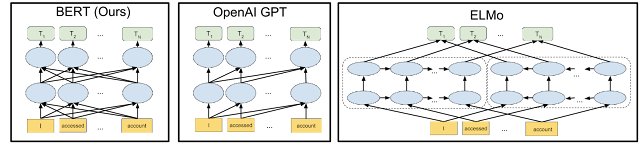
ai.googleblog.com →BERT builds upon recent work in pre-training contextual representations — including Semi-supervised Sequence Learning , Generative Pre-Training , ELMo , and ULMFit . However, unlike these previous models, BERT is the first deeply bidirectional , unsupervised language representation, pre-trained using only a plain text corpus (in this case, Wikipedia ). A visualization of BERT’s neural network architecture compared to previous state-of-the-art contextual pre-training methods is shown below. The arrows indicate the information flow from one layer to the next. The green boxes at the top indicate the final contextualized representation of each input word: BERT is deeply bidirectional, OpenAI GPT is unidirectional, and ELMo is shallowly bidirectional. If bidirectionality is so powerful, why hasn’t it been done before? To understand why, consider that unidirectional models are efficiently trained by predicting each word conditioned on the previous words in the sentence. However, it is not possible to train bidirectional models by simply conditioning each word on its previous and next words, since this would allow the word that’s being predicted to indirectly “see itself” in a multi-layer model. To solve this problem, we use the straightforward technique of masking out some of the words in the input and then condition each word bidirectionally to predict the masked words. For example: While this idea has been around for a very long time , BERT is the first time it was successfully used to pre-train a deep neural network. To evaluate performance, we compared BERT to other state-of-the-art NLP systems. Importantly, BERT achieved all of its results with almost no task-specific changes to the neural network architecture. On SQuAD v1.1 , BERT achieves 93.2% F1 score (a measure of accuracy), surpassing the previous state-of-the-art score of 91.6% and human-level score of 91.2%: BERT also improves the state-of-the-art by 7.6% absolute on the very challenging GLUE benchmark , a set of 9 diverse Natural Language Understanding (NLU) tasks. The amount of human-labeled training data in these tasks ranges from 2,500 examples to 400,000 examples, and BERT substantially improves upon the state-of-the-art accuracy on all of them: The open source TensorFlow implementation and pointers to pre-trained BERT models can be found at . Alternatively, you can get started using BERT through Colab with the notebook “BERT FineTuning with Cloud TPUs .” You can also read our paper "BERT: Pre-training of Deep Bidirectional Transformers for Language Understanding " for more details.
Excerpt from a page describing this subject · 15,186 chars · not written by Vinony
Source code
This is a release of 24 smaller BERT models (English only, uncased, trained with WordPiece masking) referenced in Well-Read Students Learn Better: On the Importance of Pre-training Compact Models. We have shown that the standard BERT recipe (including model architecture and training objective) is effective on a wide range of model sizes, beyond BERT-Base and BERT-Large. The smaller BERT models are intended for environments with restricted computational resources. They can be fine-tuned in the same manner as the original BERT models. However, they are most effective in the context of knowledge distillation, where the fine-tuning labels are produced by a larger and more accurate teacher. Note that the BERT-Base model in this release is included for completeness only; it was re-trained under the same regime as the original model. In the original pre-processing code, we randomly select WordPiece tokens to mask. For example: The new technique is called Whole Word Masking. In this case, we always mask all of the the tokens corresponding to a word at once. The overall masking rate remains the same. The training is identical -- we still predict each masked WordPiece token independently. The improvement comes from the fact that the original prediction task was too 'easy' for words that had been split into multiple WordPieces. This can be enabled during data generation by passing the flag --do whole word mask=True to create pretraining data.py . Pre-trained models with Whole Word Masking are linked below. The data and training were otherwise identical, and the models have identical structure and vocab to the original models. We only include BERT-Large models. When using these models, please make it clear in the paper that you are using the Whole Word Masking variant of BERT-Large. We uploaded a new multilingual model which does not perform any normalization on the input (no lower casing, accent stripping, or Unicode normalization), and additionally inclues Thai and Mongolian. It is recommended to use this version for developing multilingual models, especially on languages with non-Latin alphabets. We use character-based tokenization for Chinese, and WordPiece tokenization for all other languages. Both models should work out-of-the-box without any code changes. We did update the implementation of BasicTokenizer in tokenization.py to support Chinese character tokenization, so please update if you forked it. However, we did not change the tokenization API. To give a few numbers, here are the results on the SQuAD v1.1 question answering task: Moreover, these results were all obtained with almost no task-specific neural network architecture design. If you already know what BERT is and you just want to get started, you can download the pre-trained models and run a state-of-the-art fine-tuning in only a few minutes. BERT is a method of pre-training language representations, meaning that we train a general-purpose "language understanding" model on a large text corpus (like Wikipedia), and then use that model for downstream NLP tasks that we care about (like question answering). BERT outperforms previous methods because it is the first unsupervised , deeply bidirectional system for pre-training NLP. Unsupervised means that BERT was trained using only a plain text corpus, which is important because an enormous amount of plain text data is publicly available on the web in many languages. Pre-trained representations can also either be context-free or contextual , and contextual representations can further be unidirectional or bidirectional . Context-free models such as word2vec or GloVe generate a single "word embedding" representation for each word in the vocabulary, so bank would have the same representation in bank deposit and river bank . Contextual models instead generate a representation of each word that is based on the other words in the sentence. BERT was built upon recent work in pre-training contextual representations —
Excerpt from the source-code README · 50,504 chars · not written by Vinony
Wikidata facts
- Subclass of
- transformer
- Named after
- Bert
- Official website
- arxiv.org/abs/1810.04805
- Has use
- natural language processing
Show 6 more facts
- inception
- 2018-00-00
- data size
- 340000000
- source code repository URL
- github.com/google-research/bert
- copyright license
- Apache Software License 2.0
- described at URL
- devopedia.org/bert-language-model
- Commons category
- BERT
via Wikidata · CC0