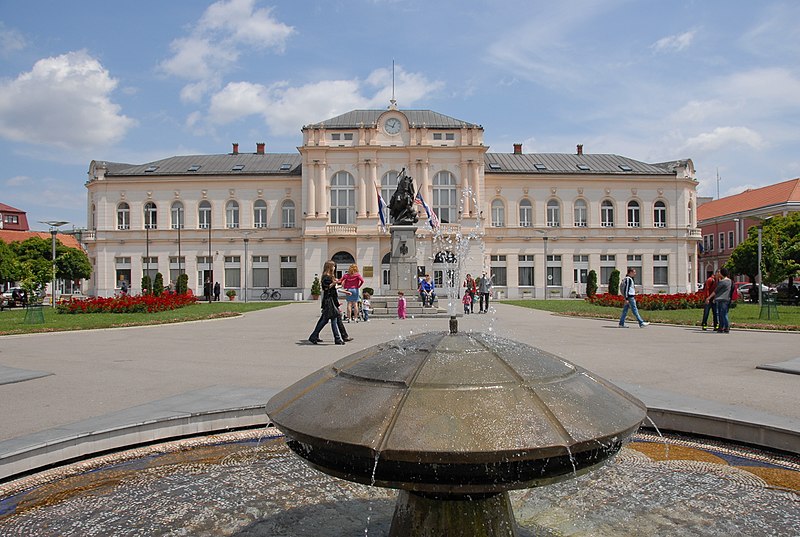
File:Opština_(22).jpg · Wikimedia Commons · See Wikimedia Commons
Bijeljina
Sign in to saveBijeljina () is a city and municipality in Republika Srpska, Bosnia and Herzegovina. It is the provincial center of Semberija, a geographic region in the country's northeast. As of 2013, it has a population of 107,715 inhabitants, making it the sixth largest city in Bosnia and Herzegovina and the second largest in the Republika Srpska entity after Banja Luka.
Bijeljina is a city in northeastern Bosnia and Herzegovina that serves as the main hub for its surrounding Semberija region. With over 107,000 residents as of 2013, it ranks as the second-largest city in Republika Srpska and the sixth-largest in all of Bosnia and Herzegovina.
AI-generated from the Wikipedia summary — may contain errors.
Key facts
- Settlement <! more fields are available for this Infobox See Template:Infobox Settlement >.image_caption
- From top, left to right: The assembly building of Bijeljina, Pavlović bank, the inside of the Church of the Holy Great Martyr George, the outside of the Church of the Holy Great Martyr George, Residential buildings, the Atik mosque, Semberija Museum and the Five Lakes Monastery.
- Settlement <! more fields are available for this Infobox See Template:Infobox Settlement >.image_flag
- Flag of Bijeljina, Bosnia and Herzegovina.svg
- Settlement <! more fields are available for this Infobox See Template:Infobox Settlement >.image_map
- Bijeljina municipality.svg
- Settlement <! more fields are available for this Infobox See Template:Infobox Settlement >.pushpin_map
- Bosnia and Herzegovina
- Settlement <! more fields are available for this Infobox See Template:Infobox Settlement >.area_total_km2
- 733.85
- Settlement <! more fields are available for this Infobox See Template:Infobox Settlement >.population_as_of
- 2013 census
- Settlement <! more fields are available for this Infobox See Template:Infobox Settlement >.population_density_km2
- auto
- Settlement <! more fields are available for this Infobox See Template:Infobox Settlement >.population_urban
- 45291
- Settlement <! more fields are available for this Infobox See Template:Infobox Settlement >.population_total
- 107715
- Settlement <! more fields are available for this Infobox See Template:Infobox Settlement >.parts_type
- Settlements
- Settlement <! more fields are available for this Infobox See Template:Infobox Settlement >.elevation_m
- 90
- Settlement <! more fields are available for this Infobox See Template:Infobox Settlement >.area_code
- +387 55
- Settlement <! more fields are available for this Infobox See Template:Infobox Settlement >.postal_code_type
- ZIP Code
- Settlement <! more fields are available for this Infobox See Template:Infobox Settlement >.postal_code
- 76300
- Settlement <! more fields are available for this Infobox See Template:Infobox Settlement >.leader_title
- Mayor
- Settlement <! more fields are available for this Infobox See Template:Infobox Settlement >.leader_name
- Ljubiša Petrović (SDS)
- Settlement <! more fields are available for this Infobox See Template:Infobox Settlement >.image_map1
- Bijeljina-naselja.PNG
- Settlement <! more fields are available for this Infobox See Template:Infobox Settlement >.name
- Bijeljina
via Wikipedia infobox
Official website
:: Град Бијељина ::
gradbijeljina.org →Link to the official site · 17,296 chars · not written by Vinony
Wikidata facts
- Instance of
- big city
- Country
- Yugoslavia
- Located in
- City of Bijeljina
- Population
- 42278
- Area
- 733.85
- Elevation
- 90
- Time zone
- UTC+01:00
- Capital of
- Bijeljina Region
- Official website
- www.gradbijeljina.org
- Image
- TRG KRALJA PETRA Bijeljina Town Hall.png
- Dialing code
- 55
Show 7 more facts
- Commons category
- Bijeljina
- topic's main category
- Category:Bijeljina
- category of associated people
- Category:People from Bijeljina
- category for people born here
- Q8046255
- postal code
- 76300
- twinned administrative body
- Azov
- P12749
- Cordinhã
Sources (6)
via Wikidata · CC0
~20 min read
Encyclopedic overview
24 sectionsContents
- Geography
- Climate
- History
- Prehistory and Antiquity
- Old Slavs and Middle Ages
- Modern history
- Bosnian War
- Post-war period
- Demographics
- Population
- Ethnic composition
- Architecture
- Education
- Economy
- Transportation
- Tourism
- Sports
- Twin towns – sister cities
- Notable people
- Notes
- See also
- References
- Bibliography
- External links
Bijeljina () is a city and municipality in Republika Srpska, Bosnia and Herzegovina. It is the provincial center of Semberija, a geographic region in the country's northeast. As of 2013, it has a population of 107,715 inhabitants, making it the sixth largest city in Bosnia and Herzegovina and the second largest in the Republika Srpska entity after Banja Luka.
==Geography== Bijeljina is located in Bosnia and Herzegovina's northeast, bound by the Sava and Drina rivers, extending over the Majevica mountains and covering a land mass of 734 km2. It is a part of the entity of Republika Srpska and is the center of the Semberija region. Semberija is a flat region with a fertile land ideal for agriculture. Due to this, Bijeljina is a major place for food production and trade, particularly wheat and vegetables.
Excerpted from Wikipedia’s “Bijeljina” article, available under the CC BY-SA 4.0 licence.
Gallery (34)
On the map
Available in 63 languages
- Español
- Français
- Deutsch
- 中文
- 日本語
- Русский
- Português
- Italiano
- العربية
- Albanian
- Armenian
- Azerbaijani
- Bahasa Indonesia
- Bashkir
- Basque
- be_x_old
- Belarusian
- Bosnian
Show 44 more
- Bulgarian
- Catalan
- Croatian
- Czech
- Danish
- Egyptian Arabic
- Esperanto
- Georgian
- Greek
- Hebrew
- Hungarian
- Interlingue
- Irish
- Javanese
- Latin
- Latvian
- Lithuanian
- Lombard
- Macedonian
- Nederlands
- Northern Frisian
- Norwegian
- Norwegian Nynorsk
- Polski
- Romanian
- Serbian
- Serbian (Latin)
- simple
- Sinhala
- Slovak
- Slovenian
- Svenska
- Tatar
- Tumbuka
- Türkçe
- Ukrainian
- Urdu
- Volapük
- Waray
- Western Panjabi
- Wu Chinese
- zh_yue
- فارسی
- 한국어
via Wikidata sitelinks · CC0