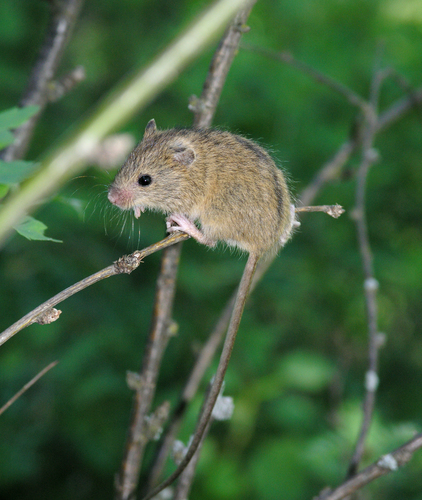
(c) Oleg Kosterin, some rights reserved (CC BY), uploaded by Oleg Kosterin · cc-by
OverviewAI-generated
The Birch mouse, also referred to as the Northern Birch Mouse, is a mammal belonging to the genus Sicista. This taxon is classified within the class Mammalia and is currently not considered extinct. The species has been recorded in 114 observations on the platform iNaturalist.
The genus Sicista is distinct from Smużki. Information regarding this organism is referenced by 447 other encyclopedia articles.
Synthesized by Vinony from 13 facts across 3 sources: Wikidata, iNaturalist, Vinony graph. Generated from structured data (not the Wikipedia text) and checked against those facts — may still contain errors.
Species
Northern Birch Mouse
species
建議将蹶鼠属併入本條目或章節。(討論) 長尾蹶鼠屬(學名Sicista),是生活在沙漠地區的小型跳鼠,具有很長的尾巴和長長的後腿。尾長在6.5-11釐米,體重在6-14千克,頭長為5-9釐米。體毛顔色為淺褐色或深褐色。 分類 包括13種: 亞美尼亞蹶鼠 Sicista armenica 北部蹶鼠 Sicista betulina 高加索蹶鼠 Sicista caucasica 長尾蹶鼠 Sicista caudata 中國蹶鼠 Sicista concolor Sicista kazbegica Sicista kluchorica 阿爾泰蹶鼠 Sicista napaea 灰蹶鼠 Sicista pseudonapaea Sicista severtzovi Sicista strandi 南部蹶鼠 Sicista subtilis 天山蹶鼠 Sicista tianshanica 取自“https://zh.wikipedia.org/w/index.php?title=長尾蹶鼠屬&oldid=42675890” 分类:長尾蹶鼠亞科 隐藏分类: 自2013年12月需要合併的條目 本地相关图片与维基数据不同
via
Wikidata facts
- Instance of
- taxon
- Image
- Sicista betulina 03.JPG
Show 5 more facts
- taxon name
- Sicista
- Commons category
- Sicista
- taxon rank
- genus
- topic's main category
- Category:Sicista
- different from
- Smużki
Sources (3)
via Wikidata · CC0
~7 min read
Encyclopedic overview
Birch mice (genus Sicista) are small jumping rodents that resemble mice with long, tufted tails and very long hind legs, allowing for remarkable leaps. They are the only extant members of the family Sminthidae. They were formerly classified as part of the subfamily Sicistinae in the family Dipodidae alongside the jerboas and jumping mice, but phylogenetic evidence supports all three of these belonging to distinct families, thus leaving only the jerboas in Dipodidae and promoting Sicistinae to its own family.
They are native to Eurasian forests, shrublands, and grasslands, and have a vast geographic distribution. They dig shallow burrows in which they build nests from grass, and are typically active at night. They use their large feet to jump and climb on bushes and shrubs, using their toes and tails to cling to branches. Birch mice are omnivores and primarily eat seeds, berries, and insects. They hibernate during the winter, losing a great deal of weight in the process. They are all of a similar size, ranging from 4–8 cm (2–3 in) long, with tail lengths ranging from 6–12 cm (2–5 in). Weights range from 5–13 g (0.2–0.5 oz).
Excerpted from Wikipedia’s “Birch mouse” article, available under the CC BY-SA 4.0 licence.