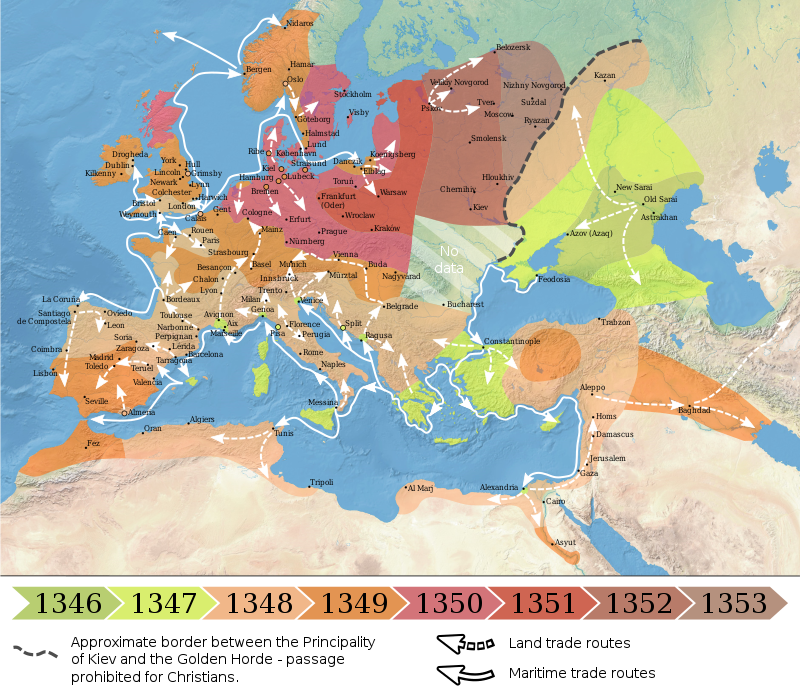
File:1346-1353_spread_of_the_Black_Death_in_Europe_map.svg · Wikimedia Commons · See Wikimedia Commons
Black Death
Sign in to saveAlso known as Great Plague, Great Mortality, plague, Bubonic Plague, Great Pestilence
1346–1353 pandemic in Eurasia and North Africa
The Black Death was a devastating pandemic that swept across Eurasia and North Africa between 1346 and 1353, killing millions of people and fundamentally reshaping the societies it affected. It remains one of history's most significant catastrophes, with lasting impacts on population, economy, and social structures across multiple continents.
AI-generated from the Wikipedia summary — may contain errors.
Wikidata facts
- Instance of
- pandemic
- Subclass of
- plague epidemic
- Has part
- bubonic plague
- Country
- Armenia
- Country of origin
- Mongol Empire
- Location
- Caucasus
- Image
- Doutielt3.jpg
- Number of deaths
- 75000000
Show 8 more facts
- described by source
- The Nuttall Encyclopædia
- start time
- 1346-00-00
- topic's main category
- Category:Black Death
- has cause
- plague
- has immediate cause
- Rattus rattus
- Commons category
- Black Death
- end time
- 1352-00-00
via Wikidata · CC0
~40 min read
Encyclopedic overview
The Black Death was a plague pandemic that occurred in Europe from 1346 to 1353. It was one of the most fatal pandemics in human history; as many as 50 million people died, perhaps 50% of Europe's 14th-century population. The disease is caused by the bacterium Yersinia pestis and is spread by fleas and through the air. One of the most significant events in European history, the Black Death had far-reaching population, economic, and cultural effects. It was the beginning of the second plague pandemic. The plague created religious, social, and economic upheavals, with profound effects on the course of European history.
The Black Death was the second great natural disaster to strike Europe during the Late Middle Ages (the first one being the Great Famine of 1315–1317) and is estimated to have killed 30% to 60% of the European population, as well as approximately 33% of the population of the Middle East. There were further outbreaks throughout the Late Middle Ages and, also due to other contributing factors (the crisis of the late Middle Ages), the European population did not regain its 14th century level until the 16th century. Outbreaks of the plague recurred around the world until the early 19th century.
Excerpted from Wikipedia’s “Black Death” article, available under the CC BY-SA 4.0 licence.
Gallery (12)
Available in 125 languages
- Español
- Français
- Deutsch
- 中文
- 日本語
- Русский
- Português
- Italiano
- العربية
- हिन्दी
- Afrikaans
- Albanian
- Albanian
- Aragonese
- Armenian
- Asturian
- azb
- Azerbaijani
Show 106 more
- Bahasa Indonesia
- Bangla
- Banjar
- Bashkir
- Basque
- be_x_old
- Belarusian
- Bosnian
- Breton
- Bulgarian
- Burmese
- Catalan
- cdo
- Central Kurdish
- Croatian
- Czech
- Danish
- Egyptian Arabic
- Esperanto
- Estonian
- Faroese
- Filipino
- Finnish
- fiu_vro
- Friulian
- Galician
- gcr
- Georgian
- Gothic
- Greek
- Haitian Creole
- Hakka Chinese
- Hausa
- Hebrew
- Hungarian
- hyw
- Icelandic
- Ido
- Inari Sami
- Interlingua
- Irish
- Jamaican Creole English
- Kabardian
- Kabyle
- Kazakh
- kbp
- Kurdish
- Ladino
- Latin
- Latvian
- Limburgish
- Lithuanian
- lld
- Low German
- Macedonian
- Maithili
- Malagasy
- Malay
- Malayalam
- Maltese
- Marathi
- Mingrelian
- Mirandese
- Mongolian
- nah
- Nederlands
- Nepali
- Newari
- Nias
- Norwegian
- Norwegian Nynorsk
- Occitan
- Ossetic
- Pashto
- Polski
- Punjabi
- Romanian
- Sardinian
- Scots
- Scottish Gaelic
- Serbian
- Serbian (Latin)
- Sicilian
- Silesian
- simple
- Sinhala
- Slovak
- Slovenian
- Svenska
- Tamil
- Tiếng Việt
- Türkçe
- Ukrainian
- Urdu
- Uzbek
- Walloon
- Waray
- Welsh
- Western Frisian
- Wu Chinese
- Zaza
- zh_min_nan
- zh_yue
- فارسی
- ไทย
- 한국어
via Wikidata sitelinks · CC0