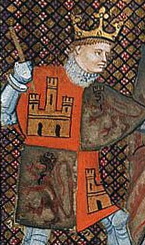
File:Alfonso_XI,_king_of_Leon_and_Castile_02.jpg · Wikimedia Commons · See Wikimedia Commons
1340s
Sign in to saveThe 1340s was a decade that began on 1 January 1340 and ended on 31 December 1349. It was in the midst of a period in human history often referred to as the Late Middle Ages in the Old World and the pre-Columbian era in the New World.
The 1340s was the decade spanning from January 1, 1340 to December 31, 1349, a period that fell within the Late Middle Ages in Europe and other parts of the Old World. This decade is historically significant as it occurred during a major transitional era in human civilization, situated between the High Middle Ages and the early modern period in some regions, while the Americas were still in their pre-Columbian period.
AI-generated from the Wikipedia summary — may contain errors.
Wikidata facts
- Instance of
- decade
- Part of
- 14th century
- Has part
- 1347
- Followed by
- 1350s
- Follows
- 1330s
Show 5 more facts
- category for births in this time period
- Category:1340s births
- category for deaths in this time period
- Category:1340s deaths
- Commons category
- 1340s
- topic's main category
- Category:1340s
- point in time
- 1340-01-01
via Wikidata · CC0
~39 min read
Encyclopedic overview
33 sectionsContents
- Political leaders
- Asia
- Political developments
- Mongol decline
- China
- India
- Culture, religion and philosophy
- Military technology
- Europe
- Political developments
- War and decline in Western Europe
- Central Europe
- Northern Europe
- Eastern Europe
- Southern Europe
- Society and economy
- Economic collapse and crisis
- Social unrest
- The Black Plague
- Fashion
- Culture, religion and philosophy
- Architecture
- Art
- Literature
- Military technology
- Philosophy and religion
- Africa
- Americas
- Notes
- References
- Bibliography
- Further reading
- External links
The 1340s was a decade that began on 1 January 1340 and ended on 31 December 1349. It was in the midst of a period in human history often referred to as the Late Middle Ages in the Old World and the pre-Columbian era in the New World.
In Asia, the Mongol Empire and its breakaway states were in a state of gradual decline. The Ilkhanate had already fragmented into several political territories and factions struggling to place their puppet leaders over the shell of an old state; the Chagatai Khanate was undermined by religious unrest and fell to rebellion. The Black Plague swept through the Kipchak Khanate in 1346, and also affected the Genoese colonies under Mongol siege, thence spreading into Europe. The Yuan dynasty in China was struck by a series of disasters, including frequent flooding, widespread banditry, fires in urban areas, declining grain harvest, increased civil unrest and local rebellion – the seeds of resistance that would lead to its downfall. Southeast Asia remained free from Mongol power; two major regional powers, the Tran dynasty and Majapahit thrived in the 1340s, after each defeated Mongol attacks in the 1280s and 1290s respectively.
Excerpted from Wikipedia’s “1340s” article, available under the CC BY-SA 4.0 licence.
Gallery (40)
Available in 85 languages
- Español
- Français
- Deutsch
- 中文
- 日本語
- Русский
- Português
- Italiano
- العربية
- Albanian
- Aragonese
- Asturian
- Bahasa Indonesia
- Balinese
- Bangla
- Basque
- be_x_old
- Belarusian
Show 66 more
- Bosnian
- Breton
- Catalan
- cdo
- Chuvash
- Czech
- Danish
- Egyptian Arabic
- eml
- Erzya
- Esperanto
- Estonian
- Faroese
- Finnish
- Galician
- Gan Chinese
- Georgian
- Hebrew
- Hungarian
- Icelandic
- Ido
- Irish
- Javanese
- Komi
- Ligurian
- Lithuanian
- Macedonian
- Malay
- Marathi
- Mari
- Mingrelian
- Moroccan Arabic
- Nederlands
- Northern Sotho
- Norwegian
- nrm
- Quechua
- Romanian
- Scottish Gaelic
- Serbian
- Serbian (Latin)
- Sicilian
- simple
- Slovak
- Slovenian
- Sundanese
- Svenska
- Swahili
- Tajik
- Tatar
- Tiếng Việt
- Türkçe
- Turkmen
- Ukrainian
- Urdu
- Uzbek
- Walloon
- Waray
- Welsh
- Wu Chinese
- Yakut
- zh_min_nan
- zh_yue
- فارسی
- ไทย
- 한국어
via Wikidata sitelinks · CC0