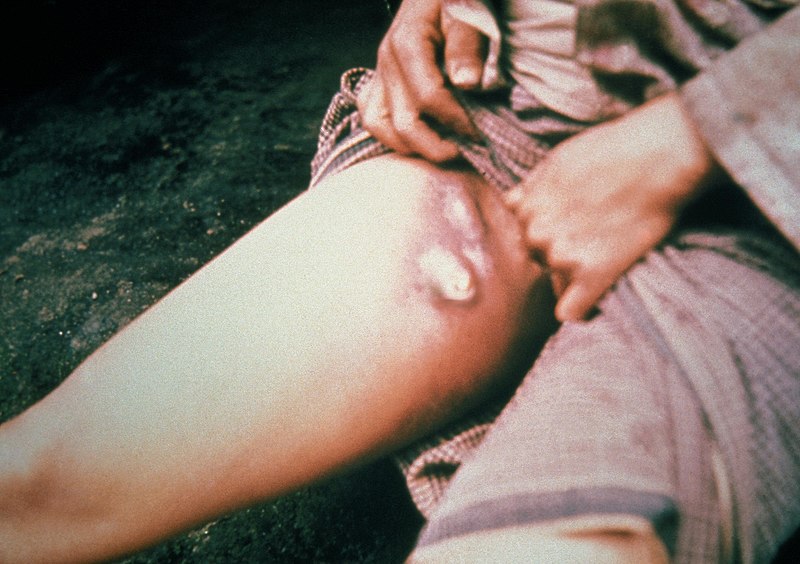
File:Plague_-buboes.jpg · Wikimedia Commons · See Wikimedia Commons
bubonic plague
Sign in to saveAlso known as Bubonic plague (disorder), black death
human and animal disease
I appreciate your request, but I don't have specific context provided to base an overview on. You've indicated the topic area (human and animal disease) but haven't included the detailed context material you'd like me to use. Could you please provide the specific context passage or information about bubonic plague that you'd like me to base the 2-sentence overview on?
AI-generated from the Wikipedia summary — may contain errors.
Wikidata facts
- Subclass of
- disease
- Image
- Yersinia pestis.jpg
Show 12 more facts
- drug or therapy used for treatment
- gentamicin
- different from
- plague
- health specialty
- infectious diseases
- has effect
- third plague pandemic
- has cause
- Yersinia pestis
- exact match
- identifiers.org/doid/DOID:10773
- anatomical location
- lymph node
- ICD-9-CM
- 020.0
- ICPC 2 ID
- A78
- on focus list of Wikimedia project
- Wikipedia:Vital articles/Level/4
- symptoms and signs
- prostration
- Commons category
- Bubonic plague
via Wikidata · CC0
~25 min read
Encyclopedic overview
Bubonic plague is one of three types of plague caused by the bacterium Yersinia pestis. One to seven days after exposure to the bacteria, flu-like symptoms develop. These symptoms include fever, headaches, and vomiting, as well as swollen and painful lymph nodes occurring in the area closest to where the bacteria entered the skin. Acral necrosis, the dark discoloration of skin, is another symptom. Occasionally, swollen lymph nodes, known as "buboes", may break open.
The three types of plague are the result of the route of infection: bubonic plague, septicemic plague, and pneumonic plague. Bubonic plague is mainly spread by infected fleas from small animals. It may also result from exposure to the body fluids from a dead plague-infected animal. Mammals such as rabbits, hares, and some cat species are susceptible to bubonic plague, and typically die upon contraction. In the bubonic form of plague, the bacteria enter through the skin through a flea bite and travel via the lymphatic vessels to a lymph node, causing it to swell. Diagnosis is made by finding the bacteria in the blood, sputum, or fluid from lymph nodes.
Excerpted from Wikipedia’s “bubonic plague” article, available under the CC BY-SA 4.0 licence.
Gallery (10)
Available in 63 languages
- Español
- Français
- Deutsch
- 中文
- 日本語
- Русский
- Português
- Italiano
- العربية
- हिन्दी
- Afrikaans
- Albanian
- Armenian
- Asturian
- azb
- Azerbaijani
- Bahasa Indonesia
- Bangla
Show 44 more
- Basque
- Belarusian
- Breton
- Catalan
- Chechen
- Croatian
- Czech
- Egyptian Arabic
- Esperanto
- Filipino
- Galician
- gpe
- Hausa
- Hebrew
- Icelandic
- Interlingua
- Irish
- Javanese
- Latin
- Latvian
- Macedonian
- Malagasy
- Malayalam
- Mongolian
- Navajo
- Nederlands
- Norwegian
- Norwegian Nynorsk
- Odia
- Serbian
- Serbian (Latin)
- Sicilian
- simple
- Svenska
- Tamil
- Tibetan
- Tiếng Việt
- Türkçe
- Ukrainian
- Welsh
- zh_yue
- فارسی
- ไทย
- 한국어
via Wikidata sitelinks · CC0