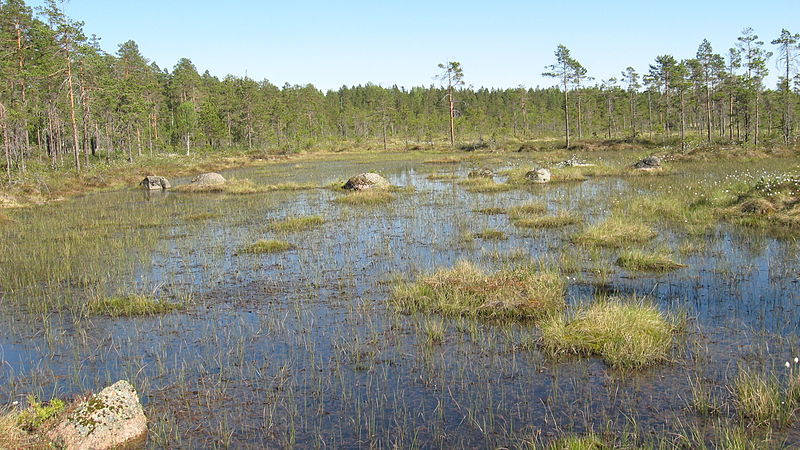
File:Lauhanvuori_suo.jpg · Wikimedia Commons · See Wikimedia Commons
Also known as mire, bogland
thumb|250px|A bog in Lauhanvuori National Park, [[Isojoki, Finland]] thumb|250px|Peat bog and peat to dry, L'Isle-aux-Coudres#Geography|L'Isle-aux-Coudres, [[Quebec, Canada, 1976]] thumb|Bog in Antwerp Province, Belgium thumb|Bog in the Seliger Lake area, Tver Oblast, Russia thumb|Peat extraction in East Frisia, Germany thumb|Drone video of Kakerdaja bog in Estonia (September 2021) thumb|A raised bog in [[Ķemeri National Park, Jūrmala, Latvia, formed approximately 10,000 years ago in the postglacial period and now a tourist attraction.]] A bog or bogland is a wetland that accumulates peat as
A bog is a type of wetland where partially decomposed plant material called peat accumulates over time, creating a distinctive landscape found in regions across Europe and beyond. Bogs are ecologically important because they store carbon, support unique plant and animal species, and have attracted human use—from peat extraction for fuel and other purposes to serving as natural attractions and areas of scientific interest.
AI-generated from the Wikipedia summary — may contain errors.
Wikidata facts
- Image
- Ujujad Ohepalu järve kõrval asuvas laukas 2021. aasta juulis.jpg
Show 6 more facts
- Commons gallery
- Bog
- different from
- peatland
- topic's main category
- Category:Bogs
- Commons category
- Bogs
- on focus list of Wikimedia project
- Wikipedia:Vital articles/Level/4
Sources (3)
via Wikidata · CC0
~18 min read
Encyclopedic overview
19 sectionsContents
- Distribution and extent
- Definition
- Ecology and protection
- Types
- By location and water source
- Valley bog
- Raised bog
- Blanket bog
- Quaking bog
- Cataract bog
- Uses
- Industrial uses
- Other uses
- Archaeology
- Image gallery
- See also
- References
- Bibliography
- External links
thumb|250px|A bog in Lauhanvuori National Park, [[Isojoki, Finland]] thumb|250px|Peat bog and peat to dry, L'Isle-aux-Coudres#Geography|L'Isle-aux-Coudres, [[Quebec, Canada, 1976]] thumb|Bog in Antwerp Province, Belgium thumb|Bog in the Seliger Lake area, Tver Oblast, Russia thumb|Peat extraction in East Frisia, Germany thumb|Drone video of Kakerdaja bog in Estonia (September 2021) thumb|A raised bog in [[Ķemeri National Park, Jūrmala, Latvia, formed approximately 10,000 years ago in the postglacial period and now a tourist attraction.]] A bog or bogland is a wetland that accumulates peat as a deposit of dead plant materials often mosses, typically sphagnum moss. It is one of the four main types of wetlands. Other names for bogs include mire, mosses, quagmire, and muskeg; alkaline mires are called fens. A bayhead is another type of bog found in the forest of the Gulf Coast states in the United States. They are often covered in heath or heather shrubs rooted in the sphagnum moss and peat. The gradual accumulation of decayed plant material in a bog functions as a carbon sink.
Bogs occur where the water at the ground surface is acidic and low in nutrients. A bog usually is found at a freshwater soft spongy ground that is made up of decayed plant matter which is known as peat. They are generally found in cooler northern climates and are formed in poorly draining lake basins. In contrast to fens, they derive most of their water from precipitation rather than mineral-rich ground or surface water. Water flowing out of bogs has a characteristic brown colour, which comes from dissolved peat tannins. In general, the low fertility and cool climate result in relatively slow plant growth, but decay is even slower due to low oxygen levels in saturated bog soils. Hence, peat accumulates. Large areas of the landscape can be covered many meters deep in peat.
Excerpted from Wikipedia’s “bog” article, available under the CC BY-SA 4.0 licence.
Gallery (42)
Available in 70 languages
- Español
- Français
- Deutsch
- 中文
- 日本語
- Русский
- Italiano
- العربية
- Aragonese
- Armenian
- Asturian
- Bahasa Indonesia
- Bashkir
- Basque
- bat_smg
- Belarusian
- Breton
- Bulgarian
Show 51 more
- Catalan
- Croatian
- Czech
- Danish
- Esperanto
- Estonian
- Finnish
- fiu_vro
- Galician
- Greek
- Hausa
- Hebrew
- Hungarian
- Icelandic
- Interlingua
- Irish
- Latin
- Latvian
- Lithuanian
- Low German
- Macedonian
- Malay
- Mongolian
- nds_nl
- Nederlands
- Northern Frisian
- Norwegian
- Norwegian Nynorsk
- Occitan
- Old English
- Romanian
- Saterland Frisian
- Serbian
- simple
- Slovak
- Slovenian
- Svenska
- Tiếng Việt
- Türkçe
- Ukrainian
- Urdu
- Veps
- Walloon
- Welsh
- Western Frisian
- Western Panjabi
- Wu Chinese
- zh_yue
- فارسی
- ไทย
- 한국어
via Wikidata sitelinks · CC0