Encyclopedia of Life · EOL (see source)
OverviewAI-generated
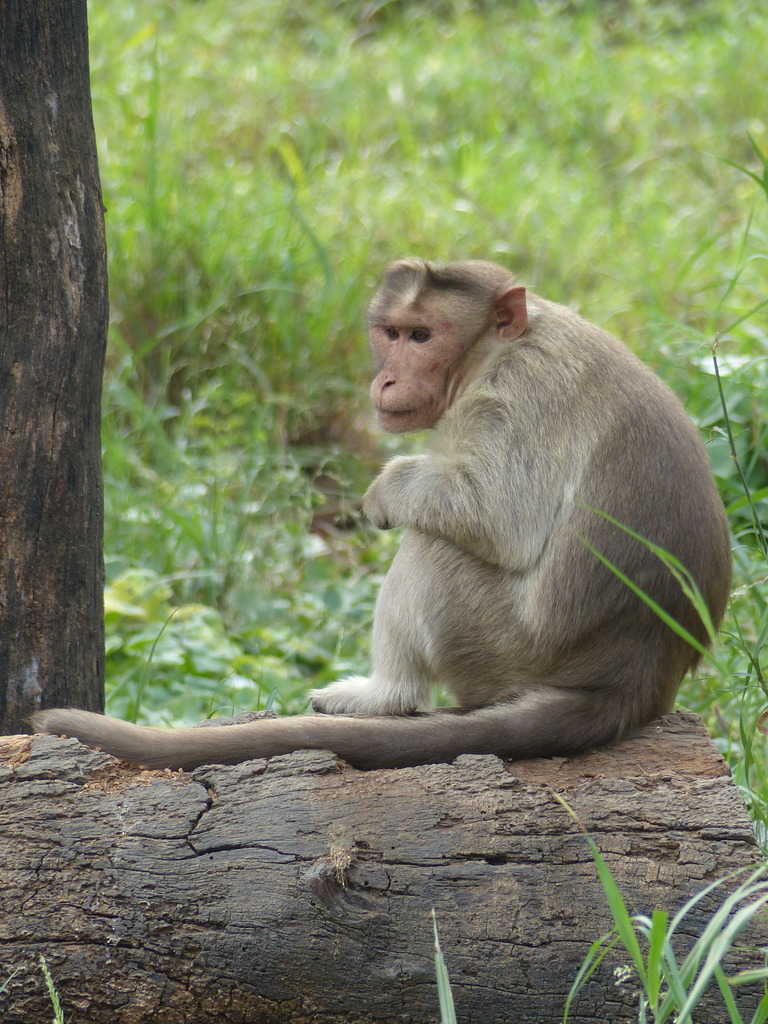
The bonnet macaque, scientifically named *Macaca radiata*, is a species within the genus *Macaca*. It is also referred to by the common names Macaca De Madras, Macaque Bonnet Chinois, and Macaque Commun. This primate exhibits diurnal activity patterns.
The species is classified as Vulnerable on the IUCN Red List, a status recorded in 2020. The longest observed lifespan for this taxon is 30 years.
Synthesized by Vinony from 16 facts across 4 sources: Wikidata, PubMed, IUCN Red List, Vinony graph. Generated from structured data (not the Wikipedia text) and checked against those facts — may still contain errors.
Species
VulnerableDas Verbreitungsgebiet im südlichen Indien Der Indische Hutaffe (Macaca radiata) ist eine Primatenart aus der Gattung der Makaken innerhalb der Familie der Meerkatzenverwandten (Cercopithecidae). Seinen Namen verdankt er ebenso wie der nahe verwandte Ceylon-Hutaffe der auffälligen Haarkrone auf dem Kopf. Inhaltsverzeichnis 1 Beschreibung 2 Verbreitung und Lebensraum 3 Lebensweise 4 Fortpflanzung 5 Indische Hutaffen und Menschen 6 Literatur 7 Weblinks Beschreibung Indische Hutaffen zählen mit einem Gewicht von 2,5 bis 8 Kilogramm zu den kleineren Makaken. Ihr kurzes Fell ist an der Oberseite graubraun gefärbt und an der Unterseite weißlich. An der Kopfoberseite haben sie zwei braune oder schwarze Haarschöpfe, die nach außen gerichtet und in der Mitte gescheitelt sind. Das nackte Gesicht ist braun gefärbt; der Schwanz ist ebenso lang oder länger als der Körper. Verbreitung und Lebensraum Indische Hutaffen leben im südlichen Indien vom südlichen Maharashtra und Andhra Pradesh an südwärts. Ihr Lebensraum sind Wälder und offenes Gelände bis zu einer Höhe von 2200 Metern. Lebensweise Indische Hutaffen sind tagaktiv. Sie verbringen einen Teil des Tages auf dem Boden, kehren zum Schlafen j
via IUCN
Research
940 papers- Surgical repair of indirect inguinal hernia in bonnet macaque (Macaca radiata).Open veterinary journal · 2022
- Prevalence of gastrointestinal parasites in bonnet macaque and possible consequences of their unmanaged relocations.PloS one · 2018
- Personality traits and their correlation with behavior in the bonnet macaque (Macaca radiata) in southern India.Scientific reports · 2024
- Well-differentiated Liposarcoma in a Bonnet Macaque (Macaca radiata).Comparative medicine · 2017
- Infant adoptions in wild bonnet macaques (Macaca radiata).Primates; journal of primatology · 2022
via PubMed
Wikidata facts
Show 9 more facts
- taxon rank
- species
- IUCN conservation status
- Vulnerable
- taxon name
- Macaca radiata
- Commons category
- Macaca radiata
- Commons gallery
- Macaca radiata
- taxon common name
- Indischer Hutaffe
- longest observed lifespan
- 30
- diel cycle
- diurnality
- short name
- M. radiata
Sources (1)
via Wikidata · CC0
~12 min read
Encyclopedic overview
The bonnet macaque (Macaca radiata), also known as zati, is a species of macaque endemic to southern India. Its distribution is limited by the Indian Ocean on three sides and the Godavari and Tapti rivers, along with that of the rhesus macaque, its related competitor to the north. Land use changes in the last few decades have resulted in changes in its distribution boundaries with the rhesus macaque, raising concern for its conservation status in the wild.
The bonnet macaque is diurnal, arboreal, and terrestrial. It can live up to 35 years in captivity.
Excerpted from Wikipedia’s “bonnet macaque” article, available under the CC BY-SA 4.0 licence.