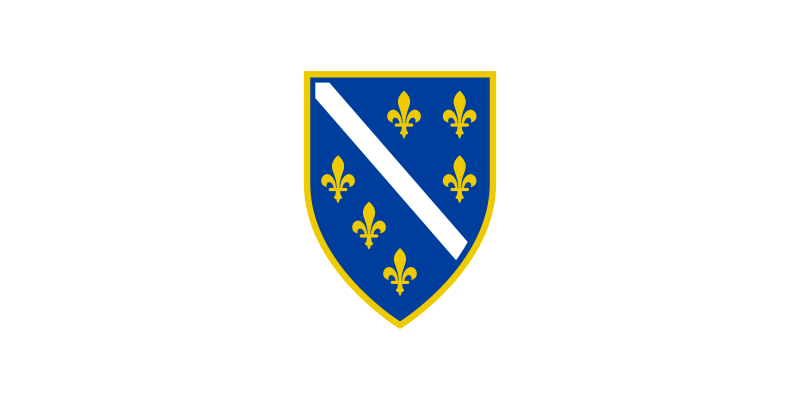
File:Flag_of_Bosnia_and_Herzegovina_(1992–1998).svg · Wikimedia Commons · See Wikimedia Commons
Bosniaks
Sign in to saveThe Bosniaks are a South Slavic ethnic group and nation native to Bosnia and Herzegovina and constitute the largest ethnic group in Bosnia and Herzegovina, followed by Serbs and Croats. They share a common ancestry, culture, history and language emanating from the Bosnian historical region; and traditionally and predominantly adhere to Sunni Islam for which reason they are often also referred to as Bosnian Muslims although this is an imprecise ethnic descriptor today. The Bosniaks constitute significant native communities in Serbia, Montenegro, Croatia and Kosovo as well. Largely due to displa
Bosniaks are a South Slavic ethnic group native to Bosnia and Herzegovina, where they form the largest population, and they share a common ancestry, culture, history, and language rooted in the Bosnian region. They are traditionally and predominantly Muslim, though they also form significant communities in neighboring countries like Serbia, Montenegro, Croatia, and Kosovo.
AI-generated from the Wikipedia summary — may contain errors.
Key facts
- Ethnic group.group
- Bosniaks
- Ethnic group.flag
- Flag of Bosnia and Herzegovina (1992–1998).svg
- Ethnic group.flag_caption
- Flag of the Republic of Bosnia and Herzegovina, today used as an ethnic flag
- Ethnic group.population
- 3.5 million (High estimate )
- Ethnic group.image
- File:A_lamb_roast_and_"kolo"_(circle)_dancing_-_Bosnia_and_Herzegovina_1895.jpg
- Ethnic group.image_caption
- 1895 painting of Bosniaks roasting a lamb and dancing the kolo
- Ethnic group.popplace
- 1,769,592
- Ethnic group.tablehdr
- Significant Bosniak diaspora
- Ethnic group.pop1
- 115,000, by ancestry 2,000,000
- Ethnic group.pop2
- 100,000
- Ethnic group.pop3
- 153,801
- Ethnic group.pop4
- 58,956
- Ethnic group.pop5
- 50,000
- Ethnic group.pop6
- 27,533
- Ethnic group.pop7
- 24,131
- Ethnic group.pop8
- 21,542
- Ethnic group.pop9
- 21,000
- Ethnic group.pop10
- 17,018
via Wikipedia infobox
Wikidata facts
- Part of
- South Slavs
- Demonym
- Boşnak
- Languages spoken
- Bosnian
- Native language
- Bosnian
- Religion
- Sunni Islam
- Country
- Russia
- Population
- 4000000
- Image
- Bosnian dance.png
Show 3 more facts
- topic's main category
- Category:Bosniak people
- Commons category
- Bosniaks
- native label
- bošnjaci,
Sources (1)
via Wikidata · CC0
~85 min read
Encyclopedic overview
28 sectionsContents
- Etymology
- History
- Origins
- Arrival of the Slavs
- Medieval Bosnia
- Ottoman Empire
- Austria-Hungary
- Yugoslavia
- Bosnian War
- Modern identity
- Relation to Bosnian nationalism
- Relation to Croat and Serb nationalism
- Genetics
- Language
- Culture
- Folklore
- Traditions and customs
- Religion
- Surnames and given names
- Symbols
- Geographical distribution
- Diaspora
- Historiography
- See also
- Notes
- References
- Sources
- External links
The Bosniaks are a South Slavic ethnic group and nation native to Bosnia and Herzegovina and constitute the largest ethnic group in Bosnia and Herzegovina, followed by Serbs and Croats. They share a common ancestry, culture, history and language emanating from the Bosnian historical region; and traditionally and predominantly adhere to Sunni Islam for which reason they are often also referred to as Bosnian Muslims although this is an imprecise ethnic descriptor today. The Bosniaks constitute significant native communities in Serbia, Montenegro, Croatia and Kosovo as well. Largely due to displacement stemming from the Bosnian War and Genocide in the 1990s, they also form a significant diaspora with several Bosniak communities across Europe, the Americas and Oceania.
A distinct native community of Bosnian Muslims began to form after the Islamisation of the Christian multi-confessional Slavic-speaking population in Bosnia and Herzegovina and neighbouring regions at the end of the 15th and, mainly, in the 16th century, following the Ottoman conquest of Serbia, Bosnia and Herzegovina and Croatia. During Ottoman rule, the social and cultural life of the population in Bosnia and Herzegovina was structured along religious lines, and the Bosniak name was applied to the population primarily as a territorial designation in a time when ethnic or national self-identification was absent among the population regardless of religion. Despite an initially steep increase upwards to three-fourths of the Bosnian population at its height, wars and plagues would later throughout Ottoman rule decimate the Bosnian Muslim population who, in contrast to their rural Christian counterparts, lived in more densely populated urban centres and were obligated to partake in Ottoman military campaigns. In the late 17th century, a large influx of Muslim immigrants from neighbouring western lands outside Bosnia and Herzegovina came to make up around half of the total Bosnian Muslim population. Significant migrations occurred during the 19th century as well, from present-day Serbia and Montenegro.
Excerpted from Wikipedia’s “Bosniaks” article, available under the CC BY-SA 4.0 licence.
Gallery (32)
Available in 75 languages
- Español
- Français
- Deutsch
- 中文
- 日本語
- Русский
- Português
- Italiano
- العربية
- Afrikaans
- Albanian
- Aragonese
- Armenian
- azb
- Azerbaijani
- Bahasa Indonesia
- Basque
- be_x_old
Show 56 more
- Belarusian
- Betawi
- Bosnian
- Bulgarian
- Catalan
- Chechen
- Church Slavic
- Croatian
- Czech
- Danish
- Egyptian Arabic
- Esperanto
- Estonian
- Finnish
- Galician
- Georgian
- Greek
- Hebrew
- Hungarian
- Javanese
- Kara-Kalpak
- Kazakh
- Kurdish
- Kyrgyz
- Latvian
- Lithuanian
- Macedonian
- Malay
- Nederlands
- Norwegian
- Polski
- Romanian
- Scots
- Serbian
- Serbian (Latin)
- simple
- Sindhi
- Slovak
- Slovenian
- Svenska
- Tajik
- Tatar
- Tiếng Việt
- Türkçe
- Ukrainian
- Upper Sorbian
- Urdu
- Uzbek
- Welsh
- Western Frisian
- Western Panjabi
- Wu Chinese
- zh_yue
- فارسی
- ไทย
- 한국어
via Wikidata sitelinks · CC0