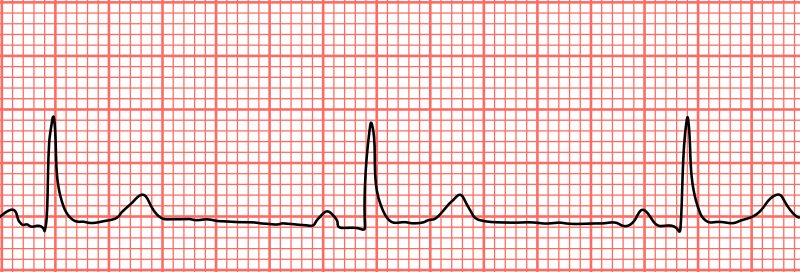
File:Sinus_bradycardia_lead2.svg · Wikimedia Commons · See Wikimedia Commons
bradycardia
Sign in to saveAlso known as bradyarrhythmia
Bradycardia, from Ancient Greek βραδύς (bradús), meaning "slow", and καρδία (kardía), meaning "heart", also called bradyarrhythmia, is a resting heart rate under 60 beats per minute (BPM). While bradycardia can result from various pathological processes, it is commonly a physiological response to cardiovascular conditioning or due to asymptomatic type 1 atrioventricular block.
Bradycardia is a condition where your resting heart rate drops below 60 beats per minute, and it can result from various medical issues or be a normal response to physical fitness. While it's often harmless or even a sign of good cardiovascular conditioning, bradycardia sometimes requires medical attention depending on its underlying cause.
AI-generated from the Wikipedia summary — may contain errors.
Key facts
- Medical condition.name
- Bradycardia
- Medical condition.synonyms
- Bradyarrhythmia, brachycardia
- Medical condition.image
- Sinus bradycardia lead2.svg
- Medical condition.caption
- Sinus bradycardia seen in lead II with a heart rate of about 50 BPM
- Medical condition.field
- Cardiology
- Medical condition.diagnosis
- electrocardiogram
- Medical condition.frequency
- 15% (males), 7% (females)
via Wikipedia infobox
Research
33,131 papers- Evaluating and managing bradycardia.Trends in cardiovascular medicine · 2020
- Evaluation and management of bradycardia in neonates and children.European journal of pediatrics · 2016
- Fifteen-minute consultation: How to manage neonatal bradycardia.Archives of disease in childhood. Education and practice edition · 2025
- Electrocardiogram essentials: Bradycardia.The American journal of emergency medicine · 2025
- Asymptomatic bradycardia amongst endurance athletes.The Physician and sportsmedicine · 2019
via PubMed
Wikidata facts
- Instance of
- symptom or sign
- Image
- Sinus bradycardia lead2.svg
Show 7 more facts
- health specialty
- cardiology
- Commons category
- Bradycardia
- drug or therapy used for treatment
- epinephrine
- opposite of
- tachycardia
- exact match
- purl.obolibrary.org/obo/SYMP_0000231
- NCI Thesaurus ID
- C37920
Sources (6)
via Wikidata · CC0
~21 min read
Encyclopedic overview
23 sectionsContents
- Normal cardiac conduction
- Classification
- Sinus node
- Sinus bradycardia
- Sinus arrhythmia
- Respiratory sinus arrhythmia
- Non-respiratory sinus arrhythmia
- Sinus node dysfunction
- Atrioventricular node
- Atrioventricular block
- Junctional rhythms
- Ventricular
- Infantile
- Causes
- Diagnosis
- Management
- Chronic or stable
- Acute or unstable
- Epidemiology
- Society and culture
- Records
- See also
- References
Bradycardia, from Ancient Greek βραδύς (bradús), meaning "slow", and καρδία (kardía), meaning "heart", also called bradyarrhythmia, is a resting heart rate under 60 beats per minute (BPM). While bradycardia can result from various pathological processes, it is commonly a physiological response to cardiovascular conditioning or due to asymptomatic type 1 atrioventricular block.
Resting heart rates of less than 50 BPM are often normal during sleep in young and healthy adults and athletes. In large population studies of adults without underlying heart disease, resting heart rates of 45–50 BPM appear to be the lower limits of normal, dependent on age and sex. Bradycardia is most likely to be discovered in the elderly, as age and underlying cardiac disease progression contribute to its development.
Excerpted from Wikipedia’s “bradycardia” article, available under the CC BY-SA 4.0 licence.