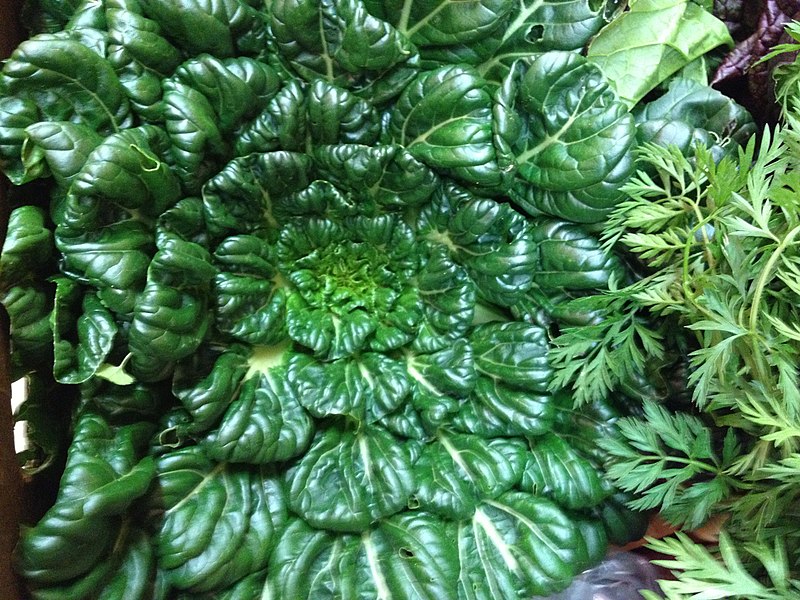
File:Tatsoi.jpg · Wikimedia Commons · See Wikimedia Commons
Brassica rapa
Sign in to saveAlso known as fast plants, turnip rape, turnip, field mustard, turnip mustard, common mustard, wild turnip
species of plant
OverviewAI-generated
*Brassica rapa* L. is a species of plant in the family Brassicaceae. It belongs to the genus *Brassica* and is classified within the order Brassicales, class Magnoliopsida, and phylum Tracheophyta. Common names for this taxon include Rübsen, field mustard, 蕪菁, Raapzaad, and long black turnip. The species produces fruit of the silique type and has uses as a vegetable, medicinal plant, fodder, and food.
The native range of *Brassica rapa* includes Albania, Algeria, Bulgaria, Eritrea, Ethiopia, Greece, Iran, Iraq, Italy, Kriti, Lebanon-Syria, and Libya. Additional records indicate presence in China, the Tibet Autonomous Region, and Guangdong. The species is the basionym of turnip rape. Its conservation status is listed as Data Deficient by the IUCN Red List, with the assessment dated 2011.
Synthesized by Vinony from 41 facts across 8 sources: Wikidata, GBIF, PubMed, Gbif Occ, Plants of the World, IUCN Red List, iDigBio, Vinony graph. Generated from structured data (not the Wikipedia text) and checked against those facts — may still contain errors.
Species
Data DeficientBrassica rapa
SPECIES
- KingdomPlantae
- PhylumTracheophyta
- ClassMagnoliopsida
- OrderBrassicales
- FamilyBrassicaceae
蕓薹(學名:Brassica rapa),又稱為油菜。是一種被耕種作為葉菜(如小白菜、大白菜、菜心)、根用植物(如蕪菁)和作為植物油(非常見的甘藍型油菜,詳見油菜)的植物。 在十八世紀時,卡爾·林奈視蕪菁和油用的變種(即白菜型油菜)為不同的品種並分別命名為B. rapa和B. campestris。然而二十世紀的分類學家發現這些植物是異體受精(英语:Allogamy),因此認為是相同的物種。自從蕪菁已先被林奈氏命名,Brassica rapa則被繼承下來作為種學名。 此品種的種子即是植物油的來源(即白菜型油菜)。但較為常見的品種為甘藍型油菜(Brassica napus)和芥菜型油菜(Brassica juncea)。
via GBIF · IUCN · Kew POWO
Museum specimens
- Specimen records
- 5,238
- With media
- 3,955
- Family
- Brassicaceae
- Collections
- UNIVERSITY OF ALBERTA MUSEUMS, CMN, UTEP, CHAS, INECOL, FC-UNAM
- Recorded in
- Canada, United States, Mexico
Research
4,837 papers- Interspecific Hybridization of Transgenic Brassica napus and Brassica rapa-An Overview.ReviewGenes · 2022Sohn SI, Thamilarasan SK, Pandian S et al.DOI: 10.3390/genes13081442
- Polysaccharides from Brassica rapa root: Extraction, purification, structural features, and biological activities. A review.ReviewInternational journal of biological macromolecules · 2024Hamed YS, Ahsan HM, Hussain M et al.DOI: 10.1016/j.ijbiomac.2023.128023
- Brassica rapa L. activates macrophages via Toll-like receptors.Bioscience, biotechnology, and biochemistry · 2021Takahashi F, Endo K, Matsui R et al.DOI: 10.1093/bbb/zbaa075
- Brassica rapa CURLY LEAF is a major H3K27 methyltransferase regulating flowering time.Planta · 2024Poza-Viejo L, Payá-Milans M, Wilkinson MD et al.DOI: 10.1007/s00425-024-04454-7
- Brassica rapa L. prevents Western diet-induced obesity in C57BL/6 mice through its binding capacity of cholesterol and fat.Bioscience, biotechnology, and biochemistry · 2023Tanaka Y, Inaba C, Sawa T et al.DOI: 10.1093/bbb/zbad086
- Brassica rapa L. ssp. chinensis Isolated Microspore Culture Protocol.Methods in molecular biology (Clifton, N.J.) · 2021Shumilina D, Kozar E, Chichvarina O et al.DOI: 10.1007/978-1-0716-1335-1_9
- Identification of Brassica rapa BrEBF1 homologs and their characterization in cold signaling.Journal of plant physiology · 2023Wu W, Yang H, Shen J et al.DOI: 10.1016/j.jplph.2023.154076
- Brassica rapa Nitrate Transporter 2 (BrNRT2) Family Genes, Identification, and Their Potential Functions in Abiotic Stress Tolerance.Genes · 2023Lv B, Li Y, Wu X et al.DOI: 10.3390/genes14081564
via PubMed
Wikidata facts
Show 12 more facts
- taxon rank
- species
- taxon name
- Brassica rapa
- Commons category
- Brassica rapa
- taxon common name
- 蔓菁
- Commons gallery
- Brassica rapa
- has fruit type
- silique
- sequenced genome URL
- plants.ensembl.org/Brassica_rapa
- taxon range
- Guangdong
- short name
- B. rapa
- taxon author citation
- L.
- basionym of
- turnip rape
Sources (7)
via Wikidata · CC0
~7 min read
Encyclopedic overview
Illustration of Brassica rapa from the Japanese agricultural encyclopedia Seikei Zusetsu.
Brassica rapa is an annual to biennial plant species native to Eurasia that is from the Brassicaceae family. The B. rapa subspecies oleifera is an oilseed commonly known as turnip rape, field mustard, bird's rape, and keblock.
Excerpted from Wikipedia’s “Brassica rapa” article, available under the CC BY-SA 4.0 licence.
Gallery (17)
Available in 69 languages
- Español
- Français
- Deutsch
- 中文
- 日本語
- Русский
- Português
- Italiano
- العربية
- Albanian
- Armenian
- Asturian
- azb
- Azerbaijani
- Bahasa Indonesia
- Basque
- Belarusian
- Bulgarian
Show 50 more
- Catalan
- Cebuano
- Chuvash
- Croatian
- Czech
- Egyptian Arabic
- Esperanto
- Estonian
- Finnish
- Galician
- Georgian
- Hungarian
- Icelandic
- Ido
- Kazakh
- Komi
- Komi-Permyak
- Kyrgyz
- Latvian
- Lezghian
- Ligurian
- Lithuanian
- Luxembourgish
- Malay
- Nederlands
- Northern Frisian
- Norwegian
- Ossetic
- Polski
- Quechua
- Romanian
- Scots
- Serbian
- Serbian (Latin)
- simple
- Slovenian
- Svenska
- Tajik
- Tamil
- Tiếng Việt
- Türkçe
- Ukrainian
- Uzbek
- Veps
- Waray
- Welsh
- Wu Chinese
- zh_yue
- فارسی
- 한국어
via Wikidata sitelinks · CC0