Encyclopedia of Life · EOL (see source)
Species
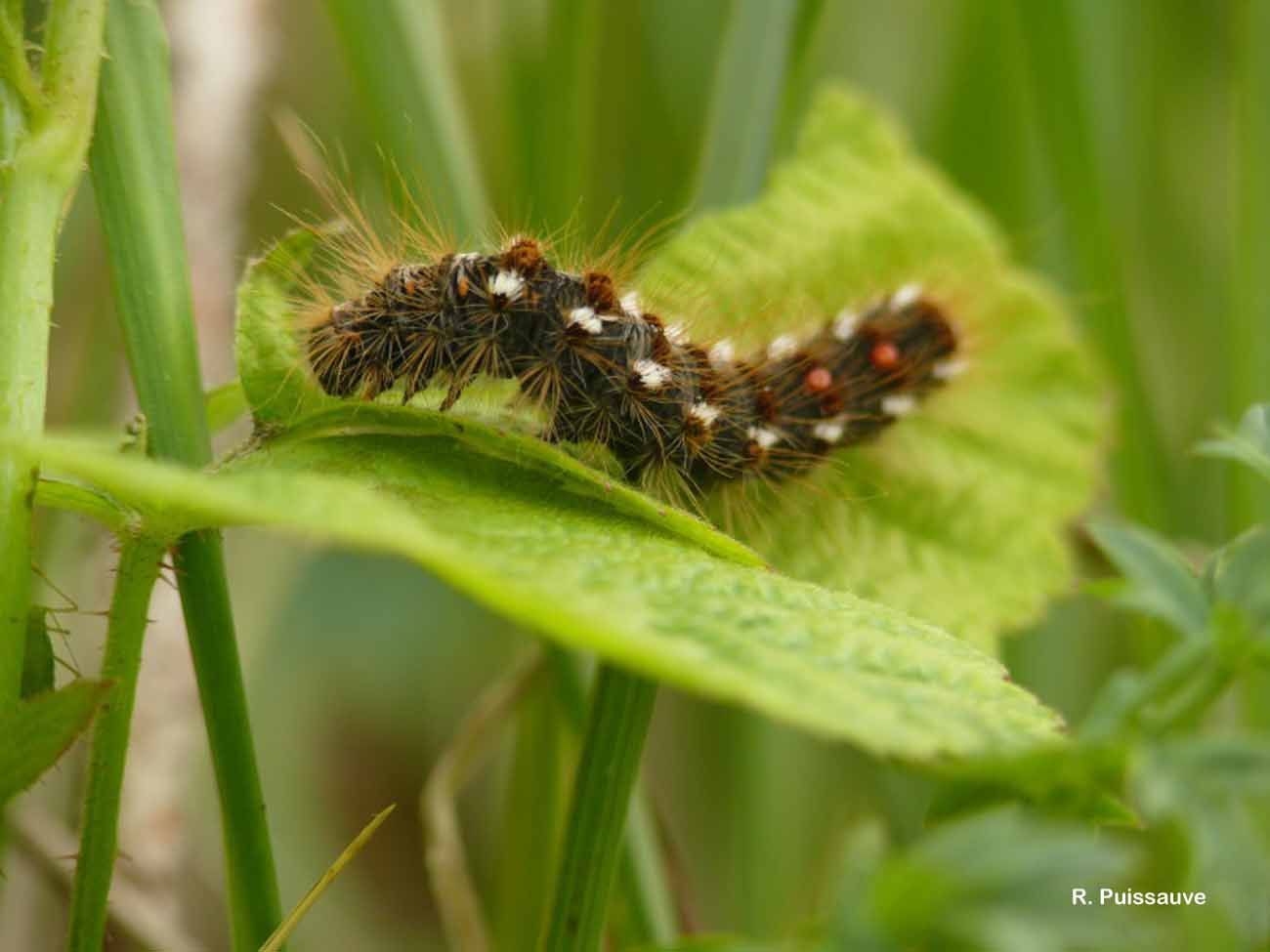
Raupe Raupen am Gespinst Eier bedeckt mit Afterwolle Der Goldafter (Euproctis chrysorrhoea) ist ein Schmetterling (Nachtfalter) aus der Unterfamilie der Trägspinner (Lymantriinae) innerhalb der Familie der Erebidae.[1] Inhaltsverzeichnis 1 Merkmale 1.1 Ähnliche Arten 2 Verbreitung 3 Lebensraum 4 Lebensweise 5 Flugzeiten 6 Schadwirkung 7 Literatur 8 Weblinks 9 Einzelnachweise Merkmale Der Goldafter erreicht eine Flügelspannweite von etwa 30 bis 35 Millimetern und ist damit deutlich größer als der ihm ähnliche Schwan (Euproctis similis). Am besten unterscheiden sich die beiden Trägspinner durch die Ausdehnung des gelben Bereichs am Hinterleib (Afterbusch). Die Männchen weisen am Hinterleib ein rostrotes Ende auf, während die Weibchen einen breiteren rostfarbenen Bereich zeigen. Manche Individuen haben zusätzlich noch gelbbraune Borsten am Hinterleib. Die Oberseite beider Flügelpaare ist weiß ohne den schwarzen Fleck, den der Schwan aufweist. ♀ ♂ Ähnliche Arten Schwan (Euproctis similis) Amerikanischer Webebär (Hyphantria cunea) Schmalflügeliger Fleckleibbär (Spilosoma urticae) Verbreitung Man findet diese Art in ganz Europa, im Norden bis Mittelschweden und Südfinnland. Weiterhin im
via
Wikidata facts
- Instance of
- taxon
- Parent taxon
- Euproctis
- Image
- Euproctis chrysorrhoea MHNT.CUT.2012.0.357 Claix (Isère) Female.jpg
Show 7 more facts
- taxon rank
- species
- taxon name
- Euproctis chrysorrhoea
- Commons category
- Euproctis chrysorrhoea
- Commons gallery
- Euproctis chrysorrhoea
- taxon common name
- kuprówka rudnica
- has host
- Quercus alba
- short name
- E. chrysorrhoea
via Wikidata · CC0
~14 min read
Encyclopedic overview
The brown-tail moth (Euproctis chrysorrhoea) is a moth of the family Erebidae. It is native to Europe, neighboring countries in Asia, and the north coast of Africa. Descriptions of outbreaks, i.e., large population increases of several years duration, have been reported as far back as the 1500s. The life cycle of the moth is atypical, in that it spends approximately nine months (August to April) as larvae (caterpillars), leaving about one month each for pupae, imagos and eggs. Larvae (caterpillars) are covered in hairs. Two red spots on the back, toward the tail, distinguish these species from other similarly hairy moth larvae. The winged adults have white wings and a hairy white body with a tuft of brown hair at the tip of the abdomen. Females lay one egg cluster, usually on the underside of a leaf of a host plant. The species is polyphagous, meaning that it feeds on many different species of trees, including pear, apple, maple and oak.
This species was accidentally introduced to the United States in the 1890s. During the early 20th century it was present from eastern Connecticut northward into New Brunswick, Canada, but a subsequent severe population collapse reduced the territory to parts of coastal Maine and Cape Cod, Massachusetts, by the late 20th century. One theory for the decline appeared to be parasitism by a fly introduced to combat spongy moths. Starting in 2015 there has been a population spike and territory expansion in coastal Maine. In Europe, there are multiple parasitic and predator species, yet there is still a history of population outbreaks.
Excerpted from Wikipedia’s “Brown-tail” article, available under the CC BY-SA 4.0 licence.
Gallery (3)
Available in 29 languages
- Español
- Français
- Deutsch
- Русский
- Português
- العربية
- Azerbaijani
- Belarusian
- Catalan
- Cebuano
- Czech
- Egyptian Arabic
- Georgian
- Hungarian
- Kazakh
- Latvian
- Nederlands
- Norwegian
via Wikidata sitelinks · CC0