
OverviewAI-generated
Cameroon, officially the Republic of Cameroon, is a sovereign state and republic located in Africa. Its capital is Yaoundé. The country shares borders with the Central African Republic, Chad, Republic of the Congo, and Equatorial Guinea. It is a member of the United Nations, African Union, Commonwealth of Nations, and World Trade Organization. The official languages are French and English, while other languages used include Tupuri, Isu, and Psikyɛ.
The population is reported as 29,442,327 and 29,123,744. The head of state is Paul Biya, with Ahmadou Ahidjo also listed, and the head of government is Philémon Yang, with Joseph Ngute also listed. The currency is the Central African CFA franc. The anthem is "O Cameroon, Cradle of Our Forefathers." The top-level Internet domain is .cm, and the telephone country code is 237. The country contains administrative entities such as Adamawa, Centre, East, and Far North.
Synthesized by Vinony from 68 facts across 9 sources: Wikidata, REST Countries, Open Meteo, Openweathermap, World Bank, OpenStreetMap, PubMed, Vinony graph, Geo. Generated from structured data (not the Wikipedia text) and checked against those facts — may still contain errors.
Weather now
7-day forecast
via Open-Meteo
Country
- Capital
- Yaoundé
- Population
- 29,442,327
- Region
- Africa · Middle Africa
- Demonym
- Cameroonian
- Currencies
- XAF (Fr)
- Languages
- English, French
- Calling code
- +237
- Drives on
- Right
- Gini
- 46.6 (2014)
- FIFA code
- CMR
- TLD
- .cm
- Timezones
- UTC+01:00
- Borders
- CAF, TCD, COG, GNQ, GAB, NGA
via REST Countries
Indicators · World Bank
- GDP
- $53.3B(2024)
- Population
- 29,123,744(2024)
- Life expectancy
- 64 yrs(2024)
- Unemployment
- 3.6 %(2025)
- Urban population
- 55.4 %(2024)
- Internet users
- 46.3 %(2024)
- Forest area
- 42.7 %(2023)
- Renewable energy
- 79.2 %(2021)
via World Bank Open Data · CC BY 4.0
Place details
- Locality
- Ngambé-Tikar
- Region
- Centre
- Country
- Cameroun
- Population
- 25,216,237
- Timezone
- Africa/Douala
via OpenStreetMap · GeoNames
Wikipedia views (30d)
97,097 totalvia Wikimedia Pageviews API
Key facts
- Country.footnote_a
- These are the titles as given in the Constitution of the Republic of Cameroon, Article X ( and versions). 18 January 1996. The French version of the song is sometimes called , as in Swarovski Orchestra (2004). National Anthems of the World. Koch International Classics; and the English version "O Cameroon, Cradle of Our Forefathers", as in DeLancey and DeLancey 61.
- Country.national_anthem
- "Rallying Song"
- Country.conventional_long_name
- Republic of Cameroon
- Country.common_name
- Cameroon
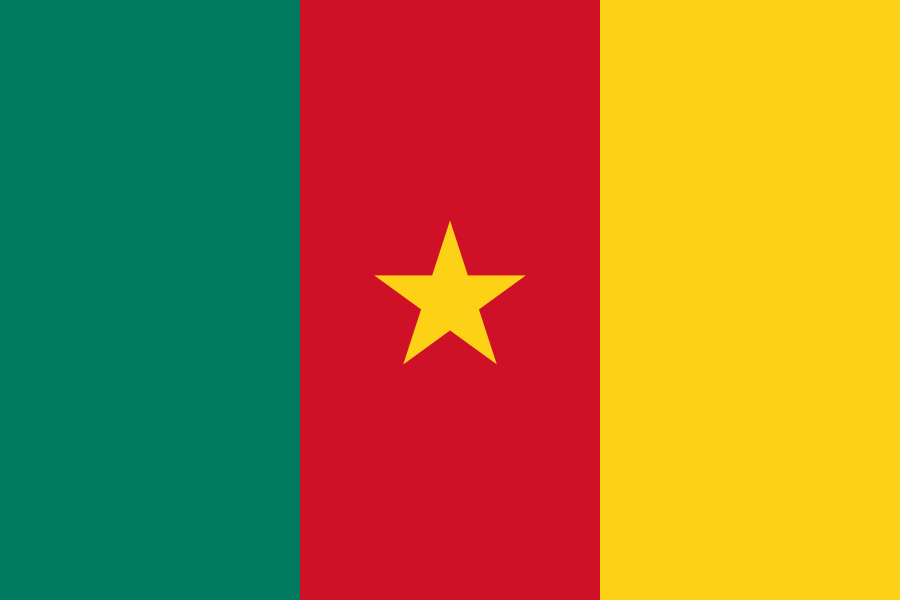
- Country.image_flag
- Flag of Cameroon.svg
- Country.alt_flag
- Vertical tricolor (green, red, yellow) with a five-pointed gold star in the center of the red
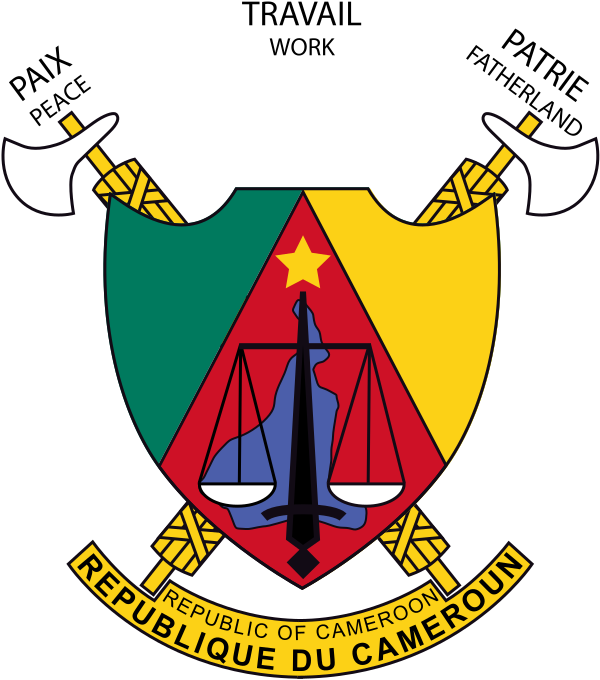
- Country.image_coat
- Coat of arms of Cameroon.svg
- Country.symbol_type
- Coat of arms
- Country.national_motto
- "Peace – Work – Fatherland"
- Country.alt_map
- Location of Cameroon on the globe.
- Country.capital
- Yaoundé
- Country.largest_city
- Douala
- Country.official_languages
- French English
- Country.regional_languages
- Grassfield Languages Beti Fufulde Sawa Hausa Baka Bassa Chadian Arabic Bafia Gbaya Pidgin Camfranglais Mandara
- Country.ethnic_groups_year
- 2022
- Country.religion_year
- 2022
- Country.demonym
- Cameroonian
- Country.government_type
- Unitary presidential republic under a dictatorship
via Wikipedia infobox
Research
19,011 papers- Surgical mission in Cameroon: reflections on the experience.Journal of wound care · 2023Boccalatte LA, Jimenez IF, Fogaing SDOI: 10.12968/jowc.2023.32.10.613
- Cameroon's slow fertility transition: A gender perspective.Population studies · 2024Fotso JC, Cleland JG, Adje EODOI: 10.1080/00324728.2023.2297687
- Digital Pathology in Cameroon.JCO global oncology · 2021Gruber-Mösenbacher U, Katzell L, McNeely M et al.DOI: 10.1200/GO.21.00166
- Cameroon.Department of State publication. Background notes series · 1992United States. Department of State. Bureau of Public Affairs. Office of Public Communication
- Concurrent Clade I and Clade II Monkeypox Virus Circulation, Cameroon, 1979-2022.ReviewEmerging infectious diseases · 2024Djuicy DD, Sadeuh-Mba SA, Bilounga CN et al.DOI: 10.3201/eid3003.230861
- [Cameroon].Jeune Afrique (Paris, France : 1980) · 1996
- Ten Recommendations for Accelerating Hypertension and Diabetes Control to Reduce Stroke, Heart, and Renal Disease with the Aim to Save Lives in Cameroon Through Partnerships and Collaborations.ReviewAdvances in therapy · 2024Dzudie A, Dehayem M, Kuate LM et al.DOI: 10.1007/s12325-024-02960-4
- Polio outbreaks in Cameroon following the COVID-19 pandemic.The Pan African medical journal · 2023Njoh AA, Josue Kedakse TSN, Eric Mboke E et al.DOI: 10.11604/pamj.2023.45.90.35332
via PubMed
Wikidata facts
- Instance of
- sovereign state
- Official name
- Hautugo Kamerun
- Demonym
- Camarúnach
- Country
- Cameroon
- Contains
- West
- Continent
- Africa
- Capital
- Yaoundé
- Official language
- English language
- Currency
- Central African CFA franc
- Population
- 28372687
- Area
- 475442
- Body of water
- Atlantic Ocean
- Head of government
- Joseph Ngute
- Head of state
- Ahmadou Ahidjo
- Form of government
- republic
- Legislature
- Parliament of Cameroon
- Shares border with
- Nigeria
- Highest point
- Mount Cameroon
- Official website
- www.prc.cm
- Life expectancy
- 58.073
- Nominal GDP
- 44341646509
- Unemployment rate
- 4
- Calling code
- +237
Show 63 more facts
- Licence plate code
- CAM
- Mains voltage
- 220
- Motto
- Affrica Cyfan Mewn Un Wald
- Flag
- flag of Cameroon
- Coat of arms
- coat of arms of Cameroon
- language used
- Mbodomo
- category for people born here
- Category:Births in Cameroon
- topic's main Wikimedia portal
- Portal:Cameroon
- top-level Internet domain
- .cm
- Commons category
- Cameroon
- topic's main category
- Category:Cameroon
- category for people who died here
- Category:Deaths in Cameroon
- category for films shot at this location
- Category:Films shot in Cameroon
- category of associated people
- Category:Cameroonian people
- diplomatic relation
- Togo
- Commons gallery
- Cameroun / Cameroon
- mobile country code
- 624
- lowest point
- Bight of Biafra
- driving side
- right
- geography of topic
- Geography of Cameroon
- emergency phone number
- 112
- age of majority
- 21
- marriageable age
- 15
- office held by head of government
- Prime Minister of Cameroon
- history of topic
- history of Cameroon
- office held by head of state
- President of Cameroon
- number of out-of-school children
- 1795056
- located in/on physical feature
- Central Africa
- total fertility rate
- 4.704
- maritime identification digits
- 613
- railway traffic side
- right
- inception
- 1960-01-01
- Unicode character
- 🇨🇲
- literacy rate
- 71
- suicide rate
- 13.3
- native label
- République du Cameroun
- culture
- culture of Cameroon
- twinned administrative body
- Tsushima
- BTI Status Index
- 4.11
- BTI Governance Index
- 3.95
- economy of topic
- economy of Cameroon
- demographics of topic
- demographics of Cameroon
- different from
- Cameron
- Democracy Index
- 2.77
- Human Development Index
- 0.576
- P11012
- Trave
- central bank
- Bank of Central African States
- hashtag
- Cameroon
- on focus list of Wikimedia project
- Wikipedia:Vital articles/Level/4
- Gini coefficient
- 46.6
- Happy Planet Index score
- 39.9
- Inequality-adjusted Human Development Index
- 0.393
- P12749
- José Joaquín Prieto
- birth rate
- 35.507
- male population
- 13922522
- death rate
- 8.225
- rural population
- 11519492
- female population
- 13992014
- urban population
- 16395044
- P8168
- Tmarus longqicus
- Commonwealth Sport country code
- CMR
- maintained by WikiProject
- WikiProject Countries
Sources (15)
via Wikidata · CC0
Travel guide
Get in
thumb|375px|A map showing the visa requirements of Cameroon, with countries in green having visa-free access Cameroon is not a country you can just come to. There are few visa-free arrangements in place, so most travelers need a visa. Citizens of Mali, Chad, the Central African Republic, Gabon, Equatorial Guinea, and Nigeria don't need a visa.
Cameroonian visas tend to be expensive. The Cameroonian Embassy in the United States charges US$93 for a tourist visa, so plan and prepare accordingly. As a general rule of thumb, the longer you intend to stay, the more expensive the visa will be. A one-year visa will cost you between US$100-300.
Cameroonian diplomatic staff recommend that you submit all relevant documentation in advance, and it normally takes up to a week to process any kind of Cameroonian visa.
See
Visit the Limbe Botanic Garden, Benedictine Museum of Mont Febe, National Museum of Yaounde and the Kribi. These are famous attractions in the city of Yaounde, meant for tourists.
Eat
thumbnail|Food in Cameroon
Signature dishes thumb|Poulet DG with fried potatoes Poisson brézè: barbecue fish Ndole: slightly bitter vegetables with peanuts, fish, prawns or beef. Often considered the national dish Poulet DG: chicken with sauce Tripes: tripe in tomato or peanut sauce Sauce arachide: peanut sauce with rice and meat Brochettes: barbecued skewers Kilichi: dried beef Mbol: black vegetable sauce served with kilichi, beef in some other form or prawns Nkui: brown vegetable sauce eaten with corn couscous Bush meat: from monkeys to snakes, perhaps a bit too exotic to visitors Mielie meal: maize porridge
garnishes include: thumb|Fried plantains, fish, onions and miondo Koki: white bean dumplings Banane plantain: grilled, steamed or deep fried plantains Couscous maniok: cassava couscous Couscous de mais: polenta-like corn-based couscous Polentaähnlicher Couscous auf Maisbasis Frites de pommes: French fries Pommes: fried potatoes Bobolo: steamed cassava bars Miondo: thinner version of the former
moreover: Safou fruits, barbecued or boiled
Drink
Always check “best before” when buying a bottle - some drinks are way out of date.
Coca-Cola is available everywhere. For something different try one of the flavourful TOP sodas. They are much sweeter than most European or North American sodas but they are very tasty.
Cameroon is rich with choice when it comes to good beer due to its past as a German and later French colony. Bottled Guinness can be found everywhere although in the heat, try one of the excellent lighter beers such as Castel, Beaufort, Mützig, Isenbeck, Satzenbrau or 33. These are inexpensive and excellent in the heat. Castel Milk Stout is an excellent choice for those who like darker beer. Outside of the cities you will sometimes be hard pressed to find them chilled (due to a lack of electricity).
Sleep
In more rural areas prices vary wildly depending on demand and local economy. It is not uncommon to find comfortable accommodations for FCFA 4,000-5,000 per night.
Because of the overvaluation of the local currency, accommodation in Cameroon is only slightly cheaper than in Europe, Hotels in the major cities will range from FCFA 7,500 to FCFA 50,000. Western standards can only be expected in the luxury segment. Camping is possible, but should be avoided if possible due to the security situation in the country.
Most hotels do not accept credit cards. In the hotels below 4-star, hot water is not always available (either not installed or the installation is defective). Hot water can be ordered in buckets in the hotel (give a small tip) and can also be self-supplied with a stick kettle (about 2000 CFA) and a bucket.
You can have your dirty laundry cleaned in all hotels. Either there is a service provided by the hotel (more expensive) or you ask the hotel staff (cheaper) who will do this for you with additional income. Remember that this is a hand wash, which is less suitable for delicate garments (intensive scrubbing). If you want boiled linen, this must be ordered separately. Laundry must be ironed if it is dried outdoors.
Stay safe
As is the case in any developing country, you should do whatever you can to blend in with the local population. What this means is that you should avoid presenting yourself in a way that would get others to think you are rich, and you should most certainly avoid isolated areas and travelling alone at night.
As long as you apply a modicum of common sense, your visit to Cameroon will be hassle free.
Stay healthy
As Cameroon is a developing country, health care facilities are poor and are much below western standards. In addition, you should expect a language barrier at healthcare facilities if your French-language skills aren't good enough.
Yellow fever is prevalent in the country. You are required to get vaccinated against it before travelling to the country.
Malaria is prevalent. To lower your chances of contracting malaria, regularly use insect repellent and consider draping a mosquito net over your bed. You may also want to consider getting vaccinated against the disease before travelling to the country.
Avoid drinking tap water, even in restaurants. Only stick to bottled water.
The country's HIV/AIDS prevalence rate among adults is at 3.2%. The situation has been getting better since the early 2000s, but still, be safe and be aware of your surroundings.
Respect
It is very common for people, including people you've never even met before, to greet people around them. You will easily observe that it's common for people to exchange greetings and say things like "good morning", "how's your health", "how is your family", and so on. Don't be fazed or surprised by this; this is how the Cameroonians get to know others, and you can very easily make a friend or two by following suit!
Connect
To make local and international calls you need to buy a pre-paid SIM card. Check if your cell phone has a compatible GSM standard (Africa/Europe) - if not, in addition to a SIM card you probably need to buy a new phone. "MTN" and "Orange" are two major telephone companies in Cameroon. E-SIMs are available for data connections from various companies such as Airalo and Ubigi. The local networks offer 4G connections which are neither fast or stable.
It had been possible to find Internet access all over the place, but the speed was often slow. In 2017, all Internet access was shut down in the largely-anglophone western portion of the country.
National post service is considered to be unreliable.
Travel guide from Wikivoyage (CC BY-SA 4.0)
Article · العربية
الكاميرون، رسمياً جمهورية الكاميرون (بالفرنسية: République du Cameroun)، دولة تقع في منطقة وسط الغرب الأفريقي. تحدّها نيجيريا من الغرب؛ والتشاد من الشمال الشرقي؛ ومن الشرق جمهورية أفريقيا الوسطى؛ ومن الجنوب غينيا الاستوائية، والغابون، وجمهورية الكونغو. تقع سواحل الكاميرون على خليج البوني، وهي جزء من خليج غينيا والمحيط الأطلسي. وغالباً ما يشار إلى هذا البلد باسم «أفريقيا المصغرة» للتنوع الجيولوجي والثقافي. وتشمل الميزات الطبيعية: الشواطئ والصحارى والجبال والغابات المطيرة والسافانا. وأعلى نقطة هي جبل الكاميرون في جنوب غرب البلاد، وأكبر المدن هي دوالا، وياوندي وغاروا. الكاميرون هي موطن لأكثر من 200 مجموعة لغوية مختلفة. البلد هو معروف جيدا بلأنماط الأصلية المتمثلة في الموسيقى، لا سيما ماكوسا وبيكتسي، ونجاح منتخبها الوطني لكرة القدم. تعد الفرنسية والإنجليزية هما اللغتان الرسميتان. السكان الأوائل للمنطقة بمن فيهم حضارة ساو حول بحيرة تشاد وصيادي الباكا في الغابات المطيرة جنوب شرق. وصل المستكشفون البرتغاليون الساحل في القرن الخامس عشر وسميت منطقة ريو دوس كاميروس (بالبرتغالية: Rio dos Camarões) (نهر الروبيان)، والتي أصبحت الكاميرون في اللغة الإنجليزية. جنود الفلانية أسسوا إمارة اداماوا في الشمال في القرن التاسع عشر، وأنشأت مجموعات عرقية مختلفه في الغرب والشمال الغربي مشيخات قوية وفوندوموس. أصبحت الكاميرون مستعمرة ألمانية عام 1884. بعد الحرب العالمية الأولى، تم تقسيم الأراضي بين فرنسا وبريطانيا وتفويض لعصبة الأمم. دعا حزب اتحاد شعوب الكاميرون (UPC) السياسي إلى الاستقلال، ولكن تم حظره من قبل فرنسا في الخمسينيات فخاض حرباً على فرنسا وقوات يو بى سى حتى عام 1971. في عام 1960 استقل الجزء الذي تسيطر عليه فرنسا من الكاميرون باسم جمهورية الكاميرون في عهد الرئيس أحمدو أهيجو. اندمج معها الجزء الجنوبي من الكاميرون البريطانية في عام 1961 لتشكيل جمهورية الكاميرون الاتحادية. تم تغيير اسم البلاد إلى جمهورية الكاميرون المتحدة في عام 1972 وجمهورية الكاميرون في عام 1984. مقارنة مع البلدان الأفريقية الأخرى، تتمتع الكاميرون بالاستقرار السياسي والاجتماعي. وقد أتاح هذا تنمية الزراعة، والطرق، والسكك الحديدية، والصناعات النفطية والأخشاب الكبيرة. ومع ذلك، تعيش أعداد كبيرة من الكاميرونيين في الفقر كمزارعي الكفاف. السلطة في يد الرئيس السلطوي منذ عام 1982، بول بيا، وحزبه الحركة الديمقراطية الكاميرونية الشعبية. وقد تزايد نفور سكان الأراضي الناطقة بالإنكليزية في الكاميرون من الحكومة، ودعا الساسة من تلك المناطق إلى قدر أكبر من اللامركزية وحتى الانفصال (على سبيل المثال: المجلس الوطني لجنوب الكاميرون) من الأراضي التي حكمتها بريطانيا سابقاً.
Abstract from DBpedia / Wikipedia · CC BY-SA
Gallery (59)
On the map
60 mapped locations
Available in 262 languages
- Español
- Français
- Deutsch
- 中文
- 日本語
- Русский
- Português
- Italiano
- العربية
- हिन्दी
- Abkhazian
- abstract
- Adyghe
- Afrikaans
- Akan
- Albanian
- Albanian
- Amharic
Show 243 more
- ami
- Angika
- Aragonese
- Aramaic
- Armenian
- Arpitan
- Asturian
- azb
- Azerbaijani
- Bahasa Indonesia
- Balinese
- Bambara
- Bangla
- Banjar
- Bashkir
- Basque
- bat_smg
- Batak Toba
- Bavarian
- be_x_old
- Belarusian
- Betawi
- Bhojpuri
- Bikol
- Bishnupriya
- Bislama
- blk
- Bosnian
- Breton
- Bulgarian
- Buriat
- Burmese
- Catalan
- cbk_zam
- cdo
- Cebuano
- Central Kurdish
- Chechen
- Cherokee
- Chuvash
- Cornish
- Corsican
- Crimean Tatar
- Croatian
- Czech
- dag
- Danish
- Dinka
- Divehi
- dty
- Egyptian Arabic
- Esperanto
- Estonian
- Ewe
- Extremaduran
- Faroese
- Fiji Hindi
- Filipino
- Finnish
- fiu_vro
- Fon
- Frafra
- Fula
- Gagauz
- Galician
- Ganda
- gcr
- Georgian
- Gilaki
- gpe
- Greek
- Guarani
- Gujarati
- guw
- Haitian Creole
- Hakka Chinese
- Hausa
- Hebrew
- Hungarian
- hyw
- Icelandic
- Ido
- Igbo
- Iloko
- Inari Sami
- Interlingua
- Interlingue
- Irish
- Jamaican Creole English
- Javanese
- Jju
- Kabyle
- kai
- Kannada
- Kanuri
- Kara-Kalpak
- Karachay-Balkar
- Kashmiri
- Kazakh
- kbp
- kge
- Kikuyu
- Kinyarwanda
- Kongo
- Kotava
- Kurdish
- Kyrgyz
- Ladino
- Lao
- Latin
- Latvian
- Ligurian
- Limburgish
- Lingala
- Lingua Franca Nova
- Lithuanian
- lld
- Lojban
- Lombard
- Low German
- Lower Sorbian
- Luxembourgish
- Macedonian
- Madurese
- Malagasy
- Malay
- Malayalam
- Maltese
- Manipuri
- Manx
- Māori
- map_bms
- Marathi
- Mazanderani
- Minangkabau
- Mingrelian
- Mirandese
- Moksha
- Mongolian
- Moroccan Arabic
- nds_nl
- Nederlands
- Nepali
- Newari
- Nigerian Pidgin
- Northern Frisian
- Northern Sami
- Northern Sotho
- Norwegian
- Norwegian Nynorsk
- Novial
- Obolo
- Occitan
- Odia
- Old English
- olo
- Oromo
- Ossetic
- Pampanga
- Papiamento
- Pashto
- Piedmontese
- Polski
- Pontic
- Punjabi
- Quechua
- roa_rup
- Romanian
- Romansh
- Rusyn
- Samoan
- Sango
- Sanskrit
- Santali
- Sardinian
- Saterland Frisian
- Scots
- Scottish Gaelic
- Serbian
- Serbian (Latin)
- Shan
- Shona
- Sicilian
- Silesian
- simple
- Sindhi
- Sinhala
- Slovak
- Slovenian
- Somali
- South Ndebele
- Southern Sotho
- Standard Moroccan Tamazight
- Sundanese
- Svenska
- Swahili
- Swati
- Tachelhit
- Tajik
- Talysh
- Tamil
- Taroko
- Tatar
- Telugu
- Tibetan
- Tiếng Việt
- Toki Pona
- Tsonga
- Tswana
- Tumbuka
- Türkçe
- Turkmen
- Tyap
- Udmurt
- Ukrainian
- Upper Sorbian
- Urdu
- Uyghur
- Uzbek
- Venetian
- Veps
- Volapük
- Waray
- Welsh
- West Flemish
- Western Frisian
- Western Mari
- Western Panjabi
- Wolof
- Wu Chinese
- Yakut
- Yiddish
- Yoruba
- Zaza
- Zeelandic
- zh_classical
- zh_min_nan
- zh_yue
- Zhuang
- Zulu
- فارسی
- ไทย
- 한국어
via Wikidata sitelinks · CC0