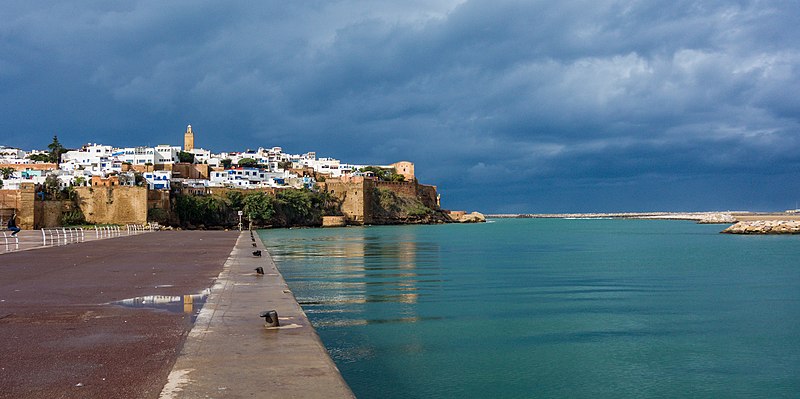
File:Morocco_-_Rabat_(31387775324).jpg · Wikimedia Commons · See Wikimedia Commons
Rabat
Sign in to saveAlso known as Rabbat
Rabat (, also , ; ) is the capital city of Morocco and the country's seventh-largest city with a population of 515,619 (2024) and the second largest metropolitan area after Casablanca, with a population of approximately 2.1 million (2025). It is also the capital city of the Rabat-Salé-Kénitra administrative region. Rabat is located on the Atlantic Ocean at the mouth of the river Bou Regreg, opposite Salé, the city's main commuter town.
OverviewAI-generated
Rabat is a city and big city in Morocco, located in the Rabat-Salé-Kénitra region. It serves as the capital of Morocco, the French protectorate in Morocco, Rabat-Salé-Kénitra, and Rabat-Salé-Zemmour-Zaër. The city is situated near the Bou Regreg river and the Atlantic Ocean. Its official name is الرباط, ⵕⵕⴱⴰⵟ.
The city has a population of 621480 and covers an area of 118 square kilometers. It stands at an elevation of 135 meters above sea level. Rabat was established in 1146. It is twinned with Bethlehem, Bursa, Lisbon, and Madrid. The local dialing code is 537, and postal codes range from 10000 to 10220. Fathallah Oualalou and Asmaa Rhlalou are listed as heads of government.
Rabat is recognized in the Unesco World Heritage collection. It is described by sources including the Armenian Soviet Encyclopedia, Granat Encyclopedic Dictionary, The Nuttall Encyclopædia, and Encyclopædia Britannica 11th edition. The city is referenced by 4,144 other encyclopedia articles.
Synthesized by Vinony from 51 facts across 8 sources: Wikidata, Open Meteo, Openweathermap, OpenStreetMap, GeoNames, Vinony collections, Vinony graph, Geo. Generated from structured data (not the Wikipedia text) and checked against those facts — may still contain errors.
Weather now
7-day forecast
via Open-Meteo
Place details
- Locality
- Rabat ⵔⴱⴰⵟ الرباط
- Region
- Rabat-Salé-Kénitra ⵔⴱⴰⵟ-ⵙⵍⴰ-ⵇⵏⵉⵟⵔⴰ الرباط-سلا-القنيطرة
- Country
- Maroc ⵍⵎⵖⵔⵉⴱ المغرب
- Population
- 1,655,753
- Timezone
- Africa/Casablanca
via OpenStreetMap · GeoNames
Key facts
- Settlement.official_name
- Rabat
- Settlement.image_seal
- Commune de Rabat Logo.png
- Settlement.seal_size
- 100px
- Settlement.pushpin_map
- Morocco#Africa
- Settlement.pushpin_map_caption
- Location in Morocco and Africa
- Settlement.pushpin_relief
- yes
- Settlement.subdivision_type
- Country
- Settlement.subdivision_name
- Morocco
- Settlement.subdivision_type1
- Region
- Settlement.subdivision_name1
- Rabat-Salé-Kénitra
- Settlement.leader_party
- RNI
- Settlement.leader_title
- Mayor
- Settlement.leader_name
- Fatiha El Moudni
- Settlement.area_total_km2
- 117
- Settlement.area_total_sq_mi
- 45.17
- Settlement.settlement_type
- Capital city
- Settlement.population_total
- 515619 (2024)
- Settlement.population_density_sq_mi
- 11400
via Wikipedia infobox
Wikidata facts
- Part of
- Imperial cities of Morocco
- Official name
- ⵕⵕⴱⴰⵟ
- Demonym
- Rabatčanka
- Country
- Morocco
- Located in
- Rabat Prefecture
- Official language
- Standard Moroccan Tamazight
- Population
- 509916
- Area
- 118
- Elevation
- 87
- Time zone
- UTC+01:00
- Body of water
- Atlantic Ocean
- Capital of
- Rabat Prefecture
- Image
- Kasbah des Oudaias P1060356.JPG
- Households
- 156398
- Dialing code
- 537
Show 15 more facts
- Commons category
- Rabat
- twinned administrative body
- Brazzaville
- topic's main category
- Category:Rabat
- category for people born here
- Category:Births in Rabat
- category for people who died here
- Category:Deaths in Rabat
- category of associated people
- Category:People from Rabat
- Commons gallery
- Rabat
- inception
- 1146-00-00
- postal code
- 10000–10220
- P8168
- Gustav Kuhn
- different from
- Rabat
- on focus list of Wikimedia project
- Wikipedia:Vital articles/Level/4
- P12749
- Felsberg
- heritage designation
- World Heritage Site
Sources (8)
via Wikidata · CC0
Travel guide
Understand
thumb|400px|Saint Pierre Cathedral, Rabat Morocco Rabat is on the Atlantic Ocean at the mouth of the river Bou Regreg. On the facing shore of the river lies Salé, Rabat's bedroom community. Together with Temara the cities account for a combined metropolitan population of 2.6 million. It is an easy-going city by Moroccan standards. Rabat visitor information
See
thumb|350px|Kasbah of the Oudaias
Do
There are many things to do here, as with most Moroccan cities it is enough just to wander around and adventure where something takes your fancy.
There is also a large and tranquil park next to the Hotel Sofitel, where people run and play football, etc. You can also use the pool at the Sofitel for a charge. The park is a 10-15 dirham taxi ride (10 minutes) from la Gare Central.
Jazz au Chellah is a jazz festival organized each year in June by the ministry of culture, the city and the European delegation. The website might have some issues. Mawazine is a festival of world music that takes place annually in Rabat featuring Arab, African and international music icons during May. It is controversial as some of the country's Muslim politicians have criticised the event for "encouraging immoral behaviour". Artists such as Stevie Wonder, Carlos Santana, Elton John or B.B. King have performed at Mawazine. There are various scenes around the city. Football: Prince Moulay Abdellah Stadium, opened in Sep 2025, is 7 km southwest of city centre. With a capacity of 69,500 it's the home stadium of the men's national football team, and in 2025/26 hosted games in the Africa Cup of Nations including the final. The complex also includes an athletics track and field stadium, the indoor Salle Moulay Abdellah arena and an Olympic swimming pool.
Buy
Rue des Consuls an interesting place to wander. This street is so named because foreign diplomats were required to reside here in the seventeenth century until 1912. At that time the main activity of the area was piracy and taking slaves, who were then auctioned. Under a treaty with the Sultan, they were to be redeemed by diplomats from their countries who then had a budget for such purchases. For convenience, these diplomats were thus a few tens of meters from the place of "negotiation". This street was already very active one of the few to be paved. Louis Chenier, the father of the poet Andre Chenier was there representing the King of France from 1768 to 1781. Trading in the redemption of captives was his main activity and he excelled so much that even the Sultan, exhausted, sent him back to France by military force. From the Rue des Consuls, opens a number of alleys housing small shops, enabling craftsmen to maintain their expertise and their art, in often difficult circumstances. Although the medina here is not as extensive as that of Fez or Marrakesh there are still some bargains to be had. You will find the normal array of babushka shoes, baggy pants, ornate mirrors and plates etc. Interestingly all the Moroccans can be found in the section of the market that sells imported western style clothing from Asia and all the tourists can be found in the 'traditional' section. The lovely woolen ponchos are well worth a look and the carpet shops near the end of the medina are al…
Eat
In the centre there are often inexpensive food stalls around the medina, serving delicious fish and salad sandwiches. Especially found right around the perimeter of the Marche Centrale, these places also serve fresh and simple salads, hot bowls of lubia (beans) or lentils, rotisserie chicken, and home-made tagines. There are also lots of stalls selling pancakes and pains au chocolat.
Stay safe
Rabat is considered a safe city. Just use some common sense: avoid wearing expensive jewellery or looking flashy, do not flash large quantities of cash, and avoid unfamiliar and deserted areas at night. If you walk in the crowded streets of the Medina or use a bus, keep a hand on your pockets. Women should avoid low-cut tops, midriffs, or shorts to avoid harassment (which almost always consists of comments, but nothing physical) although this is less of a problem than in other cities. Don't feel the need to be polite – no Moroccan woman would put up with behaviour like that.
Connect
Rabat is served by all of the mobile companies that can be found elsewhere in Morocco: Inwi, Orange, and Maroc Telecom. Mobile phones can be bought in any of these store's stands, and most do not run on calling plans. Rather, recharge cards can be bought in corner stores that contain a number to call. When that number is called, the company adds the price of the card to your account's balance. Alternatively, more than one SIM card can be bought and changed in and out of the phone, if users need more than one phone number.
Go next
Tangier lies on the North African coast at the western entrance to the Strait of Gibraltar where the Mediterranean meets the Atlantic Ocean off Cape Spartel. Tangier is a 4-hr journey from Rabat. Meknes is in the east with a small but navigable medina. Other places worth visiting on the Northern Atlantic coast are Asilah and Larache. Salé is on the right bank of the Bou Regreg river, opposite the national capital Rabat. Founded in antiquity as a Phoenician colony, it became a haven for pirates as an independent republic before being incorporated into Morocco. Modern Salé is a more polluted than Rabat, badly planned, and rapidly expanding town because of an important rural exodus. The city is now a large "dormitory town". Most of its influential and wealthy inhabitants moved to Rabat on the other side of the river. There is a bridge, a tram line and a boat (2 dirham) between the two cities. Skhirat — a small town 28 km away from Rabat, known for its beaches, the area around Skhirat has begun developing and property and land prices have increased greatly. Casablanca — Morocco's largest and wealthiest city, it hosts headquarters and main industrial facilities for the leading Moroccan and international companies based in Morocco, Casablanca is also the most liberal and progressive of Morocco's cities. However, poverty prevalent in slums on the city's outskirts and an extremely important rural exodus has led to high rates of crime, drug use, prostitution and the rise o…
Travel guide from Wikivoyage (CC BY-SA 4.0)
~32 min read
Encyclopedic overview
35 sectionsContents
- Etymology
- History
- Ancient ''Sala''
- Medieval Islamic period
- Corsair republic
- 'Alawi rule
- 20th century
- French colonial rule
- Post World War II and independence
- Geography
- Neighbourhoods of Rabat
- Subdivisions
- Climate
- Culture
- Mawazine
- Places of worship
- Museums and parks
- Historic monuments
- Education
- Colleges and universities
- Transport
- Air
- Trains
- Tram
- City buses
- Sport
- Football
- Handball
- Basketball
- Volleyball
- Notable people
- Twin towns – sister cities
- References
- Bibliography
- External links
Rabat (, also , ; ) is the capital city of Morocco and the country's seventh-largest city with a population of 515,619 (2024) and the second largest metropolitan area after Casablanca, with a population of approximately 2.1 million (2025). It is also the capital city of the Rabat-Salé-Kénitra administrative region. Rabat is located on the Atlantic Ocean at the mouth of the river Bou Regreg, opposite Salé, the city's main commuter town.
Rabat was founded in the 12th century by the Almohads. After a period of growth, the city fell into a long period of decline. In the 17th century, Rabat became a haven for the Barbary corsairs. When the French established a protectorate over Morocco in 1912, Rabat became its administrative center. When Morocco achieved independence in 1956, Rabat became its capital.
Excerpted from Wikipedia’s “Rabat” article, available under the CC BY-SA 4.0 licence.
Gallery (30)
On the map
3 mapped locations
Available in 166 languages
- Español
- Français
- Deutsch
- 中文
- 日本語
- Русский
- Português
- Italiano
- العربية
- हिन्दी
- abstract
- Achinese
- Afrikaans
- Akan
- Albanian
- Amharic
- Aragonese
- Armenian
Show 147 more
- Asturian
- azb
- Azerbaijani
- Bahasa Indonesia
- Balinese
- Bangla
- Bashkir
- Basque
- be_x_old
- Belarusian
- Bosnian
- Breton
- Bulgarian
- Catalan
- cdo
- Cebuano
- Central Kurdish
- Chechen
- Chuvash
- Cornish
- Croatian
- Czech
- Danish
- Egyptian Arabic
- Esperanto
- Estonian
- Extremaduran
- Faroese
- Fiji Hindi
- Filipino
- Finnish
- Galician
- Georgian
- Greek
- Guarani
- Haitian Creole
- Hakka Chinese
- Hausa
- Hebrew
- Hungarian
- Icelandic
- Ido
- Inari Sami
- Interlingua
- Interlingue
- Irish
- Javanese
- Kabyle
- Kazakh
- kbp
- kge
- Kinyarwanda
- Kongo
- Kotava
- Kurdish
- Kyrgyz
- Ladino
- Latin
- Latvian
- Ligurian
- Lithuanian
- Lombard
- Low German
- Luxembourgish
- Macedonian
- Maithili
- Malagasy
- Malay
- Malayalam
- Maltese
- Marathi
- Mari
- Mazanderani
- Minangkabau
- Mingrelian
- Moksha
- Mongolian
- Moroccan Arabic
- Navajo
- Nederlands
- Nepali
- Northern Frisian
- Norwegian
- Norwegian Nynorsk
- Occitan
- Odia
- Old English
- olo
- Ossetic
- Papiamento
- Pashto
- Pennsylvania German
- Piedmontese
- Polski
- Punjabi
- Quechua
- Romanian
- Sardinian
- Scots
- Scottish Gaelic
- Serbian
- Serbian (Latin)
- Shona
- Sicilian
- Silesian
- simple
- Sindhi
- Slovak
- Slovenian
- Somali
- Standard Moroccan Tamazight
- Svenska
- Swahili
- Tachelhit
- Tajik
- Talysh
- Tamil
- Telugu
- Tibetan
- Tiếng Việt
- Türkçe
- Udmurt
- Ukrainian
- Upper Sorbian
- Urdu
- Uyghur
- Uzbek
- Venetian
- Veps
- Volapük
- Waray
- Welsh
- West Flemish
- Western Frisian
- Western Mari
- Western Panjabi
- Wolof
- Wu Chinese
- Yiddish
- Yoruba
- Zaza
- Zeelandic
- zh_min_nan
- zh_yue
- فارسی
- ไทย
- 한국어
via Wikidata sitelinks · CC0