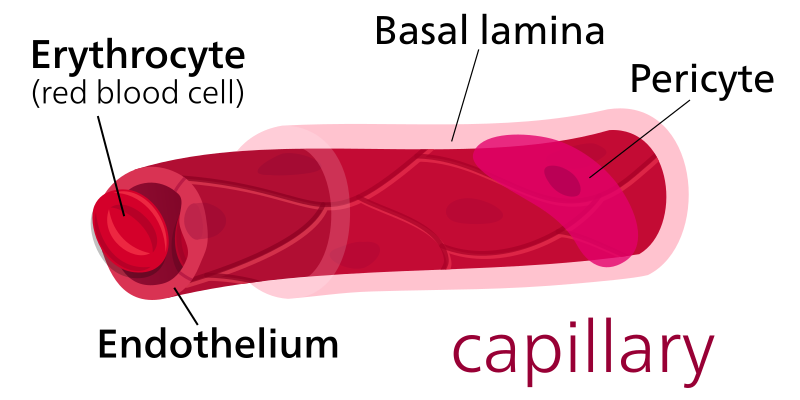
File:Capillary.svg · Wikimedia Commons · See Wikimedia Commons
Also known as capillary vessel, blood capillary, Capillary vessel, capillary, capillaries
管径最细、分布最广、连接微动脉和微静脉的血管
Capillaries are the tiniest blood vessels in your body, measuring just 5 to 10 micrometers across, and they form the final connection between arteries and veins. They matter because their extremely thin walls allow oxygen, nutrients, and other substances to pass between your blood and the surrounding tissues, making them essential for keeping your cells alive.
AI-generated from the Wikipedia summary — may contain errors.
Key facts
- Anatomy.Name
- Capillary
- Anatomy.Latin
- vas capillare
- Anatomy.Image
- Capillary.svg
- Anatomy.Caption
- Diagram of a capillary
- Anatomy.Image2
- Capillary system CERT.jpg
- Anatomy.Caption2
- A simplified illustration of a capillary network
- Anatomy.System
- Circulatory system
- Anatomy.Pronunciation
- ,
via Wikipedia infobox
Research
199,620 papers- Capillary circulation in the brain.ReviewCerebrovascular and brain metabolism reviews · 1992Kuschinsky W, Paulson OB
- Pulmonary capillary hemangiomatosis: a rare cause of pulmonary hypertension.ReviewArchives of pathology & laboratory medicine · 2015O'Keefe MC, Post MDDOI: 10.5858/arpa.2013-0500-RS
- Skeletal muscle capillary function: contemporary observations and novel hypotheses.ReviewExperimental physiology · 2013Poole DC, Copp SW, Ferguson SK et al.DOI: 10.1113/expphysiol.2013.073874
- Physiological factors influencing capillary growth.ReviewActa physiologica (Oxford, England) · 2011Egginton SDOI: 10.1111/j.1748-1716.2010.02194.x
- Blood flow in the cerebral capillary network: a review emphasizing observations with intravital microscopy.ReviewMicrocirculation (New York, N.Y. : 1994) · 1997Hudetz AGDOI: 10.3109/10739689709146787
- Characterization of the capillary network in skeletal muscles from 3D data.ReviewPhysiological research · 2011Eržen I, Janáček J, Kubínová LDOI: 10.33549/physiolres.931988
- Capillary flow disturbances after experimental subarachnoid hemorrhage: A contributor to delayed cerebral ischemia?Microcirculation (New York, N.Y. : 1994) · 2019Anzabi M, Angleys H, Aamand R et al.DOI: 10.1111/micc.12516
- Capillary resistance tests.A.M.A. archives of dermatology and syphilology · 1951HARE FW Jr, MILLER AJDOI: 10.1001/archderm.1951.01570100066012
via PubMed
Wikidata facts
- Instance of
- blood vessel
- Part of
- blood vessel
- Image
- 2101 Blood Flow Through the Heart.jpg
- Connects with
- venule
Show 3 more facts
- Commons category
- Capillaries
- NCI Thesaurus ID
- C32212
- different from
- Capillary
Sources (7)
via Wikidata · CC0
Article · 中文
{{namespace detect | category = |main=| other= 循環系統 微血管 微血管(capillary)又称为毛細血管,連接最小的動脈與最小的靜脈,是由動脈分支為較小的動脈,再分支多次的血管。 微血管是管壁最薄的血管,只有一上皮细胞构成,利於血液與組織細胞之間物質的交換。微血管平均管径为6至9微米,血液流速为主动脉的1/800;血壓則是居於動脈及靜脈之間。 微血管的主要功能在於物質的交換:在肺微血管中,因微血管的氧氣濃度小於肺泡中的濃度,氧氣透過擴散作用進入微血管中,由紅血球中的血基質運送至體內的組織細胞;而二氧化碳濃度高於肺泡中的濃度,二氧化碳透過擴散作用排出微血管,回到大氣。在其他部位的微血管,因微血管中氧氣濃度高於組織細胞中的濃度,氧氣透過擴散作用進入組織細胞中;而二氧化碳濃度低於組織細胞中的濃度,二氧化碳透過擴散作用進入微血管,送至肺泡排出體外。
Abstract from DBpedia / Wikipedia · CC BY-SA
Gallery (17)
Available in 79 languages
- Español
- Français
- Deutsch
- 中文
- 日本語
- Русский
- Português
- Italiano
- العربية
- हिन्दी
- Afrikaans
- Albanian
- Aragonese
- Armenian
- Azerbaijani
- Bahasa Indonesia
- Bangla
- Basque
Show 60 more
- be_x_old
- Belarusian
- Bosnian
- Bulgarian
- Catalan
- Central Kurdish
- Chechen
- Croatian
- Czech
- Danish
- Esperanto
- Estonian
- Filipino
- Finnish
- Galician
- Greek
- Haitian Creole
- Hebrew
- Icelandic
- Interlingua
- Irish
- Kazakh
- Kurdish
- Latin
- Latvian
- Limburgish
- Lithuanian
- Low German
- Macedonian
- Malay
- Malayalam
- Marathi
- Nederlands
- Norwegian
- Oromo
- Polski
- Quechua
- Romanian
- Serbian
- Serbian (Latin)
- Shona
- simple
- Slovak
- Slovenian
- Svenska
- Swahili
- Tiếng Việt
- Türkçe
- Ukrainian
- Urdu
- Uzbek
- Waray
- Welsh
- Wu Chinese
- Yakut
- zh_min_nan
- zh_yue
- فارسی
- ไทย
- 한국어
via Wikidata sitelinks · CC0