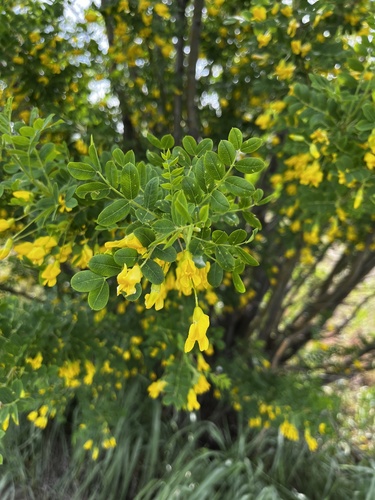
(c) Grey O'Neal, all rights reserved, uploaded by Grey O'Neal
Caragana
Sign in to saveAlso known as peashrub
thumb|Flowering caragana (camel's tail) in the south of Buryatia, Russia
OverviewAI-generated
Caragana is a genus within the plant kingdom, classified under the phylum Tracheophyta, class Magnoliopsida, order Fabales, and family Fabaceae. It is commonly referred to as the Siberian peashrub. Taxonomically, the genus is usually placed in the polyphyletic Galegeae, which also includes Alhagi.
Records of Caragana have been documented in the United States, China, India, and Pakistan. Specimens are held by institutions including the University of Alberta Museums. The genus has been the subject of 571 publications indexed in PubMed, while occurrence data totals 50,374 records. Additionally, 18,892 observations have been logged on iNaturalist, and 393 records with 253 media files are available through iDigBio.
Synthesized by Vinony from 28 facts across 8 sources: Wikidata, GBIF, iNaturalist, PubMed, Gbif Occ, Plants of the World, iDigBio, Vinony graph. Generated from structured data (not the Wikipedia text) and checked against those facts — may still contain errors.
Species
Siberian peashrub
GENUS
- KingdomPlantae
- PhylumTracheophyta
- ClassMagnoliopsida
- OrderFabales
- FamilyFabaceae
Die Erbsensträucher (Caragana) sind eine Pflanzengattung aus der Unterfamilie Schmetterlingsblütler (Faboideae) innerhalb der Familie der Hülsenfrüchtler (Fabaceae).[1] Die 80 bis 100 Arten sind im gemäßigten Asien und in Osteuropa verbreitet. Inhaltsverzeichnis 1 Beschreibung 1.1 Vegetative Merkmale 1.2 Generative Merkmale 2 Standorte 3 Systematik 3.1 Taxonomie 3.2 Arten und ihre Verbreitung 4 Nachweise 4.1 Literatur 4.2 Einzelnachweise 5 Weblinks 6 Weiterführende Literatur Beschreibung In diesem Artikel oder Abschnitt fehlen noch folgende wichtige Informationen: viele Merkmale sind nur marginal oder gar nicht beschrieben Hilf der Wikipedia, indem du sie recherchierst und Illustration aus Afbeeldingen der fraaiste, meest uitheemsche boomen en heesters, Tafel 101 des Gemeiner Erbsenstrauch (Caragana arborescens) Illustration aus Afbeeldingen der fraaiste, meest uitheemsche boomen en heesters, Tafel 106 des Dornigen Erbsenstrauch[2] (Caragana spinosa (L.) DC.) Vegetative Merkmale Caragana-Arten sind anspruchslose, verholzende Pflanzen: sommergrüne Sträucher oder selten kleine Bäume. Bei manchen Arten ist das verholzende Ende der Rhachis zu einem Dorn umgebildet. Sie zeichnen sich du
via GBIF · Kew POWO
Museum specimens
- Specimen records
- 393
- With media
- 253
- Family
- Fabaceae
- Collections
- UNIVERSITY OF ALBERTA MUSEUMS, NY, MICH, US, A, SD
- Recorded in
- United States, China, India, Pakistan
Research
571 papers- Chloroplast genome analyses of Caragana arborescens and Caragana opulens.BMC genomic data · 2024
- Hypoglycemic oligostilbenes from the stems of Caragana sinica.Bioorganic chemistry · 2023
- Chloroplast genomes of Caragana tibetica and Caragana turkestanica: structures and comparative analysis.BMC plant biology · 2024
- Caragana sinica (Buc'hoz) Rehd. (jin ji er) polysaccharide regulates the immune function and intestinal microbiota of cyclophosphamide (CTX) induced immunosuppressed mice.Journal of ethnopharmacology · 2024
- Caragana korshinskii Kom. plantation reduced soil aggregate stability and aggregate-associated organic carbon on desert steppe.PeerJ · 2022
via PubMed
Wikidata facts
- Instance of
- taxon
- Image
- Caragana sinica 3.JPG
Show 6 more facts
- taxon rank
- genus
- Commons category
- Caragana
- topic's main category
- Category:Caragana
- taxon name
- Caragana
- taxon common name
- 锦鸡儿属
via Wikidata · CC0
~4 min read
Encyclopedic overview
10 sectionsContents
- Sections and species
- Section ''Bracteolatae''
- Section ''Caragana''
- Section ''Frutescentes''
- Unnamed section
- Basal species
- ''Incertae sedis''
- Range maps
- References
- External links
thumb|Flowering caragana (camel's tail) in the south of Buryatia, Russia
Caragana is a genus of about 80–100 species of flowering plants in the family Fabaceae, native to Asia and eastern Europe.
Excerpted from Wikipedia’s “Caragana” article, available under the CC BY-SA 4.0 licence.