File:Carboxylic-acid.svg · Wikimedia Commons · See Wikimedia Commons
carboxylic acid
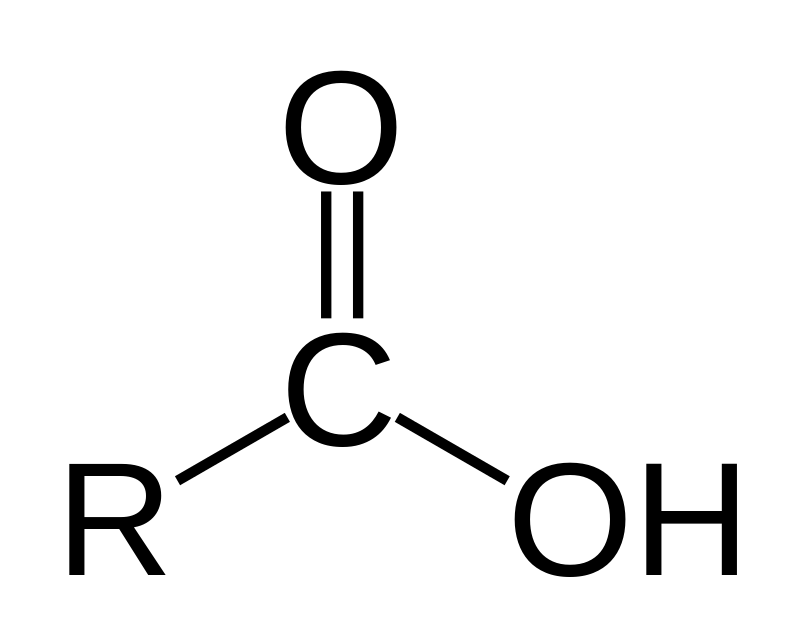
Sign in to saveoxoacid having the structure RC(=O)OH, used as a suffix in systematic name formation to denote the –C(=O)OH group including its carbon atom
A carboxylic acid is a type of chemical compound with a specific structure—a carbon atom double-bonded to oxygen and also bonded to a hydroxyl group (OH)—that gives it distinctive properties. These compounds are important in chemistry because they're used to name and classify other molecules, and they appear naturally in many substances like vinegar and fatty acids.
AI-generated from the Wikipedia summary — may contain errors.
Research
1,161,531 papers- Carboxylic Acid Derivatives in Herbicide Development.ReviewJournal of agricultural and food chemistry · 2023Cai H, Gan X, Jin Z et al.DOI: 10.1021/acs.jafc.3c00951
- Carboxylic acid reductase: Structure and mechanism.ReviewJournal of biotechnology · 2020Gahloth D, Aleku GA, Leys DDOI: 10.1016/j.jbiotec.2019.10.010
- Carboxylic acid reductases in metabolic engineering.ReviewJournal of biotechnology · 2020Butler N, Kunjapur AMDOI: 10.1016/j.jbiotec.2019.10.002
- Carboxylic acid reductases: Structure, catalytic requirements, and applications in biotechnology.ReviewInternational journal of biological macromolecules · 2023Basri RS, Rahman RNZRA, Kamarudin NHA et al.DOI: 10.1016/j.ijbiomac.2023.124526
- Carboxylic acid reductases (CARs): An industrial perspective.ReviewJournal of biotechnology · 2019Derrington SR, Turner NJ, France SPDOI: 10.1016/j.jbiotec.2019.08.010
- Carboxylic acid metabolism in cancer: Mechanisms, microenvironment interactions, and therapeutic opportunities.ReviewMetabolism: clinical and experimental · 2025Bian X, Zhuo Y, Zhou L et al.DOI: 10.1016/j.metabol.2025.156334
- Carboxylic Acid Counterions in FDA-Approved Pharmaceutical Salts.ReviewPharmaceutical research · 2021Bharate SSDOI: 10.1007/s11095-021-03080-2
- Carboxylic acid (bio)isosteres in drug design.ReviewChemMedChem · 2013Ballatore C, Huryn DM, Smith AB 3rdDOI: 10.1002/cmdc.201200585
via PubMed
Wikidata facts
Show 7 more facts
- Commons category
- Carboxylic acids
- topic's main category
- Category:Carboxylic acids
- general formula
- RC(=O)OH
- canonical SMILES
- OC([*])=O
- SMARTS notation
- [CX3](=O)[OX1H0-,OX2H1]
- CXSMILES
- [*]C(=O)O |$_R$|
- on focus list of Wikimedia project
- Wikipedia:Vital articles/Level/4
Sources (2)
via Wikidata · CC0
~24 min read
Encyclopedic overview
Structure of a carboxylic acid Carboxylate anion 3D structure of a carboxylic acid
In organic chemistry, a carboxylic acid is a polar, organic acid that contains a carboxyl group ( −C(=O)−OH) attached to an R-group. The general formula of a carboxylic acid is often written as R−COOH or R−CO2H, sometimes as R−C(O)OH, with R referring to an organyl group (e.g., alkyl, alkenyl, aryl), or hydrogen, or other groups. Carboxylic acids occur widely. Important examples include the amino acids and fatty acids. Deprotonation of a carboxylic acid gives a carboxylate anion. Carboxylic acids are often considered weak acids as they only partially ionise (dissociate) in water.
Excerpted from Wikipedia’s “carboxylic acid” article, available under the CC BY-SA 4.0 licence.
Gallery (9)
Available in 80 languages
- Español
- Français
- Deutsch
- 中文
- 日本語
- Русский
- Português
- Italiano
- العربية
- हिन्दी
- Afrikaans
- Albanian
- Armenian
- Asturian
- azb
- Azerbaijani
- Bahasa Indonesia
- Bangla
Show 61 more
- Basque
- be_x_old
- Belarusian
- Bikol
- Bosnian
- Bulgarian
- Catalan
- Central Kurdish
- Chuvash
- Croatian
- Czech
- Danish
- Esperanto
- Estonian
- Faroese
- Finnish
- Galician
- Greek
- Hausa
- Hebrew
- Hungarian
- Irish
- Kabyle
- Kazakh
- Kyrgyz
- Latin
- Latvian
- Lithuanian
- Macedonian
- Malay
- Malayalam
- Nederlands
- Norwegian
- Norwegian Nynorsk
- Occitan
- Polski
- Punjabi
- Romanian
- Serbian
- Serbian (Latin)
- simple
- Sinhala
- Slovak
- Slovenian
- Sundanese
- Svenska
- Tamil
- Telugu
- Tiếng Việt
- Türkçe
- Ukrainian
- Uzbek
- Waray
- Welsh
- Western Panjabi
- Wu Chinese
- zh_classical
- zh_yue
- فارسی
- ไทย
- 한국어
via Wikidata sitelinks · CC0