File:Amide-(tertiary).svg · Wikimedia Commons · See Wikimedia Commons
amides
Sign in to saveAlso known as acyl amide, oxoacyl amide, oxoacid amide
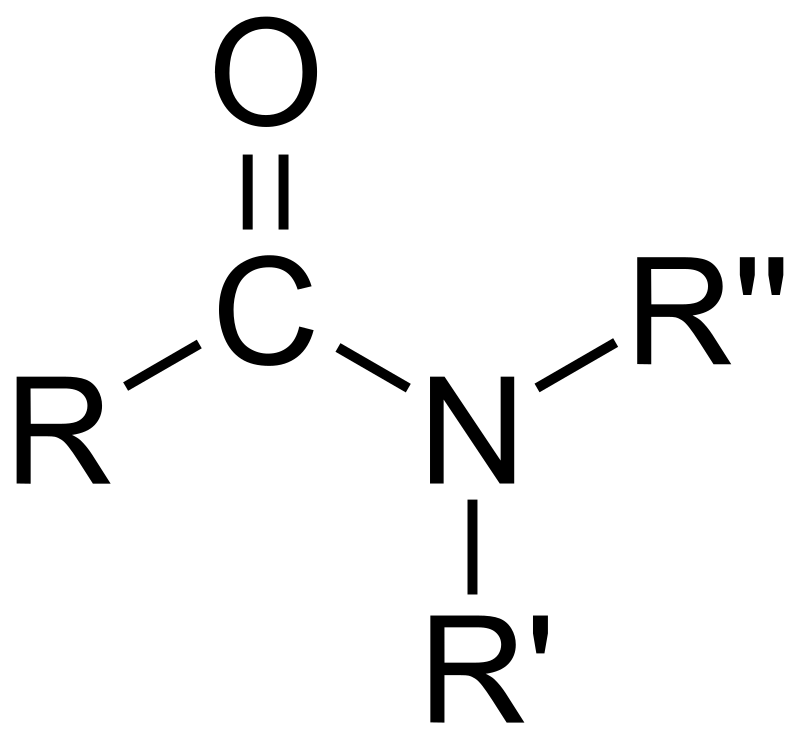
thumb|right|General structure of an amide (specifically, a carboxamide) thumb|right|Formamide, the simplest amide thumb|right|Asparagine ([[zwitterionic form), an amino acid with a side chain (highlighted) containing an amide group]]
An amide is a type of chemical compound formed when a carbon atom bonds with a nitrogen atom, commonly found in molecules ranging from simple laboratory chemicals to complex biological molecules like proteins. Amides matter because they're fundamental building blocks in nature and industry—they appear in amino acids that make up living organisms and are used to create various synthetic materials and drugs.
AI-generated from the Wikipedia summary — may contain errors.
Wikidata facts
- Has parts of class
- amide group
Show 6 more facts
- Commons category
- Amides
- topic's main category
- Category:Amides
- different from
- carboxamides
- SMARTS notation
- [NX3][CX3](=[OX1])[#6]
- on focus list of Wikimedia project
- Wikipedia:Vital articles/Level/4
- CXSMILES
- [*]N([*])[*] |$R1;;R2;Acyl_p$|
via Wikidata · CC0
~12 min read
Encyclopedic overview
14 sectionsContents
- Nomenclature
- Applications
- Structure and bonding
- Basicity
- Hydrogen bonding and solubility
- Reactions
- Hydrolysis
- Synthesis
- From carboxylic acids and related compounds
- From nitriles
- Specialty routes
- See also
- References
- External links
thumb|right|General structure of an amide (specifically, a carboxamide) thumb|right|Formamide, the simplest amide thumb|right|Asparagine ([[zwitterionic form), an amino acid with a side chain (highlighted) containing an amide group]]
In organic chemistry, an amide, also known as an organic amide or a carboxamide, is a compound with the general formula , where R, R', and R″ represent any group, typically organyl groups or hydrogen atoms. The amide functional group plays an important role in the chemistry of life where, as peptide bonds, they link amino acids together to form proteins.
Excerpted from Wikipedia’s “amides” article, available under the CC BY-SA 4.0 licence.
Gallery (256)
Available in 62 languages
- Español
- Français
- Deutsch
- 中文
- 日本語
- Русский
- Português
- Italiano
- العربية
- हिन्दी
- Afrikaans
- Armenian
- Asturian
- Bahasa Indonesia
- Basque
- Belarusian
- Bosnian
- Bulgarian
Show 43 more
- Catalan
- Croatian
- Czech
- Esperanto
- Estonian
- Filipino
- Finnish
- Galician
- Greek
- Hebrew
- Hungarian
- Ido
- Irish
- Javanese
- Kannada
- Kazakh
- Latvian
- Lithuanian
- Macedonian
- Malay
- Nederlands
- Norwegian
- Norwegian Nynorsk
- Occitan
- Polski
- Romanian
- Serbian
- Serbian (Latin)
- simple
- Slovak
- Slovenian
- Svenska
- Tamil
- Tiếng Việt
- Türkçe
- Ukrainian
- Uzbek
- Waray
- Welsh
- zh_yue
- فارسی
- ไทย
- 한국어
via Wikidata sitelinks · CC0