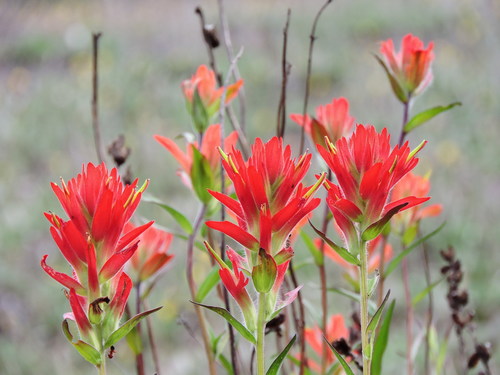
(c) BioBlitz, some rights reserved (CC BY-ND), uploaded by BioBlitz · cc-by-nd
Castilleja
Sign in to saveCastilleja ( or ), commonly known as paintbrushes, painted cups, or prairie-fire, is a genus of about 200 species of annual and perennial mostly herbaceous plants native to the west of the Americas from Alaska south to the Andes, northern Asia, and one species as far west as the Kola Peninsula in northwestern Russia. These plants are classified in the broomrape family Orobanchaceae (following major rearrangements of the order Lamiales starting around 2001; sources which do not follow these reclassifications may place them in the Scrophulariaceae). They are hemiparasitic on the roots of grasses
Species
giant red paintbrush
GENUS
- KingdomPlantae
- PhylumTracheophyta
- ClassMagnoliopsida
- OrderLamiales
- FamilyOrobanchaceae
Euchroma gigantea es una especie de escarabajo de la familia Buprestidae. Es la única especie del género Euchroma. Fue descrita científicamente por Linnaeus en 1758.
via GBIF
Museum specimens
- Specimen records
- 5,698
- With media
- 4,057
- Family
- Orobanchaceae
- Collections
- UNIVERSITY OF ALBERTA MUSEUMS, ECOSUR, IBUNAM, INECOL, CICY, FCB-BUAP
- Recorded in
- Canada, United States, Mexico
Wikidata facts
- Instance of
- taxon
- Parent taxon
- Orobanchaceae
- Image
- Castilleja miniata close.jpg
Show 7 more facts
- Commons category
- Castilleja
- taxon rank
- genus
- topic's main category
- Category:Castilleja
- Commons gallery
- Castilleja
- taxon name
- Castilleja
- taxon common name
- 火焰草属
Sources (2)
via Wikidata · CC0
~5 min read
Encyclopedic overview
11 sectionsContents
- Taxonomy
- Species
- Names
- Description
- Ecology
- Hybridization
- Uses
- Symbolism
- References
- Further reading
- External links
Castilleja ( or ), commonly known as paintbrushes, painted cups, or prairie-fire, is a genus of about 200 species of annual and perennial mostly herbaceous plants native to the west of the Americas from Alaska south to the Andes, northern Asia, and one species as far west as the Kola Peninsula in northwestern Russia. These plants are classified in the broomrape family Orobanchaceae (following major rearrangements of the order Lamiales starting around 2001; sources which do not follow these reclassifications may place them in the Scrophulariaceae). They are hemiparasitic on the roots of grasses and forbs. The genus was named after Spanish botanist Domingo Castillejo.
==Taxonomy== Castilleja was scientifically described by Carl Linnaeus the Younger using a partial description by José Celestino Bruno Mutis in 1782. The type species was Castilleja fissifolia from Columbia. The genus as a whole has never been renamed, however five others were described and named that are considered to be synonyms of Castilleja. For example, in 1818 Thomas Nuttall described a genus that he named Euchroma meaning "finely colored", moving the species now known as Castilleja coccinea out of Bartsia where it had been placed by Carl Linnaeus. It is also named Euchroma grandiflora, as another species. However, Nutttall's Euchroma grandiflora had already been named and correctly placed as Castilleja sessiliflora by Frederick Traugott Pursh in 1813.
Excerpted from Wikipedia’s “Castilleja” article, available under the CC BY-SA 4.0 licence.