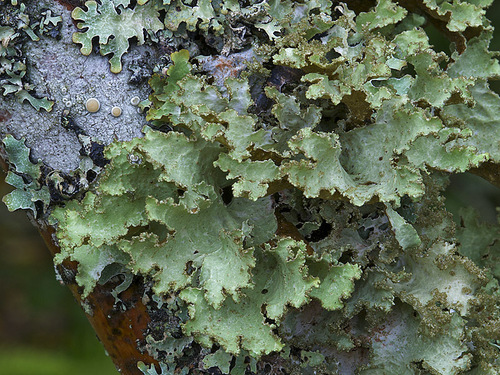
(c) Richard Droker, some rights reserved (CC BY-NC-ND) · cc-by-nc-nd
Cetraria
Sign in to saveCetraria is a genus of fruticose lichens that associate with green algae as photobionts. Most species are found at high latitudes, occurring on sand or heath, and are characterised by their "strap-like" form with spiny edges. The lobes can range from narrow and linear to broader and flattened, often forming loose or densely packed cushions. Their distinctive spiny margins serve both a defensive role and aid in vegetative reproduction through fragmentation. The genus was created by Erik Acharius in 1803 and belongs to the large family Parmeliaceae. While originally a species-rich genus, taxonom
Species
Varied Rag Lichen
GENUS
- KingdomFungi
- PhylumAscomycota
- ClassLecanoromycetes
- OrderLecanorales
- FamilyParmeliaceae
Die Gattung Cetraria umfasste ursprünglich recht verschieden aussehende Laub- und Strauchflechten. Die Gattung ist kosmopolitisch, aber hauptsächlich in den kalten und gemäßigten Gebieten der Nordhalbkugel anzutreffen. Von Cetraria werden weitere Gattungen abgetrennt. So wurden etwa die Schneeflechte (früher C. nivalis) und die Kapuzenflechte (früher C. cucullata) in die neu geschaffene Gattung Flavocetraria verschoben. Cetraria im engen Sinn umfasst dann nur mehr ca. 15 Arten. In Mitteleuropa kommen 5 Arten vor: Cetraria aculeata, ericetorum, islandica, muricata und sepincola. Aus dem Thallus von Cetraria islandica wird ein Extrakt gewonnen, der schleimlösende Wirkung hat und zum Beispiel in Hustenbonbons verwendet wird. Der Name Cetraria kommt vom lateinischen Wort caetra = kleiner leichter Lederschild und bezieht sich darauf, dass die Lagerabschnitte des Isländischen Mooses oft glänzend braun sind.
via GBIF
Museum specimens
- Specimen records
- 1,486
- With media
- 778
- Family
- Parmeliaceae
- Collections
- CAS, US, F, CHRB
- Recorded in
- United States, Venezuela, Canada, Nicaragua, Mexico
Wikidata facts
- Instance of
- taxon
- Parent taxon
- Parmeliaceae
- Image
- Cetraria aculeata habito.jpg
Show 7 more facts
- Commons category
- Cetraria
- taxon name
- Cetraria
- taxon rank
- genus
- topic's main category
- Category:Cetraria
- taxonomic type
- Cetraria islandica
- taxon common name
- 岛衣属
- taxon author citation
- Ach.
via Wikidata · CC0
~26 min read
Encyclopedic overview
13 sectionsContents
- Systematics
- Historical development (1800s–1950s)
- Modern revisions (1960s–2000s)
- Current classification debates
- Naming
- Description
- Photobiont
- Habitat, distribution, and ecology
- Species
- Chemistry
- Traditional uses
- Environmental monitoring
- References
Cetraria is a genus of fruticose lichens that associate with green algae as photobionts. Most species are found at high latitudes, occurring on sand or heath, and are characterised by their "strap-like" form with spiny edges. The lobes can range from narrow and linear to broader and flattened, often forming loose or densely packed cushions. Their distinctive spiny margins serve both a defensive role and aid in vegetative reproduction through fragmentation. The genus was created by Erik Acharius in 1803 and belongs to the large family Parmeliaceae. While originally a species-rich genus, taxonomic revisions since the 1960s have split many species into new genera, though the exact circumscription remains debated among lichenologists.
Several Cetraria species have cultural and economic importance, particularly C. islandica (Iceland moss), which has been widely used in European traditional medicine for treating digestive and respiratory ailments. This species was also historically important as a famine food in Northern Europe and continues to find applications in modern cosmetics and pharmaceutical products. Cetraria species are also ecologically important, serving as indicators of air quality and climate change due to their sensitivity to environmental conditions and ability to accumulate various elements, including potentially toxic heavy metals and radioactive isotopes.
Excerpted from Wikipedia’s “Cetraria” article, available under the CC BY-SA 4.0 licence.
Gallery (12)
Available in 21 languages
- Español
- Français
- Deutsch
- 中文
- Русский
- Belarusian
- Catalan
- Cebuano
- Egyptian Arabic
- Estonian
- Finnish
- Lithuanian
- Nederlands
- Norwegian
- Polski
- Svenska
- Tatar
- Türkçe
via Wikidata sitelinks · CC0