(c) Mark Webber, some rights reserved (CC BY-NC), uploaded by Mark Webber · cc-by-nc
Chaetoceros
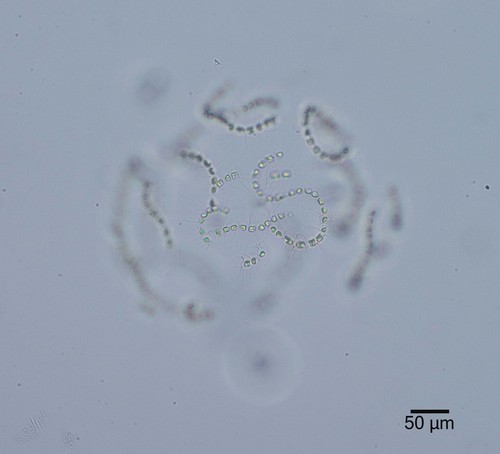
Sign in to savethumb|upright=1.2| Phytoplankton – such as this colony of Chaetoceros socialis – naturally give off fluorescent light as they dissipate excess solar energy that they cannot consume through photosynthesis. thumb|upright=1.2|Bright-field microscopy image of epiphytic cyanobacterial symbiont [[Calothrix rhizosoleniae SC01 9 (indicated by arrows) attached to a host diatom Chaetoceros sp. (c). Scale bar, 50 μm.]]
Species
キートケロス属
GENUS
- KingdomChromista
- PhylumOchrophyta
- ClassBacillariophyceae
- OrderChaetocerotales
- FamilyChaetocerotaceae
via GBIF
Museum specimens
- Specimen records
- 227
- With media
- 19
- Family
- Chaetocerotaceae
- Collections
- CCBA-FMVZ-UADY, US, NY
- Recorded in
- Mexico, United States, New Zealand, Canada, Sweden, Ecuador
~15 min read
Encyclopedic overview
9 sectionsContents
- Description
- Environmental ranges
- Ecology
- Uses
- Diversity
- Species
- See also
- References
- External links
thumb|upright=1.2| Phytoplankton – such as this colony of Chaetoceros socialis – naturally give off fluorescent light as they dissipate excess solar energy that they cannot consume through photosynthesis. thumb|upright=1.2|Bright-field microscopy image of epiphytic cyanobacterial symbiont [[Calothrix rhizosoleniae SC01 9 (indicated by arrows) attached to a host diatom Chaetoceros sp. (c). Scale bar, 50 μm.]]
Chaetoceros is a genus of diatoms in the family Chaetocerotaceae, first described by the German naturalist C. G. Ehrenberg in 1844. Species of this genus are mostly found in marine habitats, but a few species exist in freshwater. It is arguably the common and most diverse genus of marine planktonic diatoms, with over 200 accepted species. It is the type genus of its family.
Excerpted from Wikipedia’s “Chaetoceros” article, available under the CC BY-SA 4.0 licence.