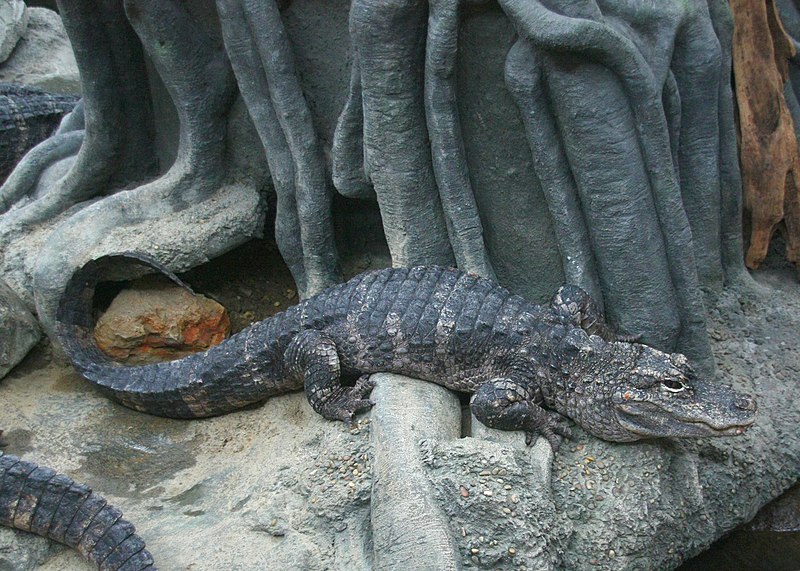
File:ChineseAlligator15.JPG · Wikimedia Commons · See Wikimedia Commons
The Chinese alligator is a species of alligator native to China that is one of the world's rarest reptiles, found only in a small area of the Yangtze River. It is smaller than the American alligator and faces serious threats from habitat loss, making conservation efforts important for preventing its extinction.
AI-generated from the Wikipedia summary — may contain errors.
Species
Critically EndangeredMaximum longevity: 60.7 years (captivity)
via IUCN
Wikidata facts
Show 10 more facts
- taxon rank
- species
- IUCN conservation status
- Critically Endangered
- Commons category
- Alligator sinensis
- taxon name
- Alligator sinensis
- Commons gallery
- Alligator sinensis
- taxon common name
- kitajski aligator
- described by source
- Gujin Tushu Jicheng
- CITES Appendix
- Appendix I of CITES
- sequenced genome URL
- www.dnazoo.org/assemblies/Alligator_sinensis
- short name
- A. sinensis
Sources (1)
via Wikidata · CC0
~29 min read
Encyclopedic overview
The Chinese alligator (Alligator sinensis; simplified Chinese: 鼍; traditional Chinese: 鼉; pinyin: tuó), also known as the Yangtze alligator (simplified Chinese: 扬子鳄; traditional Chinese: 揚子鱷; pinyin: yángzǐ'è), China alligator, or historically the muddy dragon, is a crocodilian endemic to China. It and the American alligator (A. mississippiensis) are the only living species in the genus Alligator of the family Alligatoridae. Dark gray or black in color with a fully armored body, the Chinese alligator grows to 1.5–2.1 metres (5–7 ft) in length and weighs 36–45 kilograms (80–100 lb) as an adult. It brumates in burrows in winter and is nocturnal in summer. Mating occurs in early summer, with females most commonly producing 20–30 eggs, which are smaller than those of any other crocodilian. The species is an opportunistic feeder, primarily eating fish and invertebrates. A vocal species, adults bellow during the mating season and young vocalize to communicate with their parents and other juveniles. Captive specimens have reached age 70, and wild specimens can live past 50.
Living in bodies of fresh water, the Chinese alligator's range is restricted to six regions in the province of Anhui, as well as possibly the provinces of Jiangsu and Zhejiang. Originally living as far away from its current range as Japan, the species previously had a wide range and population, but beginning in 6000 BC, multiple threats, such as habitat destruction, caused the species' population and range to decline. The population in the wild was about 1,000 in the 1970s, decreased to below 130 in 2001, and grew after 2003, with its population being about 300 as of 2017. Listed as critically endangered by the International Union for Conservation of Nature, multiple conservation actions have been taking place for this species.
Excerpted from Wikipedia’s “Chinese alligator” article, available under the CC BY-SA 4.0 licence.
Gallery (10)
On the map
2 mapped locations