Described at
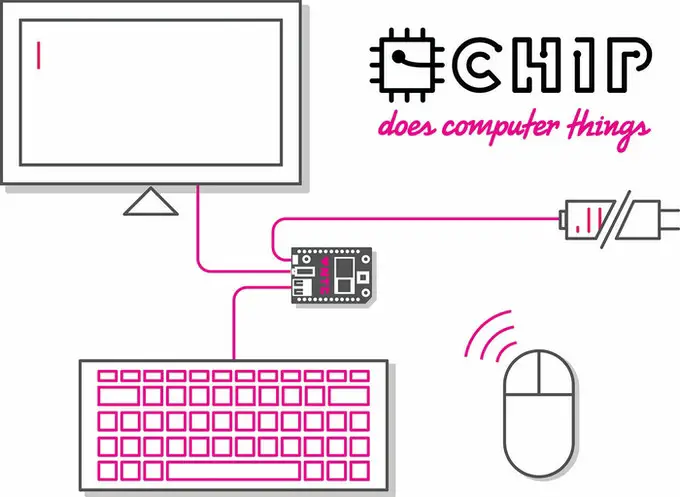
CHIP - The World's First Nine Dollar Computer - getchip
getchip.com →CHIP (stylized as C.H.I.P. ) is a single-board computer crowd funded by now-defunct Next Thing Co. (NTC), released as open-source hardware running open-source software. It was advertised as “the world’s first $9 computer”. CHIP and related products are discontinued. NTC has since gone insolvent. By March 2018, Next Thing Co. had entered insolvency. Many customers still had not received their pre-orders. CHIP was the original board, mostly targeting hobbyists. The system is built around the All winner R8 SoC processor, which integrates an ARM Cortex-A8 CPU (based on ARM architecture V7-A) and peripherals, such as Graphic Engine, UART, SPI, USB ports, CIR, CMOS Sensor Interface and LCD controller. The CPU is also accompanied by a NEON SIMD coprocessor and has RCT JAVA-Accelerations to optimize just-in-time (JIT) and dynamic adaptive compilation (DAC). Built-in Wi-Fi 802.11b/g/n, Bluetooth 4.0 One USB host with type-A receptacle, one USB On-The-Go port Composite video and stereo audio port via mini TRRS Optional composite TRRS to RCA audio-video cable Optional VGA adapter and HDMI adapter (see Hardware extensions below) Open source hardware and open source software Up to 45 GPIO ports Supports 1-Wire and I2C protocols, PWM output Serial console and Ethernet via USB for quick headless operation Power options include 5V via USB OTG, 5V via CHN pin, and by 3.7 battery Onboard NAND storage, 4-8GB, pre-installed Linux OS Web-based firmware update Few details were available in regard to CHIP’s would-be successor or successors except it would have used Next Thing’s own SiP GR8 instead of Allwinner’s original R8. In addition to feature-sharing with CHIP Pro, the company wanted to “take advantage of CHIP Pro’s much more stable supply chain”[]]( in order to address the uneasiness in its user base about the future of the product. In responding to user concerns, Next Thing also disclosed that more than one successor product line was in the works. In addition to open-source hardware and software, Next Thing also published an HPI and an API for users to develop add-ons boards called “DIP” The company produced several DIPs including the Pocket CHIP. Pocket CHIP comes loaded with a special edition of CHIP OS that includes the DIP’s driver and a couple of additional applications, including a special version of video game console virtual machine Pico-8, a fully functional Linux terminal, a file browser, a terminal based web browser called surf, and modular synthesizer Sunvox. The Pockulus is a virtual reality setup incorporating a Pocket CH.I.P. that requires some 3D printing. For users who did not want to use the small screen in Pocket CHIP and also did not want to use the built-in composite TV output, Next Thing sold a VGA DIP and an HDMI DIP. Unlike Pocket CHIP, physical dimensions of these DIPs are similar to CHIP, so the snapped assembly looks like a thicker CHIP. CHIP received favorable reviews, and constant comparisons to Raspberry Pi. Laura Sydell of NPR asked if the device could “spark a new wave of tinkering and innovation”, noting it was also open source hardware. Marco della Cava of USA Today said that the device “represent[s] opportunities to both close the technology gap in developing and developed countries alike, while encouraging children to learn coding, due to their approachable design”. Reviewers also noted its low price. Bo Moore of PC Gamer said the price of CHIP “[puts] Raspberry Pi 2 to shame”, and Ian Paul of PC World said it made “Raspberry Pi’s price seem luxurious”. Within days of the launch of its Kickstarter, US national media outlets like The Washington Post and Time followed with glowing coverage. Even Fortune joined the chorus with headline “This $9 computer could change the economics of building hardware.” Despite enthusiasm from reviewers and users, Next Thing Co. declared bankruptcy in March 2018, leaving many pre-order customers with undelivered orders. While NTC has published many of its hardware a
Excerpt from a page describing this subject · 10,748 chars · not written by Vinony
Wikidata facts
- Subclass of
- single-board computer
- Official website
- getchip.com
- Image
- NTC Linux board upper.jpg
Show 4 more facts
- funding scheme
- crowdfunding
- Commons category
- Next Thing Co CHIP
- operating system
- Linux
- described at URL
- linux-sunxi.org/NextThingCo_CHIP
Sources (3)
via Wikidata · CC0