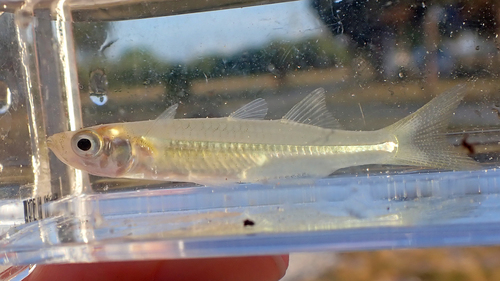
(c) trinectes, all rights reserved, uploaded by trinectes
Chirostoma
Sign in to saveAlso known as Charales
Chirostoma is a genus of Neotropical silversides from the Lerma River basin in Mexico, including lakes Chapala and Pátzcuaro. Fish in the genus collectively go by the common name charal/charales in their native range (a name also used for the related Poblana). They are heavily fished, but several of the species have become threatened due to habitat loss (pollution, water extraction and drought), introduced species and overfishing. Three species are considered extinct: C. bartoni (disappeared 2006), C. charari (1957) and C. compressum (1900). Four others have not been recorded recently and may
Species
Tidewater Silverside
GENUS
- KingdomAnimalia
- PhylumChordata
- ClassTeleostei
- OrderAtheriniformes
- FamilyAtherinopsidae
Vissen Chirostoma is een geslacht van straalvinnige vissen uit de familie van koornaarvissen (Atherinopsidae).[1] Soorten Chirostoma aculeatum Barbour, 1973 Chirostoma arge Jordan & Snyder, 1899 Chirostoma attenuatum Meek, 1902 Chirostoma bartoni Jordan & Evermann, 1896 Chirostoma chapalae Jordan & Snyder, 1899 Chirostoma charari de Buen, 1945 Chirostoma compressum de Buen, 1940 Chirostoma consocium Jordan & Hubbs, 1919 Chirostoma contrerasi Barbour, 2002 Chirostoma copandaro de Buen, 1945 Chirostoma estor Jordan, 1880 Chirostoma grandocule Steindachner, 1894 Chirostoma humboldtianum Valenciennes, 1835 Chirostoma jordani Woolman, 1894 Chirostoma labarcae Meek, 1902 Chirostoma lucius Boulenger, 1900 Chirostoma melanoccus Alvarez, 1963 Chirostoma patzcuaro Meek, 1902 Chirostoma promelas Jordan & Snyder, 1899 Chirostoma reseratum Alvarez, 1963 Chirostoma riojai Solórzano & López, 1966 Chirostoma sphyraena Boulenger, 1900 Chirostoma zirahuen Meek, 1902 Bronnen, noten en/of referenties ↑ (en) Chirostoma. FishBase. Ed. Ranier Froese and Daniel Pauly. 10 2011 version. N.p.: FishBase, 2011.
via GBIF
Museum specimens
- Specimen records
- 126
- Family
- Atherinopsidae
- Collections
- IBUNAM, ENCB-IPN, ASU, SIO, MADUG-UG, UA
- Recorded in
- Mexico
Wikidata facts
- Instance of
- taxon
- Parent taxon
- Menidiinae
- Image
- Charales2011.JPG
Show 5 more facts
- Commons category
- Chirostoma
- topic's main category
- Category:Chirostoma
- taxon name
- Chirostoma
- taxon rank
- genus
- start time
- 5000000-00
Sources (1)
via Wikidata · CC0
~4 min read
Encyclopedic overview
5 sectionsContents
- Appearance and behavior
- Species
- Culinary use
- Availability
- References
Chirostoma is a genus of Neotropical silversides from the Lerma River basin in Mexico, including lakes Chapala and Pátzcuaro. Fish in the genus collectively go by the common name charal/charales in their native range (a name also used for the related Poblana). They are heavily fished, but several of the species have become threatened due to habitat loss (pollution, water extraction and drought), introduced species and overfishing. Three species are considered extinct: C. bartoni (disappeared 2006), C. charari (1957) and C. compressum (1900). Four others have not been recorded recently and may also be extinct.
== Appearance and behavior == Chirostoma are generally silvery-white, pale gray-brown or dull yellowish in color, and have a long horizontal line on the side of the body (inconspicuous and more spotty in some species). They vary in size, ranging from species that are less than long to species that can surpass . Despite the differences, there is great overlap in the food choice of these filter feeders with the main diet being composed of various small organisms (mostly planktonic) such as copepods, cladocerans, rotifers, amphipods, oligochaetes, nematodes, insect larvae, and fish eggs and embryos (including those of silversides).
Excerpted from Wikipedia’s “Chirostoma” article, available under the CC BY-SA 4.0 licence.