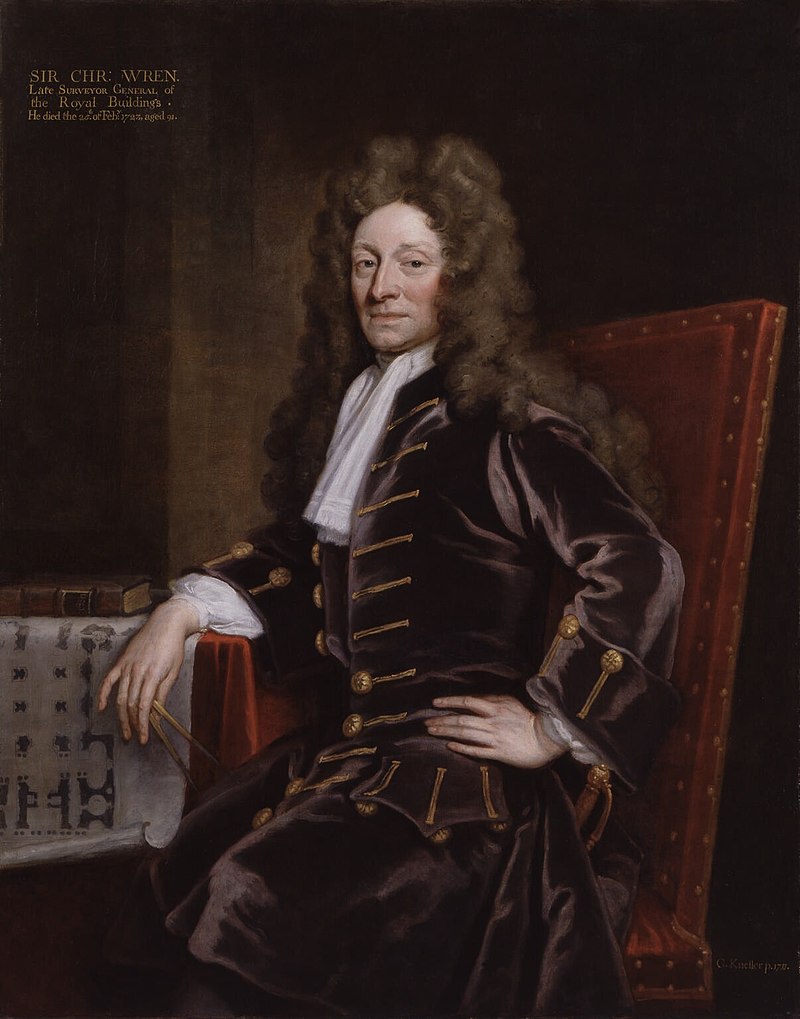
File:Christopher_Wren_by_Godfrey_Kneller_1711.jpg · Wikimedia Commons · See Wikimedia Commons
Christopher Wren
Sign in to saveAlso known as Sir Christopher Michael Wren, Christopher Michael Wren, Sir Wren, Sir Christopher Wren, Christopher, Sir Wren
English architect (1632–1723)
Christopher Wren was an English architect who lived from 1632 to 1723 and became one of the most influential designers of his era. He is best known for redesigning London after the Great Fire of 1666, including his most famous work, St. Paul's Cathedral.
AI-generated from the Wikipedia summary — may contain errors.
Wikidata facts
- Instance of
- human
- Given name
- Christopher
- Gender
- male
- Citizenship
- Kingdom of Great Britain
- Place of birth
- East Knoyle
- Place of death
- London
- Father
- Christopher Wren
- Occupation
- mathematician
- Educated at
- University of Oxford
- Employer
- University of Oxford
- Languages spoken
- English language
- Religion
- Christianity
- Award
- Knight Bachelor
- Doctoral student
- Robert Hooke
- Field of work
- architecture
- Image
- Christopher Wren by Godfrey Kneller 1711.jpg
- Work location
- Cambridge
- Residence
- Oxford
Show 16 more facts
- Commons category
- Christopher Wren
- member of
- Royal Society
- date of birth
- 1632-10-20
- date of death
- 1723-02-25
- Commons Creator page
- Christopher Wren
- place of burial
- St Paul's Cathedral
- name in native language
- Christopher Wren
- has works in the collection
- Nationalmuseum
- writing language
- English language
- honorific prefix
- Sir
- on focus list of Wikimedia project
- Wikipedia:Vital articles/Level/4
- ethnic group
- English people
- topic's main category
- Category:Christopher Wren
- maintained by WikiProject
- WikiProject Mathematics
- P12749
- Hana
- student
- Robert Hooke
Sources (7)
via Wikidata · CC0
Works in European collections
3 objects attributed to Christopher Wren, held across European museums, libraries & archives · via Europeana

~39 min read
Encyclopedic overview
Sir Christopher Wren (/rɛn/; 30 October 1632 [O.S. 20 October] – 8 March 1723 [O.S. 25 February]) was an English architect, astronomer, mathematician and physicist who is one of the most highly acclaimed architects in the history of England. Known for his work in the English Baroque style, he was accorded responsibility for rebuilding 52 churches in the City of London after the Great Fire in 1666, including what is regarded as his masterpiece, St Paul's Cathedral, on Ludgate Hill, completed in 1710.
The principal creative responsibility for a number of the churches is now more commonly attributed to others in his office, especially Nicholas Hawksmoor. Other notable buildings by Wren include the Royal Hospital Chelsea, the Old Royal Naval College, Greenwich, and the south front of Hampton Court Palace. Educated in Latin and Aristotelian physics at the University of Oxford, Wren was a founder of the Royal Society and served as its president from 1680 to 1682. His scientific work was highly regarded by Isaac Newton and Blaise Pascal.
Excerpted from Wikipedia’s “Christopher Wren” article, available under the CC BY-SA 4.0 licence.
Gallery (12)
Available in 80 languages
- Español
- Français
- Deutsch
- 中文
- 日本語
- Русский
- Português
- Italiano
- العربية
- Afrikaans
- Aragonese
- Armenian
- Asturian
- azb
- Azerbaijani
- Bahasa Indonesia
- Bangla
- Basque
Show 61 more
- be_x_old
- Belarusian
- Bulgarian
- Burmese
- Catalan
- Chechen
- Croatian
- Czech
- Danish
- Egyptian Arabic
- Esperanto
- Estonian
- Fiji Hindi
- Filipino
- Finnish
- Galician
- Georgian
- Greek
- Hebrew
- Hungarian
- Icelandic
- Ido
- Irish
- Latin
- Latvian
- Lithuanian
- Malagasy
- Malay
- Marathi
- Mingrelian
- Nederlands
- Newari
- Northern Frisian
- Norwegian
- Norwegian Nynorsk
- Pampanga
- Pashto
- Piedmontese
- Polski
- Punjabi
- rki
- Romanian
- Serbian
- Serbian (Latin)
- simple
- Slovak
- Slovenian
- Svenska
- Swahili
- Tamil
- Tiếng Việt
- Türkçe
- Ukrainian
- Waray
- Welsh
- Western Panjabi
- Wu Chinese
- zh_yue
- فارسی
- ไทย
- 한국어
via Wikidata sitelinks · CC0