
File:Portrait_of_a_Mathematician_1680c.jpg · Wikimedia Commons · See Wikimedia Commons
Robert Hooke
Sign in to saveAlso known as Hooke
English natural philosopher, architect and polymath (1635 — 1703)
Robert Hooke was an English scientist, architect, and inventor of the 1600s who made discoveries across multiple fields including physics, biology, and astronomy. His work laid important groundwork for modern science, and he remains famous for discoveries like Hooke's Law (which describes how materials stretch and spring back) and early microscopic observations of living things.
AI-generated from the Wikipedia summary — may contain errors.
Wikidata facts
- Instance of
- human
- Given name
- Robert
- Gender
- male
- Citizenship
- Kingdom of England
- Place of birth
- Freshwater
- Place of death
- London
- Occupation
- naturalist
- Educated at
- University of Oxford
- Employer
- Robert Boyle
- Languages spoken
- Ancient Greek
- Religion
- Anglicanism
- Doctoral advisor
- Christopher Wren
- Field of work
- materials science
- Image
- Portrait of a Mathematician 1680c.jpg
- Work location
- London
Show 12 more facts
- writing language
- English language
- member of
- Royal Society
- Commons category
- Robert Hooke
- date of birth
- 1635-00-00
- date of death
- 1703-03-14
- Commons gallery
- Robert Hooke
- name in native language
- Robert Hooke
- student
- Edmond Halley
- on focus list of Wikimedia project
- Wikipedia:Vital articles/Level/4
- place of burial
- St Helen's Bishopsgate
- maintained by WikiProject
- WikiProject Mathematics
- Commons Creator page
- Robert Hooke
Sources (8)
via Wikidata · CC0
Works in European collections
7 objects attributed to Robert Hooke, held across European museums, libraries & archives · via Europeana

Micrographia: Or Some Physiological Descriptions Of Minute Bodies Made By Magnifying Glasses. With Observations and Inquiries thereupon
Microscopic observations or, Dr. Hooke's wonderful discoveries by the microscope
Philosophical experiments and observations of the late eminent Dr. Robert Hooke ... and other eminent virtuoso's in his time with copper plates
Lectiones Cutlerianae, or a collection of lectures physical,mechanical, geographical & astronomical, made before the Royal Society on several occasions ... to which are added divers miscellaneous discourses
Untitled
Untitled
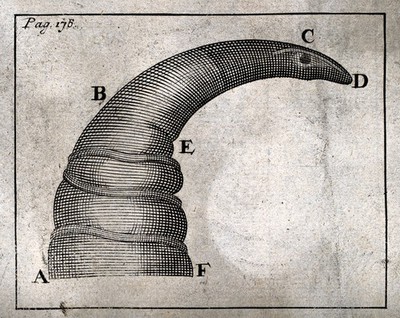
Untitled
~40 min read
Encyclopedic overview
Robert Hooke (/hʊk/; 18 July 1635 – 3 March 1703) was an English polymath who was active as a physicist ('natural philosopher'), astronomer, geologist, meteorologist, and architect. He is credited as one of the first scientists to investigate living things at microscopic scale in 1665, using a compound microscope that he designed. Hooke was an impoverished scientific inquirer in young adulthood who went on to become one of the most important scientists of his time. After the Great Fire of London in 1666, Hooke (as a surveyor and architect) attained wealth and esteem by performing more than half of the property line surveys and assisting with the city's rapid reconstruction. Often vilified by writers in the centuries after his death, his reputation was restored at the end of the twentieth century and he has been called "England's Leonardo [da Vinci]".
Hooke was a Fellow of the Royal Society and from 1662, he was its first Curator of Experiments. From 1665 to 1703, he was also Professor of Geometry at Gresham College. Hooke began his scientific career as an assistant to the physical scientist Robert Boyle. Hooke built the vacuum pumps that were used in Boyle's experiments on gas law and also conducted experiments. In 1664, Hooke identified the rotations of Mars and Jupiter. Hooke's 1665 book Micrographia, in which he coined the term cell, encouraged microscopic investigations. Investigating optics – specifically light refraction – Hooke inferred a wave theory of light. His is the first-recorded hypothesis of the cause of the expansion of matter by heat, of air's composition by small particles in constant motion that thus generate its pressure, and of heat as energy.
Excerpted from Wikipedia’s “Robert Hooke” article, available under the CC BY-SA 4.0 licence.
Gallery (12)
Available in 95 languages
- Español
- Français
- Deutsch
- 中文
- 日本語
- Русский
- Português
- Italiano
- العربية
- हिन्दी
- Afrikaans
- Albanian
- Amharic
- Armenian
- Asturian
- azb
- Azerbaijani
- Bahasa Indonesia
Show 76 more
- Balinese
- Bangla
- Basque
- be_x_old
- Belarusian
- Bosnian
- Bulgarian
- Burmese
- Catalan
- Central Kurdish
- Croatian
- Czech
- Danish
- Egyptian Arabic
- Esperanto
- Estonian
- Filipino
- Finnish
- Galician
- Georgian
- Greek
- Haitian Creole
- Hebrew
- Hungarian
- Icelandic
- Ido
- Irish
- Javanese
- Kannada
- Kazakh
- Kurdish
- Latin
- Latvian
- Lithuanian
- Macedonian
- Malagasy
- Malay
- Malayalam
- Mingrelian
- Nederlands
- Northern Frisian
- Norwegian
- Norwegian Nynorsk
- Occitan
- Pashto
- Piedmontese
- Polski
- Punjabi
- Romanian
- Sanskrit
- Serbian
- Serbian (Latin)
- simple
- Sinhala
- skr
- Slovak
- Slovenian
- Svenska
- Swahili
- Tamil
- Telugu
- Tiếng Việt
- Türkçe
- Ukrainian
- Urdu
- Uzbek
- Waray
- Welsh
- Western Frisian
- Western Panjabi
- Wu Chinese
- zh_min_nan
- zh_yue
- فارسی
- ไทย
- 한국어
via Wikidata sitelinks · CC0