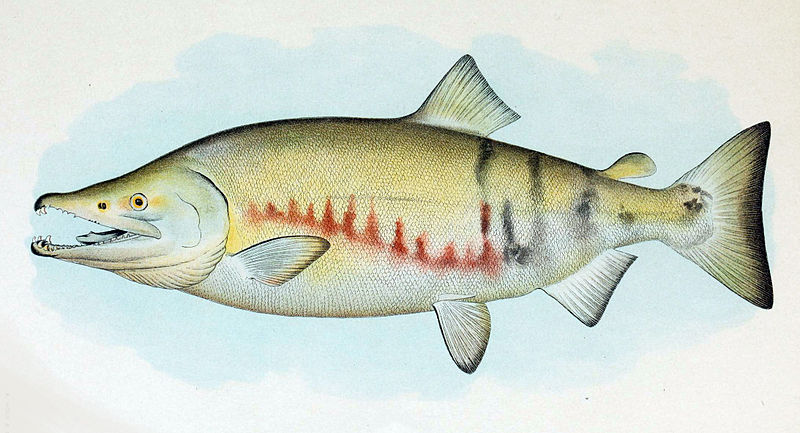
File:Dog_Salmon_Breeding_Male.jpg · Wikimedia Commons · See Wikimedia Commons
chum salmon
Sign in to saveAlso known as Oncorhynchus keta, dog salmon, keta salmon, calico salmon, Salmo keta
species of Pacific salmon
OverviewAI-generated
Chum salmon, also known as koiralohi, is a species of fish classified within the family Salmonidae. Its scientific name is *Oncorhynchus keta*, and it belongs to the genus *Oncorhynchus*. The species is part of the order Salmoniformes, class Teleostei, and phylum Chordata. The taxon was described by Walbaum in 1792 and holds an accepted status in biological records.
This fish inhabits marine, brackish, and freshwater environments. It is categorized as a food product and a subclass of fish as food. The species is distinct from the taxon Keta. Information regarding its life history and habitat is documented by the Alaska Department of Fish and Game.
Synthesized by Vinony from 26 facts across 5 sources: Wikidata, PubMed, Firecrawl, WoRMS, Vinony graph. Generated from structured data (not the Wikipedia text) and checked against those facts — may still contain errors.
In the Vinony graph
Vinony's link graph records 344 inbound references to chum salmon, and connects out to binomial nomenclature, Salmonidae and National Center for Biotechnology Information.
Vinony files it under Cold water fish, Fish described in 1792 and Fish of the North Pacific.
Vinony links it to 42 Wikipedia language editions.
Species
chum salmon
Species
- PhylumChordata
- ClassTeleostei
- OrderSalmoniformes
- FamilySalmonidae
Maximum longevity: 7 years (wild) Observations: As in other members of its genus, these animals age and die shortly after spawning. It is not considered ageing but rather sudden death.
via
Research
765 papers- Pharmacological Activity and Clinical Use of PDRN.Frontiers in pharmacology · 2017
- Insights from a chum salmon (Oncorhynchus keta) genome assembly regarding whole-genome duplication and nucleotide variation influencing gene function.G3 (Bethesda, Md.) · 2023
- Expression of hormone genes and osmoregulation in homing chum salmon: a minireview.General and comparative endocrinology · 2007
- Chum salmon migrating upriver adjust to environmental temperatures through metabolic compensation.The Journal of experimental biology · 2019
- Efficacy of Topical Application of Chum Salmon (Oncorhynchus keta) Skin-derived Collagen Extracts in Improving Oral Traumatic Ulcer Healing.Contemporary clinical dentistry · 2024
via PubMed
Described at

Chum Salmon Species Profile, Alaska Department of Fish and Game
General information about Chum Salmon in Alaska such as description, life history, range, habitat and more.
adfg.alaska.gov →Chum salmon can be found along the Arctic coast of Alaska, Canada, and Russia. Chum salmon, also known as dog salmon, are the most widely distributed of all the Pacific salmon and generally occur throughout Alaska. Like most other Pacific salmon species, chum salmon spend most of their life feeding in saltwater, then return to freshwater when mature to spawn once in the fall then die. Most chum salmon populations do not travel far upstream to spawn; however, some travel up to 2,000 miles upstream to the headwaters of the Yukon River. Although generally regarded as one of the less desirable species of salmon, in Arctic, Northwestern, and Interior Alaska, chum salmon are highly prized as a traditional source of dried winter food. Since the 1980s, commercial chum salmon harvests in Alaska have more than doubled as a result of the Alaska hatchery program and increased foreign sales. During their brief freshwater residency, chum salmon fry have 8–12 vertical, uniformly-shaped and -spaced dark bars (parr marks) typically not extending below the lateral line. Overall color is dark greenish-brown along the back and pale iridescent green below the lateral line. Since they commonly migrate to sea soon after hatching, juvenile chum salmon are usually only 1–2 inches long by the time they leave freshwater. Ocean-stage chum salmon are metallic bluish-green along the back and above the lateral line with profuse tiny speckles often present, though not resembling the larger spots of Chinook, coho, or pink salmon. The tail is highly forked, more so than other species of Pacific salmon, and is not spotted. The tail also has silver streaks along (but not between) the fin rays. As adult chum salmon enter fresh water to spawn, both sexes’ color and appearance change dramatically. Males lose their silvery appearance and take on a dark olive to brown coloration with red to purple wavy vertical stripes. They develop a hooked snout (kype) lined with large canine-like teeth. Females become brown to grey colored with a broad dark horizontal bar running along the lateral line. Females also develop kypes and canine-like teeth, though less noticeably than males. Chum salmon, also known as dog salmon, are the most widely distributed of all the Pacific salmon and generally occur throughout Alaska. Like most other Pacific salmon species, chum salmon spend most of their life feeding in saltwater, then return to freshwater when mature to spawn once in the fall then die. Most chum salmon populations do not travel far upstream to spawn; however, some travel up to 2,000 miles upstream to the headwaters of the Yukon River. Although generally regarded as one of the less desirable species of salmon, in Arctic, Northwestern, and Interior Alaska, chum salmon are highly prized as a traditional source of dried winter food. Since the 1980s, commercial chum salmon harvests in Alaska have more than doubled as a result of the Alaska hatchery program and increased foreign sales. During their brief freshwater residency, chum salmon fry have 8–12 vertical, uniformly-shaped and -spaced dark bars (parr marks) typically not extending below the lateral line. Overall color is dark greenish-brown along the back and pale iridescent green below the lateral line. Since they commonly migrate to sea soon after hatching, juvenile chum salmon are usually only 1–2 inches long by the time they leave freshwater. Ocean-stage chum salmon are metallic bluish-green along the back and above the lateral line with profuse tiny speckles often present, though not resembling the larger spots of Chinook, coho, or pink salmon. The tail is highly forked, more so than other species of Pacific salmon, and is not spotted. The tail also has silver streaks along (but not between) the fin rays. As adult chum salmon enter fresh water to spawn, both sexes’ color and appearance change dramatically. Males lose their silvery appearance and take on a dark olive to brown coloration with red to purple wavy vertica
Excerpt from a page describing this subject · 15,373 chars · not written by Vinony
Wikidata facts
- Instance of
- food product
- Subclass of
- fish as food
- Parent taxon
- Oncorhynchus
- Image
- 202406 Chum salmon.svg
Show 6 more facts
- taxon rank
- species
- Commons category
- Oncorhynchus keta
- taxon name
- Oncorhynchus keta
- described at URL
- spsseg.org/meet-the-7-species-of-pacific-salmon
- different from
- Keta
- taxon common name
- losos keta
Sources (2)
via Wikidata · CC0
~7 min read
Encyclopedic overview
The chum salmon (Oncorhynchus keta), also known as dog salmon or keta salmon, is a species of anadromous salmonid fish from the genus Oncorhynchus (Pacific salmon) native to the coastal rivers of the North Pacific and the Beringian Arctic. The English name "chum salmon" comes from the Chinook Jargon term tsəm, meaning "spotted" or "marked"; while keta in the scientific name comes from Russian, which in turn comes from the Evenki language of Eastern Siberia.
In Japan, chum salmon is also known as the white salmon (白鮭 シロサケ, shiro sake), autumn salmon (秋鮭 アキサケ, aki sake) or simply "the salmon" (鮭 サケ, sa ke), while historically it was known in kun'yomi as "stone katsura fish" (石桂魚 さけ, sa ke) up until the Meiji period. In Greater China, it is known academically as the "hook-snout salmon" (Chinese: 钩吻鲑), but is more often called the damaha fish (simplified Chinese: 大马哈鱼; traditional Chinese: 大麻哈魚), which is borrowed from dawa ịmaχa, the Nanai name of the fish used by the Hezhe minority in northern Northeast China.
Excerpted from Wikipedia’s “chum salmon” article, available under the CC BY-SA 4.0 licence.