Encyclopedia of Life · EOL (see source)
Clianthus
Sign in to saveAlso known as Kakabeak
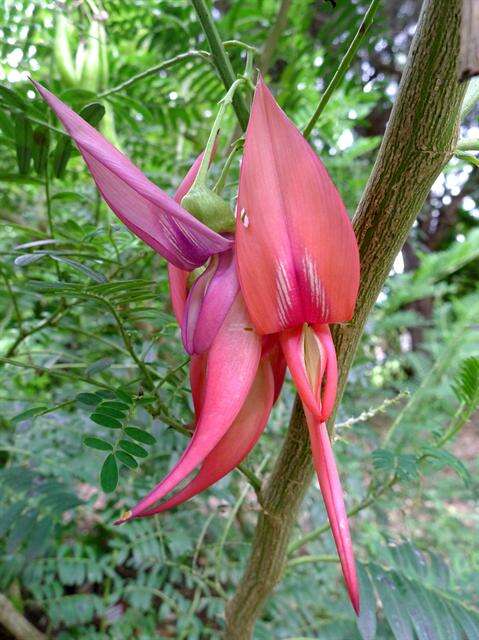
Clianthus, commonly known as kaka beak (kōwhai ngutukākā in Māori), is a genus of flowering plants in the legume family Fabaceae, comprising two species of shrubs endemic to the North Island of New Zealand. They have striking clusters of red flowers which resemble the beak of the kākā, a New Zealand parrot. The plants are also known as '''parrot's beak, parrot's bill and lobster claw''' – all references to the distinctive flowers. There is also a variety with white to creamy coloured flowers called: "Albus", and a variety with rosy pink flowers called: "Roseus".
Species
GENUS
- KingdomPlantae
- PhylumTracheophyta
- ClassMagnoliopsida
- OrderFabales
- FamilyFabaceae
Clianthus es un género de plantas con flores perteneciente a la familia Fabaceae. Índice 1 Descripción 2 Especies 3 Taxonomía 4 Referencias 5 Bibliografía 6 Enlaces externos Descripción Alcanzan un tamaño de alrededor de dos metros de altura, con ramas extendidas que producen tallos de las hojas de hasta 15 cm de largo que lleva varios pares de pequeños foliolos. Por lo general, la flor aparece desde la primavera hasta principios de verano, pero puede florecer dos veces al año o incluso durante todo el año.[2] Especies Clianthus puniceus Clianthus maximus Taxonomía El género fue descrito por Sol. ex Lindl. y publicado en Edwards's Botanical Register 21: pl. 1775. 1835.[3]> Referencias ↑ «Clianthus». Departamento de Agricultura de los Estados Unidos: Germplasm Resources Information Network (GRIN). Archivado desde el original el 28 de mayo de 2010. Consultado el 7 de diciembre de 2010. ↑ "Kakabeak", pp. 168-169 in Gerard Hutching's The Natural World of New Zealand, Penguin Books (NZ) Ltd, 1998. ISBN 0-670-87782-4 ↑ «Clianthus». Tropicos.org. Jardín Botánico de Misuri. Consultado el 8 de agosto de 2014. Bibliografía CONABIO. 2009. Catálogo taxonómico de especies de México. 1. En
via GBIF · Kew POWO
Museum specimens
- Specimen records
- 11
- With media
- 10
- Family
- Fabaceae
- Collections
- BRIT, MO, NO, MEL, VT, YPM
- Recorded in
- United States, Colombia, Mexico, New Zealand, Australia
Wikidata facts
- Instance of
- taxon
- Image
- Clianthus puniceus.jpg
Show 6 more facts
- Commons category
- Clianthus
- taxon name
- Clianthus
- taxon rank
- genus
- topic's main category
- Category:Clianthus
- taxon common name
- 耀花豆属
Sources (3)
via Wikidata · CC0
~3 min read
Encyclopedic overview
5 sectionsContents
- Description and taxonomy
- History
- Gallery
- References
- External links
Clianthus, commonly known as kaka beak (kōwhai ngutukākā in Māori), is a genus of flowering plants in the legume family Fabaceae, comprising two species of shrubs endemic to the North Island of New Zealand. They have striking clusters of red flowers which resemble the beak of the kākā, a New Zealand parrot. The plants are also known as '''parrot's beak, parrot's bill and lobster claw' – all references to the distinctive flowers. There is also a variety with white to creamy coloured flowers called: "Albus", and a variety with rosy pink flowers called: "Roseus".
==Description and taxonomy== Kakabeak grows to around two metres high, with spreading branches producing leaf stalks up to 15 cm long bearing several pairs of small leaflets. They usually flower from spring through to early summer, but can flower twice a year or even year round.
Excerpted from Wikipedia’s “Clianthus” article, available under the CC BY-SA 4.0 licence.
Gallery (3)
Available in 15 languages
- Español
- 中文
- Русский
- Português
- العربية
- Azerbaijani
- Czech
- Finnish
- Nederlands
- Polski
- Sindhi
- Tiếng Việt
- Türkçe
- Ukrainian
via Wikidata sitelinks · CC0