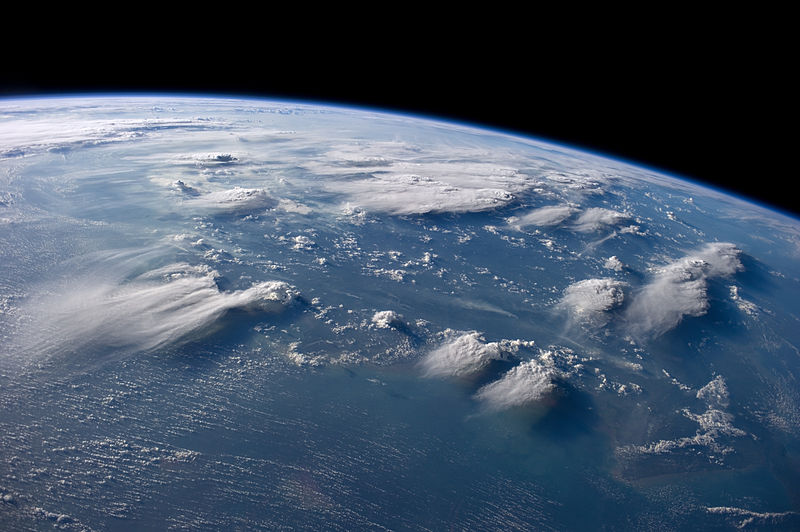
File:ISS-40_Thunderheads_near_Borneo.jpg · Wikimedia Commons · See Wikimedia Commons
cloud
Sign in to saveAlso known as clouds
alt=|thumb|upright=1.5|Cloudscape over Borneo, taken by the [[International Space Station]]
A cloud is a visible collection of water droplets or ice crystals that forms in the atmosphere when water vapor condenses, typically appearing as white or gray masses in the sky. Clouds are important because they play a key role in Earth's weather and climate by storing and moving water around the planet, reflecting sunlight, and trapping heat.
AI-generated from the Wikipedia summary — may contain errors.
Wikidata facts
- Subclass of
- Weather
- Material used
- ice crystal
- Image
- Clouds in the sky and sun.jpg
Show 9 more facts
- Commons category
- Clouds
- topic's main category
- Category:Clouds
- Unicode character
- ☁
- Commons gallery
- Cloud
- on focus list of Wikimedia project
- WikiProject Climate change
- has effect
- sun dog
- studied by
- nephology
- exact match
- purl.obolibrary.org/obo/ENVO_01000760
- Digital Atlas of Idaho URL
- digitalatlas.cose.isu.edu/clima/imaging/cldfr.htm
via Wikidata · CC0
~65 min read
Encyclopedic overview
45 sectionsContents
- Etymology
- Homospheric nomenclatures and cross-classification
- History of cloud science
- Formation
- Adiabatic cooling
- Non-adiabatic cooling
- Adding moisture to the air
- Tropospheric classification
- Levels and genera
- High-level
- Mid-level
- Low-level
- Multi-level or moderate vertical
- Towering vertical
- Species
- Stable or mostly stable
- Ragged
- Partly unstable
- Unstable or mostly unstable
- Varieties
- Opacity-based
- Pattern-based
- Combinations
- Other types
- Precipitation-based supplementary features
- Cloud-based supplementary features
- Accessory clouds
- Mother clouds
- Other genitus and mutatus clouds
- Large scale patterns
- Stratocumulus fields
- Vortex streets
- Distribution
- Convergence along low-pressure zones
- Divergence along high pressure zones
- Luminance, reflectivity, and coloration
- Effects
- Stratospheric classification and distribution
- Mesospheric classification and distribution
- Extraterrestrial
- In culture and religion
- See also
- References
- Bibliography
- External links
alt=|thumb|upright=1.5|Cloudscape over Borneo, taken by the [[International Space Station]]
In meteorology, a cloud is an aerosol consisting of a visible mass of miniature liquid droplets, ice crystals, or other particles, suspended in the atmosphere of a planetary body or similar space. Water, primarily, comprises the droplets and crystals. On Earth, clouds are formed as a result of saturation of the air when it is cooled to its dew point, or when it gains sufficient moisture, usually in the form of water vapor, from an adjacent source to raise the dew point to the ambient temperature.
Excerpted from Wikipedia’s “cloud” article, available under the CC BY-SA 4.0 licence.
Gallery (52)
Available in 201 languages
- Español
- Français
- Deutsch
- 中文
- 日本語
- Русский
- Português
- Italiano
- العربية
- हिन्दी
- Afrikaans
- Akan
- Albanian
- Albanian
- Amharic
- Angika
- Aragonese
- Aramaic
Show 182 more
- Armenian
- Assamese
- Asturian
- Atikamekw
- Avaric
- Awadhi
- Aymara
- azb
- Azerbaijani
- Bahasa Indonesia
- Bangla
- Banjar
- Bashkir
- Basque
- bat_smg
- Batak Toba
- Bavarian
- be_x_old
- Belarusian
- Betawi
- Bhojpuri
- Bikol
- Bosnian
- Breton
- Bulgarian
- Buriat
- Burmese
- Catalan
- cdo
- Cebuano
- Central Kurdish
- Chechen
- Cherokee
- Chuvash
- Cornish
- Corsican
- Croatian
- Czech
- Danish
- dty
- Egyptian Arabic
- eml
- Erzya
- Esperanto
- Estonian
- Extremaduran
- Fiji Hindi
- Fijian
- Filipino
- Finnish
- fiu_vro
- Fon
- Friulian
- Galician
- gcr
- Georgian
- Greek
- Guarani
- Gujarati
- Haitian Creole
- Hakka Chinese
- Hausa
- Hebrew
- Hungarian
- hyw
- Iban
- Icelandic
- Ido
- Iloko
- Interlingua
- Interlingue
- Inuktitut
- Irish
- Jamaican Creole English
- Javanese
- Kannada
- Karachay-Balkar
- Kashmiri
- Kazakh
- kbp
- Kurdish
- Kyrgyz
- Latin
- Latvian
- Ligurian
- Limburgish
- Lingala
- Lingua Franca Nova
- Lithuanian
- Lojban
- Lombard
- Low German
- Luxembourgish
- Macedonian
- Maithili
- Malagasy
- Malay
- Malayalam
- Manipuri
- Manx
- Marathi
- Minangkabau
- Mingrelian
- Moksha
- Mongolian
- nah
- Neapolitan
- Nederlands
- Nepali
- Newari
- Northern Frisian
- Northern Sotho
- Norwegian
- Norwegian Nynorsk
- nrm
- Obolo
- Occitan
- Odia
- Old English
- Papiamento
- Pashto
- Pennsylvania German
- Picard
- Polski
- Punjabi
- Quechua
- roa_rup
- Romanian
- Rusyn
- Santali
- Saterland Frisian
- Scots
- Scottish Gaelic
- Serbian
- Serbian (Latin)
- Shan
- Sicilian
- simple
- Sindhi
- Slovak
- Slovenian
- Somali
- Sundanese
- Svenska
- Swahili
- syl
- szy
- Tachelhit
- Tajik
- Tamil
- Tatar
- tdd
- Telugu
- Tibetan
- Tiếng Việt
- Türkçe
- Tuvinian
- Ukrainian
- Urdu
- Uyghur
- Uzbek
- Venetian
- Veps
- Volapük
- Walloon
- Waray
- Welsh
- Western Frisian
- Western Panjabi
- Wu Chinese
- Xhosa
- Yakut
- Yiddish
- Zaza
- zh_classical
- zh_min_nan
- zh_yue
- Zhuang
- Zulu
- فارسی
- ไทย
- 한국어
via Wikidata sitelinks · CC0