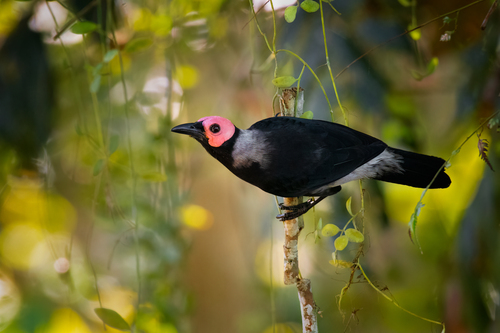
(c) Domzjuniorwildlife, some rights reserved (CC BY-SA) · cc-by-sa
Coleto
Sign in to saveAlso known as Sarcops calvus
The coleto (Sarcops calvus) is a starling species (family Sturnidae) in the monotypic genus Sarcops. It is endemic to the Philippines. Its natural habitats are tropical dry forest, tropical moist lowland forest, and tropical moist montane forest. In Filipino and Tagalog, this bird is known as kuling or koleto, while in Central Visayas, it is commonly known as the sal-ing.
Species
Least ConcernColeto
species
via IUCN
Wikidata facts
Show 7 more facts
- taxon rank
- species
- IUCN conservation status
- Least Concern
- Commons category
- Sarcops calvus
- taxon name
- Sarcops calvus
- endemic to
- Philippines
- taxon common name
- mainato-calvo
- short name
- S. calvus
Sources (3)
via Wikidata · CC0
~3 min read
Encyclopedic overview
6 sectionsContents
- Description and taxonomy
- Subspecies
- Ecology and behavior
- Habitat and conservation status
- References
- External links
The coleto (Sarcops calvus) is a starling species (family Sturnidae) in the monotypic genus Sarcops. It is endemic to the Philippines. Its natural habitats are tropical dry forest, tropical moist lowland forest, and tropical moist montane forest. In Filipino and Tagalog, this bird is known as kuling or koleto, while in Central Visayas, it is commonly known as the sal-ing.
== Description and taxonomy == EBird describes the bird as " A fairly large bird of forest canopy and more open wooded areas from the lowlands to low elevations in the mountains. Often seen on exposed snags. Pale gray from the back of the neck down the back to the rump and the sides. The rest of the underparts and wings are black. Head mostly covered with bare pink skin. Unmistakable. Voice includes a mixture of clicks, squeals, metallic warbling, and piping notes."thumb|A captive coleto|leftIn 1760 the French zoologist Mathurin Jacques Brisson included a description of the coleto in his Ornithologie based on a specimen collected in the Philippines. He used the French name Le merle chauve des Philippines and the Latin Mname "erula Calva Philippensis. Although Brisson coined Latin names, these do not conform to the binomial system and are not recognised by the International Commission on Zoological Nomenclature. WI 1766 , when the Swedish naturalist Carl Linnaeus updated his Systema Naturae for the twelfth edition, he added 240 species that had been previously described by Brisson. One of these was the coleto. Linnaeus included a brief description, coined the binomial name Gracula calva and cited Brisson's work. The specific name is from Latin calvus "bald" or "without hair". This species is now the only member of the genus Sarcops that was introduced by the English ornithologist Arthur Walden in 1875. The name combines the Ancient Greek words sarx, sarkos "flesh" and ōps, ōpos "face" or "complexion".
Excerpted from Wikipedia’s “Coleto” article, available under the CC BY-SA 4.0 licence.