
Columbus Day
Sign in to saveAlso known as Indigenous People's Resistance Day, Indigenous Peoples and Intercultural Dialogue Day, Native American Day, Discoverers' Day, Indigenous Peoples' Day, North American First People's Day
Columbus Day is a national holiday in many countries of the Americas and elsewhere, and a federal holiday in the United States, which officially celebrates the anniversary of Christopher Columbus's arrival in the Americas. He went ashore at Guanahaní, an island in the Bahamas, on October 12, 1492 [OS]. He built La Navidad on the northwestern coast of the island of Hispaniola in late December 1492, the first European fort in the Americas. After the destruction of the fort by the indigenous Taíno people, Columbus established La Isabela on the central-northern coast of the island in late December 1493, the first stable European settlement in the Americas.
In the Vinony graph
Within Vinony's link graph, Columbus Day is referenced by 657 other articles, and connects out to The Bahamas, European colonization of the Americas and Italian Americans.
Vinony files it under Autumn in the United States, Christianity-related controversies and Christopher Columbus.
Its subject is documented across 36 Wikipedia language editions.
Wikipedia views (30d)
13,421 totalvia Wikimedia Pageviews API
Key facts
- Observed by
- Various countries in the Americas, Italy, Spain, various barrios around the world, various Little Italys around the world
- Type
- Historical
- Significance
- Celebrations honoring Christopher Columbus ' arrival in the Americas in 1492 Recognize contributions of Americans of Hispanic descent and Italian descent
- Date
- October 12 (actual/traditional); second Monday in October (United States)
- 2025 date
- October 13 (United States)
- 2026 date
- October 12 (United States)
- 2027 date
- October 11 (United States)
- 2028 date
- October 9 (United States)
- Frequency
- Annual
via Wikipedia infobox
Described at
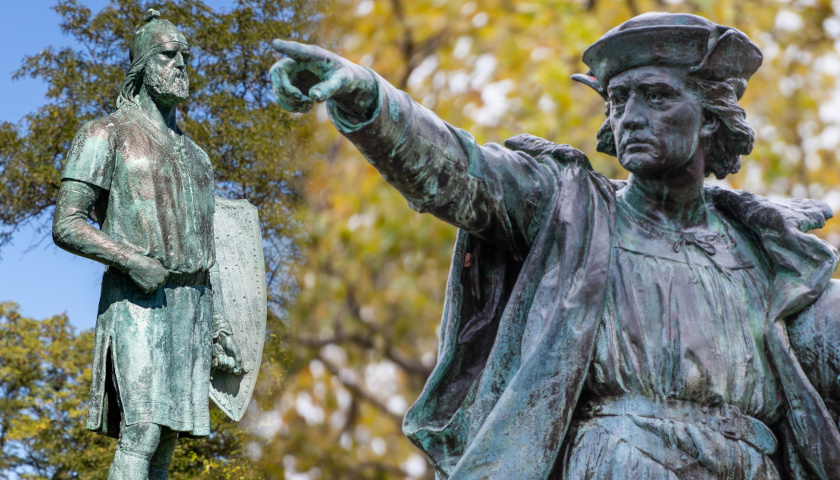
Trump Issues Dual Proclamations Honoring Columbus Day, Leif Erikson, Condemns Efforts to 'Erase History' - Tennessee Star
President Trump issued dual proclamations honoring Columbus and Leif Erikson, denouncing efforts to erase explorers from American history.
tennesseestar.com →President Donald J. Trump issued two presidential proclamations Thursday morning, reaffirming Columbus Day as a celebration of faith and discovery while also honoring Leif Erikson , the Viking explorer credited with reaching North America more than 500 years before Christopher Columbus. The dual proclamations marked a sweeping tribute to the spirit of exploration and Western civilization, as well as a rebuke of efforts to erase or defame historical figures whose legacies shaped the modern world. In his Columbus Day proclamation , Trump declared October 13, 2025, as a day to “reclaim” Columbus’s legacy from what he described as “left-wing arsonists” who have “sought to destroy his name and dishonor his memory.” He praised the Italian navigator as “the original American hero” and “one of the most gallant and visionary men to ever walk the face of the earth,” detailing his 1492 transatlantic voyage as a triumph of faith and courage that “carried thousands of years of wisdom, philosophy, reason, and culture across the Atlantic into the Americas.” “Outrageously, in recent years, Christopher Columbus has been a prime target of a vicious and merciless campaign to erase our history, slander our heroes, and attack our heritage,” Trump said . “Before our very eyes, left-wing radicals toppled his statues, vandalized his monuments, tarnished his character, and sought to exile him from our public spaces. He added, “Under my leadership, those days are finally over — and our Nation will now abide by a simple truth: Christopher Columbus was a true American hero.” The proclamation comes five years after a wave of statue removals and vandalism swept through major American cities in 2020, when demonstrators targeted Columbus monuments amid broader protests over what organizers perceived as historical injustice. In Baltimore, protesters pulled down a Columbus statue on Independence Day and dumped it into the Inner Harbor. In Denver, activists toppled a monument in front of the state capitol, and in Columbia, South Carolina, city officials ordered their statue removed after repeated vandalism. In San Francisco, the statue near Coit Tower was taken down by city crews and remains in storage to this day. In January 2019, The Tennessee Star reported that the University of Notre Dame moved to cover a series of historical Columbus murals – originally painted in the 1880s to celebrate immigrant Catholics – after critics argued the works failed to reckon with the consequences of Columbus’s arrival for Indigenous peoples. In June 2020, Detroit Mayor Mike Duggan ordered the city’s Columbus bust to be removed and placed into storage after it was defaced with protest signage. Two years later, a Philadelphia court’s ruling forced city officials to uncover a Columbus statue they had boxed off during the unrest, saying the city’s concealment unlawful and politically motivated. Protesters’ targets during that period extended well beyond Columbus, encompassing statues of Founding Fathers, Confederate figures, and other historic leaders. Trump’s Columbus Day proclamation also honored the contributions of Italian Americans and reaffirmed U.S. ties with Italy. “To this day, the United States and Italy share a special bond rooted in the timeless values of faith, family, and freedom,” he said . “My Administration looks forward to strengthening our long and storied friendship in the years to come.” The proclamation concludes by directing that American flags be flown on all public buildings on Columbus Day to honor “the great Christopher Columbus and all who have contributed to building our Nation.” Later Thursday morning, Trump issued a separate proclamation recognizing Leif Erikson Day, honoring the Norse Viking explorer widely believed to have been the first European to set foot in the New World around the year 1000. The president described Erikson as a man of “deep Christian faith” whose daring expedition “forever changed the course of history.” “More than a
Excerpt from a page describing this subject · 14,655 chars · not written by Vinony
Wikidata facts
- Instance of
- anniversary
- Named after
- Christopher Columbus
- Country
- Venezuela
- Image
- Columbus-day.jpg
Show 4 more facts
- Commons category
- Columbus Day
- commemorates
- first arrival of Christopher Columbus to America
- different from
- Indigenous People's Day
Sources (2)
via Wikidata · CC0
~29 min read
Encyclopedic overview
Columbus Day is a national holiday in many countries of the Americas and elsewhere, and a federal holiday in the United States, which officially celebrates the anniversary of Christopher Columbus's arrival in the Americas. He went ashore at Guanahaní, an island in the Bahamas, on October 12, 1492 [OS]. He built La Navidad on the northwestern coast of the island of Hispaniola (near present-day Caracol, Nord-Est Department, Haiti) in late December 1492, the first European fort in the Americas. After the destruction of the fort by the indigenous Taíno people, Columbus established La Isabela on the central-northern coast of the island (now present-day Dominican Republic) in late December 1493, the first stable European settlement in the Americas.
Christopher Columbus (Italian: Cristoforo Colombo [kriˈstɔːforo koˈlombo]) was an Italian explorer from Genoa who led a Spanish maritime expedition to cross the Atlantic Ocean in search of an alternative route to the Far East. Columbus believed he sailed his crew to the East Indies, but Europeans realized years later that his voyages landed them in the New World. His first voyage to the New World was made on the Spanish ships Niña, Pinta, and Santa María and took about three months. The crew's arrival in the New World initiated the colonization of the Americas by Spain, followed in the ensuing centuries by other European powers, as well as the transfer of plants, animals, culture, human populations, and technology between the New and Old Worlds, an event referred to by some late 20th‐century historians as the Columbian exchange.
Excerpted from Wikipedia’s “Columbus Day” article, available under the CC BY-SA 4.0 licence.