File:Malpaga10.JPG · Wikimedia Commons · See Wikimedia Commons
condottiero
Sign in to saveAlso known as condottiere, condottieri, venture captain, venture captains
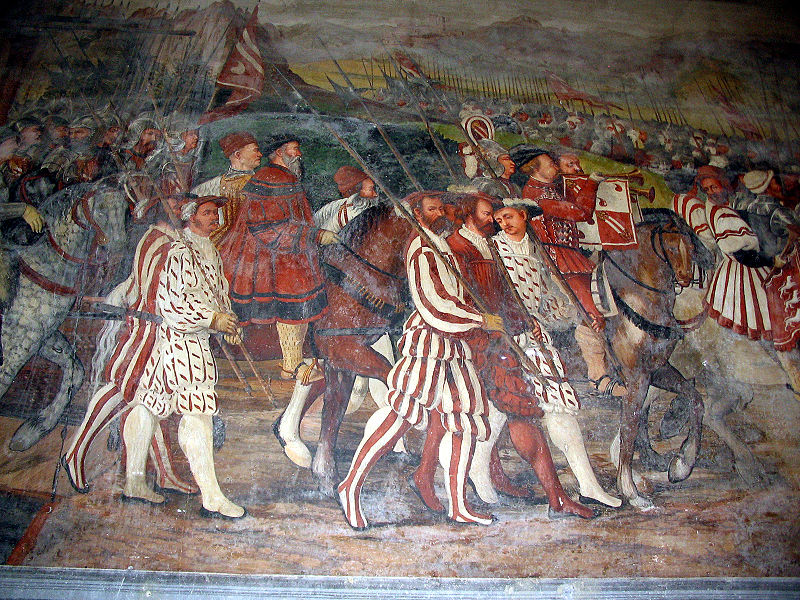
thumb|Condottiero and his troops in a Renaissance-era [[fresco, influenced by Landsknecht mercenary fashion]] Condottieri (; singular: condottiero or condottiere) were Italian military leaders active during the Middle Ages and the early modern period. The term originally referred specifically to commanders of mercenary companies, derived from the Italian word condotta—the contract under which they served a city-state or lord. The word condottiero thus meant 'contractor'. Over time, however, in Italian usage, condottiero came to mean any 'commander' or 'military leader'.
Wikidata facts
- Instance of
- position
- Image
- Artemisia Gentileschi Condottiero Bologna.jpg
Show 7 more facts
- female form of label
- קונדוטיירו
- Commons category
- Condottieri
- topic's main category
- Category:Condottieri
- described by source
- Encyclopædia Britannica 11th edition
- male form of label
- condotier
- different from
- military leader
Sources (1)
via Wikidata · CC0
~14 min read
Encyclopedic overview
8 sectionsContents
- Mercenary captains
- Background
- Rise
- List
- Evolution of the term
- References
- Sources
- External links
thumb|Condottiero and his troops in a Renaissance-era [[fresco, influenced by Landsknecht mercenary fashion]] Condottieri (; singular: condottiero or condottiere) were Italian military leaders active during the Middle Ages and the early modern period. The term originally referred specifically to commanders of mercenary companies, derived from the Italian word condotta—the contract under which they served a city-state or lord. The word condottiero thus meant 'contractor'. Over time, however, in Italian usage, condottiero came to mean any 'commander' or 'military leader'.
==Mercenary captains== ===Background=== In the 13th and 14th centuries, the Italian city-states of Venice, Florence, and Genoa were very rich from their trade with the Levant, yet possessed woefully small armies. In the event that foreign powers and envious neighbours attacked, the ruling nobles hired foreign mercenaries to fight for them. The military-service terms and conditions were stipulated in a (contract) between the city-state and the soldiers (officers and enlisted men), thus, the "contracted" leader, the mercenary captain commanding, was titled the "Condottiere".
Excerpted from Wikipedia’s “condottiero” article, available under the CC BY-SA 4.0 licence.