
OverviewAI-generated
Cuba, officially the Republic of Cuba, is a country in the Caribbean subregion of the Americas. Its capital is Havana. The nation is located in North America and has a total area of 109884. The official language is Spanish. The currency used is the Cuban peso and the convertible peso. The license plate code is C.
Population figures vary by source, with estimates including 11484636, 9748007, and 10979783. The urban population percentage is 77.1664929228275. The life expectancy is 78.264 years. The unemployment rate is 1.746 percent. Internet users comprise 70.47699738 percent of the population. The gross domestic product is 107352000000 USD. Forest area accounts for 31.233140655106 percent of the land, with renewable energy at 20.9 percent.
The legislative body is the National Assembly of People's Power. The head of government holds the office of Prime Minister of Cuba. Diplomatic relations exist with Brazil, Russia, Germany, and Cape Verde. The inception date is recorded as 1898-12-10. The top-level domain is .cu. The flag and Unicode character are 🇨🇺.
Synthesized by Vinony from 67 facts across 9 sources: Wikidata, REST Countries, Openweathermap, Open Meteo, World Bank, OpenStreetMap, PubMed, Vinony graph, Geo. Generated from structured data (not the Wikipedia text) and checked against those facts — may still contain errors.
Weather now
7-day forecast
via Open-Meteo
Country

- Capital
- Havana
- Population
- 9,748,007
- Region
- Americas · Caribbean
- Demonym
- Cuban
- Currencies
- CUC ($), CUP ($)
- Languages
- Spanish
- Calling code
- +53
- Drives on
- Right
- FIFA code
- CUB
- TLD
- .cu
- Timezones
- UTC-05:00
via REST Countries
Indicators · World Bank
- GDP
- $107.4B(2020)
- Population
- 10,979,783(2024)
- Life expectancy
- 78.3 yrs(2024)
- Unemployment
- 1.7 %(2025)
- Urban population
- 77.2 %(2024)
- Internet users
- 70.5 %(2024)
- Forest area
- 31.2 %(2023)
- Renewable energy
- 20.9 %(2021)
via World Bank Open Data · CC BY 4.0
Place details
- Locality
- Manicaragua
- Country
- Cuba
- Population
- 11,338,138
- Timezone
- America/Havana
via OpenStreetMap · GeoNames
Wikipedia views (30d)
246,799 totalvia Wikimedia Pageviews API
Key facts
- Country.HDI_rank
- 97th
- Country.HDI_change
- decrease
- Country.conventional_long_name
- Republic of Cuba
- Country.common_name
- Cuba
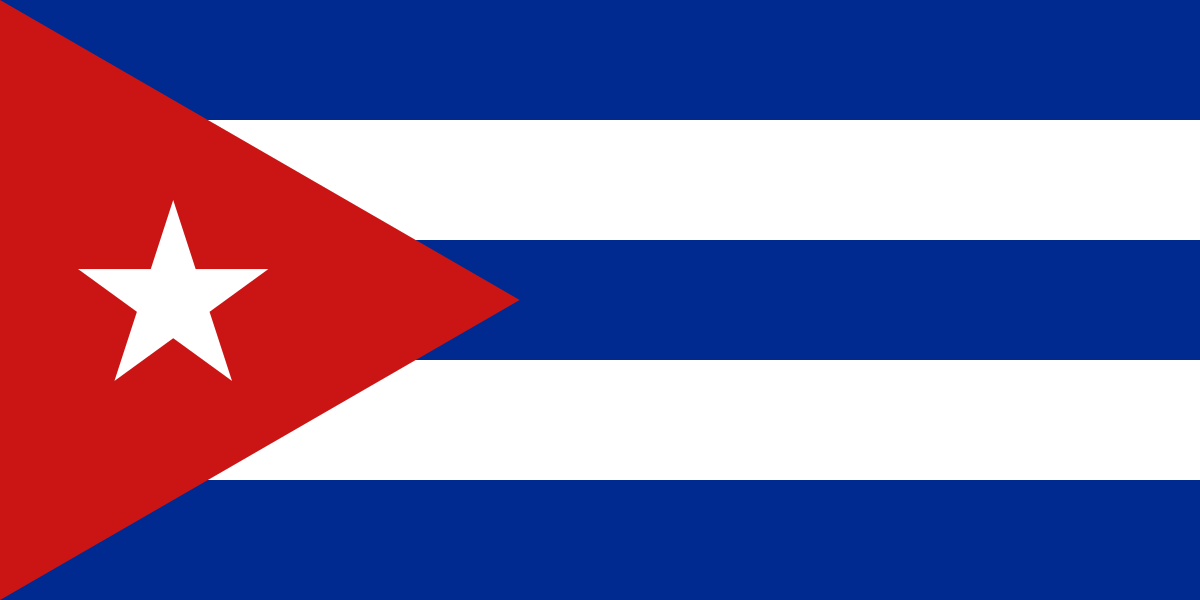
- Country.image_flag
- Flag of Cuba.svg
- Country.image_coat
- Coat of arms of Cuba.svg
- Country.alt_coat
- A shield in front of a Fasces crowned by the Phrygian Cap, all supported by an oak branch and a laurel wreath
- Country.symbol_type
- Coat of arms
- Country.national_motto
- ("Homeland or Death, We Shall Overcome!")
- Country.image_map
- CUB orthographic.svg
- Country.map_width
- 250px
- Country.map_caption
- Cuba, shown in dark green
- Country.capital
- Havana
- Country.largest_city
- capital
- Country.official_languages
- Spanish
- Country.religion_year
- 2020
- Country.demonym
- Cuban
- Country.government_type
- Communist state
via Wikipedia infobox
Research
21,018 papers- Cuba.Department of State publication. Background notes series · 1985United States. Department of State. Bureau of Public Affairs
- Cuba y seguridad sanitaria mundial: Cuba's role in global health security.ReviewBMJ global health · 2020Wenham C, Kittelsen SKDOI: 10.1136/bmjgh-2019-002227
- Oropouche Fever, Cuba, May 2024.Emerging infectious diseases · 2024Benitez AJ, Alvarez M, Perez L et al.DOI: 10.3201/eid3010.240900
- Cuba-U.S. scientific collaboration: Beyond the embargo.PloS one · 2021Ronda-Pupo GADOI: 10.1371/journal.pone.0255106
- Toxocariasis in Cuba: a literature review.ReviewPLoS neglected tropical diseases · 2012Sariego I, Kanobana K, Rojas L et al.DOI: 10.1371/journal.pntd.0001382
- Cuba's doctors-abroad programme comes under fire.Lancet (London, England) · 2019Alves LDOI: 10.1016/S0140-6736(19)32214-7
- COVID-19 and Cancer in Cuba.Seminars in oncology · 2020Rubio MC, Sanchez L, Abreu-Ruíz G et al.DOI: 10.1053/j.seminoncol.2020.07.009
- Fascioliasis: can Cuba conquer this emerging parasitosis?ReviewTrends in parasitology · 2010Rojas L, Vazquez A, Domenech I et al.DOI: 10.1016/j.pt.2009.10.005
via PubMed
Wikidata facts
- Instance of
- country
- Part of
- Latin America
- Official name
- la République de Cuba
- Demonym
- Kubanka
- Country
- Cuba
- Contains
- Cienfuegos Province
- Continent
- North America
- Capital
- Havana
- Official language
- Spanish
- Currency
- convertible peso
- Population
- 10985974
- Area
- 109884
- Body of water
- Gulf of Mexico
- Head of government
- Manuel Marrero Cruz
- Head of state
- Fidel Castro
- Form of government
- unitary state
- Legislature
- National Assembly of People's Power
- Anthem
- El Himno de Bayamo
- Shares border with
- United Kingdom
- Highest point
- Pico Turquino
- Follows
- Captaincy General of Cuba
- Official website
- www.cuba.cu
- Image
- Santa Clara (Cuba).jpg
- Life expectancy
- 78
Show 66 more facts
- Unemployment rate
- 1.2
- Calling code
- +53
- Licence plate code
- C
- Mains voltage
- 110
- Motto
- Autentica Cuba
- Flag
- flag of Cuba
- Coat of arms
- coat of arms of Cuba
- topic's main Wikimedia portal
- Portal:Cuba
- Unicode character
- 🇨🇺
- category of associated people
- Category:Cuban people
- different from
- Cuba
- geography of topic
- geography of Cuba
- office held by head of government
- Prime Minister of Cuba
- number of out-of-school children
- 163813
- diplomatic relation
- Hungary
- inception
- 1898-12-10
- Commons gallery
- Cuba
- trunk prefix
- 0
- history of topic
- history of Cuba
- marriageable age
- 16
- on focus list of Wikimedia project
- Wikipedia:Vital articles/Level/4
- twinned administrative body
- Santa Fe
- mobile country code
- 368
- total fertility rate
- 1.615
- maritime identification digits
- 323
- topic's main category
- Category:Cuba
- central bank
- Central Bank of Cuba
- category for people buried here
- Category:Burials in Cuba
- age of majority
- 18
- GS1 country code
- 850
- category for films shot at this location
- Category:Films shot in Cuba
- category for people who died here
- Category:Deaths in Cuba
- office held by head of state
- President of Cuba
- Commons category
- Cuba
- top-level Internet domain
- .cu
- category for people born here
- Category:Births in Cuba
- driving side
- right
- lowest point
- Caribbean Sea
- maintained by WikiProject
- WikiProject Cuba
- language used
- Lucumí
- suicide rate
- 17.4
- culture
- culture of Cuba
- native label
- República de Cuba
- BTI Status Index
- 3.7
- BTI Governance Index
- 4.46
- economy of topic
- economy of Cuba
- replaces
- Republic of Cuba
- demographics of topic
- demographics of Cuba
- Democracy Index
- 2.84
- Human Development Index
- 0.764
- hashtag
- Cuba
- P12749
- Domingo Santa María
- birth rate
- 8.889
- male population
- 5562694
- death rate
- 9.852
- rural population
- 2533843
- female population
- 5649497
- urban population
- 8678348
- P8168
- Zahavi
- highest judicial authority
- People's Supreme Court of Cuba
- executive body
- Council of Ministers
- located in/on physical feature
- Caribbean
- most populous urban area
- Havana
- position held by head of the organization
- First Secretary of the Communist Party of Cuba
- party chief representative
- Miguel Díaz-Canel
Sources (15)
via Wikidata · CC0
Travel guide
Understand
Before the 1959 Cuban Revolution, Cuba was a popular tourist destination for U.S. citizens, largely due to its vibrant nightlife, casinos, and beaches. Many of the casinos were operated by American organized crime groups, and the country became a playground for wealthy visitors. The government of Fulgencio Batista, the military dictator in power at the time, was criticized for neglecting the welfare of many Cuban citizens while fostering close ties with U.S. businesses and investors. American companies owned significant portions of Cuban land and industry, and many wealthy Americans maintained vacation homes on the island.
Following the Revolution, Cuba underwent significant changes. The new revolutionary government nationalized foreign-owned properties, leading to strained relations with the United States. In response, the U.S. imposed a trade and economic embargo (referred to in Cuba as el bloqueo, or "the blockade") that remains in place to this day. However, since 2009, U.S. citizens with family in Cuba have been permitted to visit the island under specific conditions.
After 1959, tourism in Cuba primarily catered to domestic visitors, and many facilities fell into disrepair. This changed in the 1990s when the collapse of the Soviet Union, a key ally and financial supporter, forced Cuba to seek new sources of revenue. The government reopened the country to international tourism, investing in modern hotels and resorts. Today, Cuba welcomes visitors from Europe, Canada, a…
See
The highlights of a trip to Cuba should include Old Havana Varadero Beach The Bay of Pigs in Western Cuba is historically important for the failed Bay of Pigs Invasion of 1961. The area is a site known for its diving, with an abundance of marine fauna. Valle de Viñales: a beautiful and lush valley inscribed on the UNESCO World Heritage List as a cultural landscape because of its use of traditional tobacco-growing techniques. Alexander von Humboldt National Park in Baracoa Playa Paraiso in Western Cuba Saturno Cave, near Matanzas Ciénaga de Zapata National Park Fabrica de Arte Cubano in Havana is one of Havana's premier nightclubs and art galleries. Parque Monumento Nacional Bariay, north of Holguín Cayo Saetia Island, east of Holguín Castillo de San Pedro de la Roca in Santiago de Cuba is a UNESCO world heritage site The main historical sites to visit in Cuba including Cienfuegos, Trinidad (Cuba) and Camagüey.
Do
Walk along Havana's Malécon during the early evening and take in some of Havana's culture. Be cautious about prostitutes, as mentioned above; they are common in this area, especially in sections where rich white male tourists are known to walk. If you have the money (usually about US$60 or the euro equivalent), go to the Tropicana, which is an ex-Mafia hangout owned and operated by the state. The Tropicana is located, as it has always been, deep within a strategically tree-heavy area with a narrow road within the city, back behind the trees, and since its admission price is far too expensive for any average Cuban to afford, the people who go there are almost all international tourists. The club still has old-style traditions such as table service, lavish costumes, dazzling lights, a coat check area, etc. Real (but quite small) cigars are also available and can be smoked inside the venue, including near the stage. The Tropicana is so well-kept that it is almost a time warp (with the exception of the modern stage-equipment and the lack of a dress code) and, so long as you can forgive yourself the fact that most Cubans cannot afford what you are doing, your night is sure to be extremely enjoyable. thumb|A trumpeter in main street [[Vinales]] Visit a neighbourhood performance of Afro-Cuban dance, which exists in almost every neighbourhood. Experience local music, which exists in almost every neighbourhood. Go to the clubs, all of which heavily play things like Cuban reggae and Cu…
Buy
If you are planning to head to the U.S. after your visit to Cuba, keep in mind the Cuban products cannot be brought into the U.S. due to the embargo, and they will be confiscated by customs if found. This rule applies even if you are just transiting.
Eat
thumb|A meal in Trinidad
Cuban cuisine has a partly deserved reputation for being bland, particularly compared with some neighbors like Jamaica. The national dish in Cuba is rice and beans (moros y cristianos), and the local spice repertoire rarely extends beyond salt and garlic. While the state-run restaurants many tourists ended up eating at had little incentive to improve flavor, the dining scene has improved considerably and the best food will generally be found in your casa particular or in privately owned and operated restaurants called paladares.
Black beans are a main staple in Cuban households. Cubans eat mainly pork and chicken for meat. Beef and lobster are controlled by the state, and therefore illegal to sell outside of state owned hotels and restaurants, however special lobster lunch/supper offers are plentiful for tourists. You may see turtle on menus in paladares, but they are endangered and eating them is illegal. That an item is listed on a menu does not, however, mean it is available.
Small street vendors typically sell sandwiches fruits (1 banana CUP1-2) small pizzas (CUP10-20) handed in whatever clean paper is around (usually approximately a 15-20 cm round piece with some tomato sauce and few flakes of cheese. They are OK.) refrescos (usually various juices) spaghetti in tomato sauce ice cream cream cakes
The quality varies from vendor to vendor.
Drink
thumb|Cuban rums Bottled water is sold throughout the country where one litre will cost you around ~US$0.80-1.20. You can by a 5-L bottle for ~US$1.90 and transfer it to smaller ones.
Cuban national cocktails include the Cuba Libre (rum and cola) and the Mojito (rum, lime, sugar, mint leaves, club soda and ice).
If you request a rum in a small country restaurant do not be surprised if it is only available by the bottle. Havana Club is the national brand and the most popular. Expect to pay US$4 for three year old white rum or US$8 for seven year old dark rum.
Cristal is a light beer and is available in "dollar" stores. Cubans prefer the Bucanero Fuerte, which at 5.5% alcohol is a strong (hence the "fuerte") darker beer. Cristal and Bucanero are brewed by a joint venture with Labatts of Canada, whose beer is the only Cuban beer. A stronger version, Bucanero Max is also available - primarily available in Havana.
There are also smaller brews, not available everywhere, such as Hatuey and Corona del Mar. These are sold in CUP.
Similar to restaurants - there are two types of establishments you can go to drink in Cuba: Western-style bars with near-Western prices, a good selection of quality drinks (and sometimes food), nice decorations, semi-motivated staff and often live music, typically found around tourist hot-spots such as Old Havana and tourist hotels. Here you will mostly meet other tourists, expats and a few Cubans with access to hard currency, but do not expect a 'local'…
Stay safe
Cuba is a very safe country, mainly because the Cuban government severely punishes crime.
Strict and prominent policing, combined with neighborhood-watch-style programs (known as the Committee for the Defense of the Revolution, or CDR) generally keep the streets safe from violent crime.
Drug laws are incredibly harsh in Cuba, as are the laws against prostitution and the importation, distribution and production of pornography.
Stay healthy
thumb|Bar in [[Varadero]] Cuba is considered very healthy except for the water; even many Cubans boil their water. That said, some travelers drink untreated water without ill effect. The best solution is bottled water and lots of it, especially for visitors who are not used to the temperatures over 30°C/85°F. Bottled water (agua de botella) is easily found and costs between ~US$0.65-2 for a 1.5-L bottle, depending on the shop. The mineral count (total dissolved solids) of bottled water is quite high compared to elsewhere in the world, so if you are planning to visit Cuba for an extended period of time (e.g. as a student or on work permit), it might be a useful idea to bring a small jug/sports bottle water filter with a few cartridges along to further purify the water.
Cuban milk is usually unpasteurized, and can make visitors sick. Additionally, tourists should be wary of vegetables washed in tap water. Meat sold on the streets (esp. "jamon") often even looks barely edible, but meat served in the casas is usually OK. Despite the warnings, most Cuban food is safe to eat and you do not need to be paranoid.
The island is tropical and thus host to a number of diseases. Some recommend an aggressive program of inoculations when planning a trip to Cuba, but most travellers come with little or none. Hepatitis B and tetanus shots are recommended by most travel clinics. Hepatitis B is generally spread by direct blood or sexual contact, the inoculation course requires three injections…
Respect
Compared to other countries in Latin America, Cubans tend to be straightforward and have a preference for getting to the point. This said, Cubans generally take measures to be polite and courteous in conversations.
Cubans are generally friendly and helpful people. They make about US$15 a month: if they can help you, they probably will, but they may expect you to return the favor. If you are invited into a Cuban's home for supper, take the invitation. You will really be treated like a guest of honor. It is a great way to get a feel for the culture. Of course, ordinary Cubans are not permitted to host this type of event, but it goes on as a matter of course.
Avoid having political discussions or inquiring more about local politics; although political discourse has been a lot more open than before, political discussions can make Cubans uncomfortable and suspicious about your intentions. Cubans abroad might be more open to having political discussions.
Tourists are considered being "walking wallets" by many locals working in tourism (esp. taxi drivers and merchandise sellers); if you aren't proficient in Spanish, be prepared to constantly say "no quiero", "no hablo español", or variations thereof.
All of your actions may be projected onto tourists in general - consider this, when you are asked for shampoo and soap by the locals (because they were told that tourists leave those products behind when going back home).
One way to help local Cubans is by staying in casas parti…
Connect
Cuba is, by design, one of the most expensive and difficult places in which to communicate.
Travel guide from Wikivoyage (CC BY-SA 4.0)
Article · Italiano
Cuba, ufficialmente Repubblica di Cuba, è uno Stato insulare nell'America Centrale, posto tra il mar dei Caraibi, il golfo del Messico e l'oceano Atlantico. A nord si trovano gli Stati Uniti e le Bahamas, a ovest il Messico, a sud le isole Cayman e la Giamaica, e a sud-est Haiti.
Abstract from DBpedia / Wikipedia · CC BY-SA
Gallery (39)
On the map
4 mapped locations
Available in 267 languages
- Español
- Français
- Deutsch
- 中文
- 日本語
- Русский
- Português
- Italiano
- العربية
- हिन्दी
- Abkhazian
- abstract
- Achinese
- Afrikaans
- Akan
- Albanian
- Albanian
- Amharic
Show 248 more
- ami
- Angika
- Aragonese
- Armenian
- Arpitan
- Assamese
- Asturian
- Aymara
- azb
- Azerbaijani
- Bahasa Indonesia
- Balinese
- Bambara
- Bangla
- Bashkir
- Basque
- bat_smg
- Bavarian
- be_x_old
- Belarusian
- Betawi
- Bhojpuri
- Bikol
- Bishnupriya
- Bislama
- Bosnian
- Breton
- btm
- Bulgarian
- Buriat
- Burmese
- Catalan
- cbk_zam
- cdo
- Cebuano
- Central Kurdish
- Chechen
- Cherokee
- Chuvash
- Cornish
- Corsican
- Crimean Tatar
- Croatian
- Czech
- dag
- Danish
- Divehi
- dty
- Egyptian Arabic
- Erzya
- Esperanto
- Estonian
- Ewe
- Extremaduran
- Faroese
- Fiji Hindi
- Fijian
- Filipino
- Finnish
- fiu_vro
- Friulian
- Fula
- Gagauz
- Galician
- Gan Chinese
- gcr
- Georgian
- Gilaki
- Goan Konkani
- Gothic
- Greek
- Guarani
- Gujarati
- Haitian Creole
- Hakka Chinese
- Hausa
- Hebrew
- Hungarian
- hyw
- Icelandic
- Ido
- Iloko
- Inari Sami
- Ingush
- Interlingua
- Interlingue
- Irish
- Jamaican Creole English
- Javanese
- Jju
- Kabardian
- Kabyle
- Kannada
- Kara-Kalpak
- Karachay-Balkar
- Kashmiri
- Kashubian
- Kazakh
- kbp
- Khmer
- Kinyarwanda
- Komi
- Kotava
- Kurdish
- Kyrgyz
- Ladino
- Lao
- Latgalian
- Latin
- Latvian
- Lezghian
- Ligurian
- Limburgish
- Lingala
- Lingua Franca Nova
- Lithuanian
- lld
- Lojban
- Lombard
- Low German
- Lower Sorbian
- Luxembourgish
- Macedonian
- Madurese
- Maithili
- Malagasy
- Malay
- Malayalam
- Maltese
- Manipuri
- Manx
- Māori
- Marathi
- Mari
- Mazanderani
- Minangkabau
- Mingrelian
- Mirandese
- Moksha
- Mongolian
- Moroccan Arabic
- N’Ko
- Navajo
- nds_nl
- Nederlands
- Nepali
- Newari
- Northern Frisian
- Northern Sami
- Norwegian
- Norwegian Nynorsk
- Novial
- nup
- Occitan
- Odia
- Old English
- olo
- Oromo
- Ossetic
- Pampanga
- Pangasinan
- Papiamento
- Pashto
- Pennsylvania German
- Picard
- Piedmontese
- Polski
- Punjabi
- Quechua
- roa_tara
- Romanian
- Romany
- Rusyn
- Samoan
- Sanskrit
- Santali
- Sardinian
- Saterland Frisian
- Scots
- Scottish Gaelic
- Serbian
- Serbian (Latin)
- Shan
- Shona
- Sicilian
- Silesian
- simple
- Sindhi
- Sinhala
- Slovak
- Slovenian
- Somali
- Sranan Tongo
- Standard Moroccan Tamazight
- Sundanese
- Svenska
- Swahili
- Swati
- syl
- szy
- Tajik
- Talysh
- Tamil
- Taroko
- Tatar
- tay
- Telugu
- Tetum
- Tibetan
- Tiếng Việt
- Tigrinya
- Toki Pona
- Tongan
- Tswana
- Tumbuka
- Türkçe
- Turkmen
- Tyap
- Udmurt
- Ukrainian
- Upper Sorbian
- Urdu
- Uyghur
- Uzbek
- Venetian
- Veps
- Volapük
- Walloon
- Waray
- Welsh
- Western Frisian
- Western Mari
- Western Panjabi
- Wolof
- Wu Chinese
- Xhosa
- Yakut
- Yiddish
- Yoruba
- Zaza
- Zeelandic
- zh_classical
- zh_min_nan
- zh_yue
- Zhuang
- فارسی
- ไทย
- 한국어
via Wikidata sitelinks · CC0