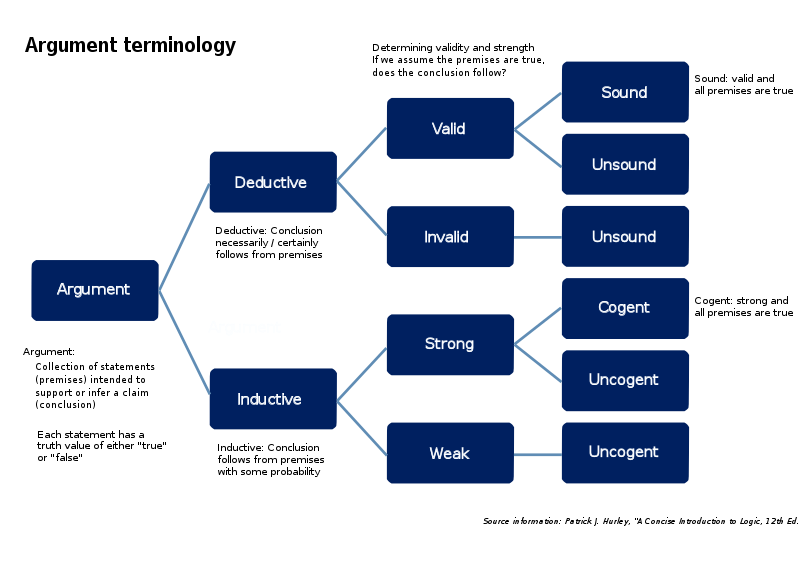
File:Argument_terminology_used_in_logic_(en).svg · Wikimedia Commons · See Wikimedia Commons
演绎推理
Sign in to saveAlso known as deductive logic, deduction, deductive methods, deductive inference
邏輯上可以理解為前提的推理方法可以得出邏輯上的某些結論
Deductive reasoning is a method where you start with statements you accept as true and follow the logical rules of how ideas connect to reach conclusions that must be true. It matters because it allows you to arrive at reliable, certain conclusions rather than just making educated guesses.
AI-generated from the Wikipedia summary — may contain errors.
Wikidata facts
Show 5 more facts
- has characteristic
- working hypothesis
- topic's main category
- Category:Deductive reasoning
- Commons category
- Deductive reasoning
- discoverer or inventor
- Thales
- maintained by WikiProject
- WikiProject Mathematics
via Wikidata · CC0
Article · 中文
演绎推理(英語:Deductive Reasoning)、正向推理在传统的亚里士多德逻辑中是「结论,可从叫做‘前提’的已知事实,‘必然地’得出的推理」。如果前提为真,则结论必然为真。这区别于溯因推理和归纳推理:它们的前提可以预测出高概率的结论,但是不确保结论为真。 “演绎推理”还可以定义为结论在普遍性上不大于前提的推理,或「结论在确定性上,同前提一样」的推理。
Abstract from DBpedia / Wikipedia · CC BY-SA
Gallery (2)
Available in 65 languages
- Español
- Français
- Deutsch
- 中文
- 日本語
- Русский
- Português
- Italiano
- العربية
- हिन्दी
- Albanian
- Armenian
- Azerbaijani
- Bahasa Indonesia
- Basque
- Bosnian
- Bulgarian
- Catalan
Show 46 more
- Central Kurdish
- Croatian
- Czech
- Danish
- Esperanto
- Estonian
- Finnish
- Galician
- Greek
- Hebrew
- Hungarian
- Icelandic
- Ido
- Javanese
- Kazakh
- Kikuyu
- Kyrgyz
- Latvian
- Lojban
- Macedonian
- Malay
- Nederlands
- Norwegian
- Norwegian Nynorsk
- Pashto
- Polski
- Romanian
- Serbian
- Serbian (Latin)
- simple
- Slovak
- Slovenian
- Svenska
- Tamil
- Tatar
- Tiếng Việt
- Türkçe
- Ukrainian
- Urdu
- Uzbek
- Western Panjabi
- Wu Chinese
- zh_yue
- فارسی
- ไทย
- 한국어
via Wikidata sitelinks · CC0