metrópole indiana e território da união que inclui Nova Deli
Delhi is India's capital city and a union territory located along the Yamuna River, with a population of roughly 16.8 million people according to the 2011 census. It matters because it serves as the political and administrative center of India, containing New Delhi, the nation's capital, and is one of the world's largest cities by population.
AI-generated from the Wikipedia summary — may contain errors.
via Open-Meteo
Travellers with little experience of visiting developing megacities will find Delhi to be chaotic at its worst, crowded and for much of the year, polluted. Air pollution is a major problem in Delhi since the 1980s, with much of the day dominated with a very unhealthy amount of particles. During the late spring and early summer months, the city is scorchingly hot. Dig a little deeper however and you will get a glimpse of order beneath the chaos as well as India's traditional and modern cultural richness flourishing side by side. First-time visitors feeling the culture shock are recommended to not compound that by visiting during adverse weather conditions, and get a decent hotel room so you can stay in comfort between your sightseeing trips. In addition, read up on the various scams and other uncomfortable situations travellers to India often encounter. Prepaid SIM cards for tourists are readily available at the airport arrivals hall and convenience stores. They offer generous data packages at low rates.
Getting around Delhi is always an adventure. Traffic is, by and large, horribly congested and many drivers will think nothing of quoting ten times the going price to a tourist. Use the prices below as broad guidelines and agree on prices before setting off. The best way to travel is via metro, where there are separate cabins for women (which prove to be very useful during rush hour). Metro is clean, efficient, and typically ridden by relatively affluent middle-class students or commuters en route to/from work; there is almost nowhere in the city that you cannot get to by metro.
thumb|Humayun's Tomb Delhi is known for its impressive range of structures — fortifications, mosques, and tombs — built during the centuries when Delhi was the centre of large Muslim empires. There are dozens of notable sites scattered around the city, and several of them are internationally famous as UNESCO World Heritage Sites.Detailed listings of all sights in Delhi can be found in the district articles.
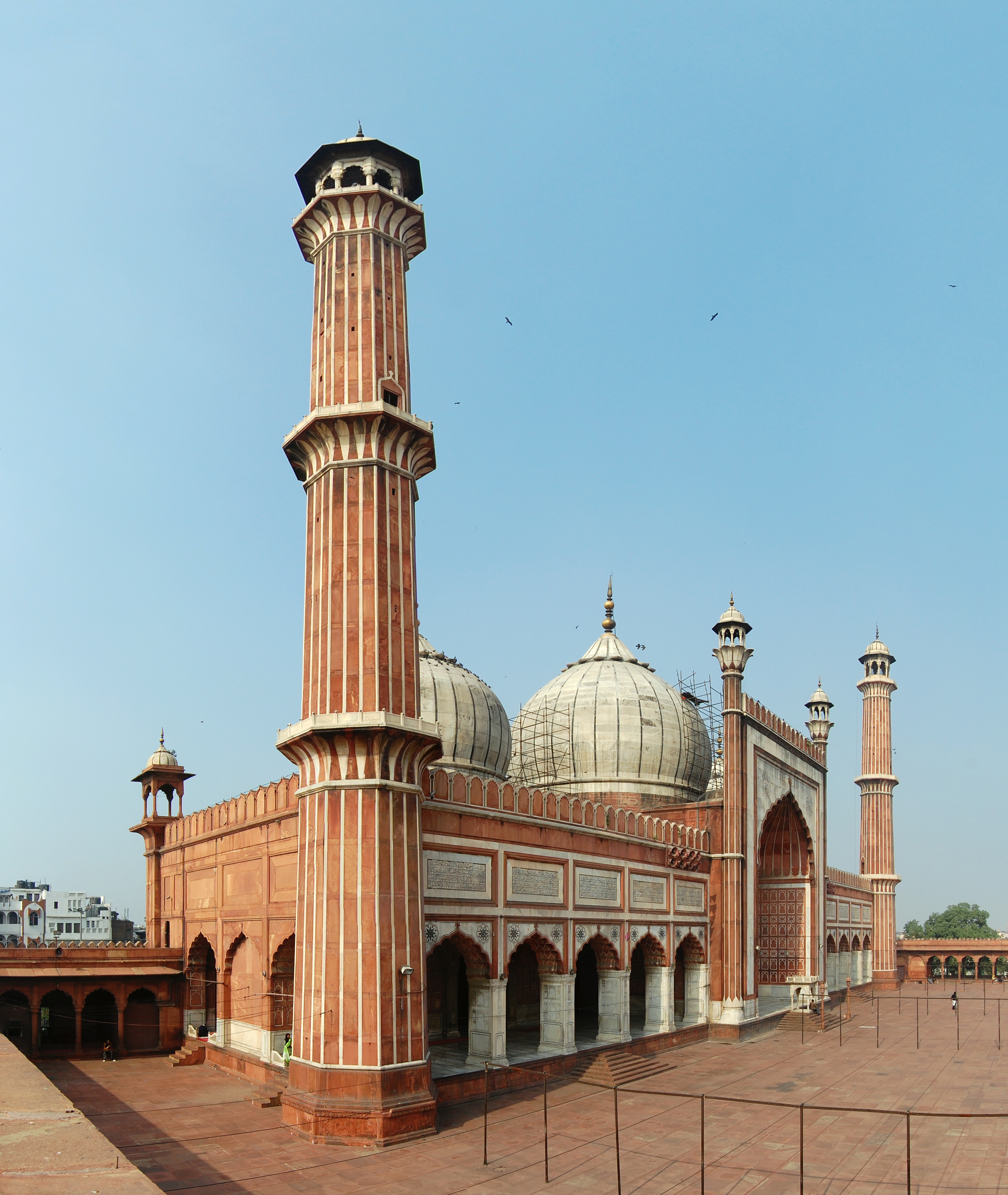
The most visited sites are the Red Fort (the 17th century palace of the Mughal emperor), Jama Masjid (a vast and beautiful 17th century mosque), the Qutub Minar (a 73-meter high tower, dating to the 13th century but still with well-preserved intricate carvings), Humayun's Tomb (the vast 16th century tomb of the Mughal emperor Humayun), and Purana Qila (a 16th-century Mughal citadel).
Newcomers are often confused about the relationship between Delhi and New Delhi. In fact, New Delhi, the capital of India, is actually one of the districts of Delhi. New Delhi was built in 1911–12 under the British rule. Being centrally planned in the modern era, it features wide boulevards, large parks, and roundabouts between its government buildings. Popular sights here are the India Gate, Kartavya Path "national mall" connecting the main government buildings, and Rashtrapati Bhavan (presidential palace). Many of the most important museums in Delhi are located here too.
Deli, Déli ou Delhi, conhecida localmente como Dilli (em hindi: दिल्ली; romaniz.: Dilli; em panjabi: ਦਿੱਲੀ; em urdu: دِہلی dihlī), é a segunda maior e mais importante cidade da Índia, atrás apenas de Bombaim. Situada no norte do país, engloba a região de Nova Deli (em hindi: Ni Dilli), a capital do país. Com uma população estimada em 2011 em pouco mais de 11 milhões de habitantes, a cidade de Deli figura a segunda maior cidade da Índia, e a oitava maior do mundo — porém se consideramos seu complexo metropolitano expandido, conhecido como a Região da Capital Nacional (TCN), que engloba partes dos estados de Haryana, Uttarakhand, Utar Pradexe e Rajastão, a população da cidade sobe para 23,2 milhões de habitantes (2011), a maior do país e a segunda maior do mundo, distribuída por uma área estimada em 1 483 km². Deli tornou-se a capital do Império Mogol em 1638. Quando o Império Britânico passou a dominar grande parte da Índia, com Deli conquistada em 1803, Calcutá se tornou a capital. Voltou a ser capital administrativa do Reino Unido de 1912. Em 1947, quando a Índia declarou-se independente do domínio britânico, Nova Deli, nova cidade construída ao Sul da antiga cidade, reurbanizada sobre antigas partes da cidade, foi declarada capital e sede administrativa do governo indiano, passando a sediar o Parlamento Indiano e outros órgãos importantes do governo do país. Os idiomas principais são o hindi, o urdu, o panjabi e o inglês.
Abstract from DBpedia / Wikipedia · CC BY-SA
5 mapped locations
Discovered by embedding cosine similarity (sentence-transformers MiniLM, 384-dim).
via OpenStreetMap · GeoNames
via Wikimedia Pageviews API
via Wikipedia infobox
via Wikidata · CC0
Another popular attraction is the Bahá'í Lotus Temple in South East Delhi, a modern structure built with a flower-like …
thumb|Watching cricket at the Arun Jaitley Cricket Stadium
Take a walk at Connaught Place (CP), the heart of New Delhi. The British-designed colonial equivalent of a shopping mall, it's laid out in two concentric rings divided into blocks, all bursting with shops and lots of pampered pigeons waddling about. Long neglected, the area received an upsurge after the opening of the major Metro junction of Rajiv Chowk under it, and it's going more upmarket by the day. At the centre is a small but pleasant park, while on one edge is the notorious Palika Bazaar, an underground den of cheap wares, many pirated or smuggled from overseas. The area is surrounded by tall office buildings on nearly all sides. Train fans will want to check out the Metro Museum inside the Patel Chowk station, open Tu-Su 10AM-4PM (free with valid Metro ticket).
You can find many major sports venues in Delhi such as the Arun Jaitley Cricket Stadium, the Ambedkar Stadium for football and the Indira Gandhi Arena - one of Asia's largest indoor arenas in the southeastern corner of Central Delhi. A bit further south is the Jawaharlal Nehru Stadium, home to the national football team and the venue for major sports events in the city.
New Delhi is the place to go for parks; here are Delhi's Central Park, the Nehru Park which is a great place to hang out on a sunny afternoon in the winter, and the Kartavya Path which is the city's main parade route lined by grassy lawns and leading from the presidential residence Ra…
thumb|250px|Fabindia - a clothing chain store If you're not afraid to haggle and bump elbows in bazaars, Delhi is a great place to shop. Most of the well-known bazaars are located in the most central parts of Delhi, both Central Delhi and New Delhi. Western-style malls are plentiful and are found further south - in South Delhi and South East Delhi, as well as the suburbs of Gurgaon and Noida. Many shopping districts are overcrowded on Saturdays and closed on Sundays.
thumbnail|Sweet jalebis are very popular in Delhi
Delhiites complain about many things in their city, but the food will satisfy even the most demanding gourmet. Not only can you find some of the best Indian food on the subcontinent, but there is also an increasing number of excellent (if often pricey) international restaurants offering cuisine from around the world. When ordering, do remember that Delhi is about 1,000 km from the nearest ocean, so vegetarian, chicken and mutton dishes are the way to go.
Do visit Paranthe Wali Gali in Chandni Chowk. This street has shops that make and sell solely parathas (stuffed Indian bread)with pandit ji parathe wale being in the business for over 150 years and many generations. These are available in all the possible flavours and stuffing you may imagine, with hundreds of varieties from bitter gourd to ice cream.
Delhi has arguably the best street food in India. However, do not eat unhygienic or open food. There are plenty of restaurants offering street food in a potentially more hygienic environment.
You can join local groups of foodies who go out regularly to sample and savour what new and old dishes the city has to offer. If you want a fully customized food tour tailored specifically for you, then Food Tour In Delhi is a good choice. The guests can explore the street food of Delhi in a fun and safe manner. Their tours cover food joints which are in business for 50 to 120 years and serve some of the best street food in the worl…
Delhi's nightlife scene has changed since the beginning of the millennium. There are plenty of modern, cosmopolitan places to separate you from your rupees. In a desperate attempt to keep the sex ratio vaguely equitable, many lounges and clubs have couples only policies (that is, no single men or men-only groups), enforced with varying degrees of strictness. While everything is supposed to shut down by 1AM, things can keep going much longer.
The coffee culture in Delhi consists mostly of large, heavily standardised chains. The two most common, Barista and Cafe Coffee Day, can be found in multiple locations across the city, most notably around Connaught Place. The UK-based Costa Coffee and the US-based Starbucks have also made a foray into the market. For listings of independent coffee shops, see the district articles.
Prices quoted may not include taxes of up to 22.5%, calculated based on the published rack rates - not necessarily the price that you actually pay, which could be discounted. Smoking is not allowed in Delhi hotels.
thumb|Delhi at night
Many first-time travellers to India find themselves falling victim to scams and touts, and unfortunately Delhi has a lot of both. Be on guard for anybody trying to help you by giving you unsolicited directions or travel advice. Do not blindly rely on the advice of taxi and auto drivers. If this is your first time to India, do not openly admit it, as this will make you more vulnerable to touts.
Delhi is very unsafe for women travellers, and is among the three unsafest cities for women in India. It is considered as the 'rape capital of the world'. It is not uncommon in some areas to receive lewd remarks or even physical touching. If you are arriving into Delhi at night, stay in either the airport lounge or well lit areas until daybreak if this is your first trip to Delhi and if you haven't booked a hotel. Never use public transport, or travel outside your hotel during the night, to avoid sexual harrasment. Dress conservatively (preferably in Indian clothing so as to blend in). Learn to shout and consider carrying mace/pepper spray. It is recommended to walk with a male that you know, to avoid this.
Carry your cash, passport, and cards in a secure money belt, with only enough cash for a few hours at a time in your wallet or other accessible place. Some recommend carrying an expendable wallet with a few ten rupee notes in it in an obvious place such as your hip pocket as a decoy to Delhi's ubiquitous pickpockets.
Several tourist agencies have been known t…
thumb|The air quality is among the worst in the world in Delhi Summer begins in early April and continues till the end of June, with the heat peaking in May. By the latter part of April or during early May. The temperatures regularly exceed 40 °C (104 °F), meaning that proper hydration is of the utmost importance. Keep yourself covered in summers to avoid a heat stroke. Drink a lot of water — around 3 litres a day — particularly in the summer. Keep in mind that the water is almost always manufactured by reverse osmosis (RO). This means that it is close to distilled water, and you might want to mix some ORS / WHO solutions into the water.
Winter arrives in Delhi by late November or early December and continues till mid-February. In winter there can be seasonal fog; on particularly foggy days, it can be difficult to see across the street. If you are flying in or out Delhi during the winters, be aware of fog-related flight delays.
Drink only packaged bottled water to avoid water-related illness. Sticking to freshly- and well-cooked food will lessen your chances on acquiring the "Delhi belly".
Delhi is one of the most polluted cities in the world, with pollution levels often in the "poor", "severe", or "hazardous" range. Keep an eye on air quality data. Air quality is especially bad around the crop burning season, which begins in late September and extends towards early November. Consider wearing a surgical mask or other approved N95/N99 mask, especially if spending …
Travel guide from Wikivoyage (CC BY-SA 4.0)
via Wikidata sitelinks · CC0