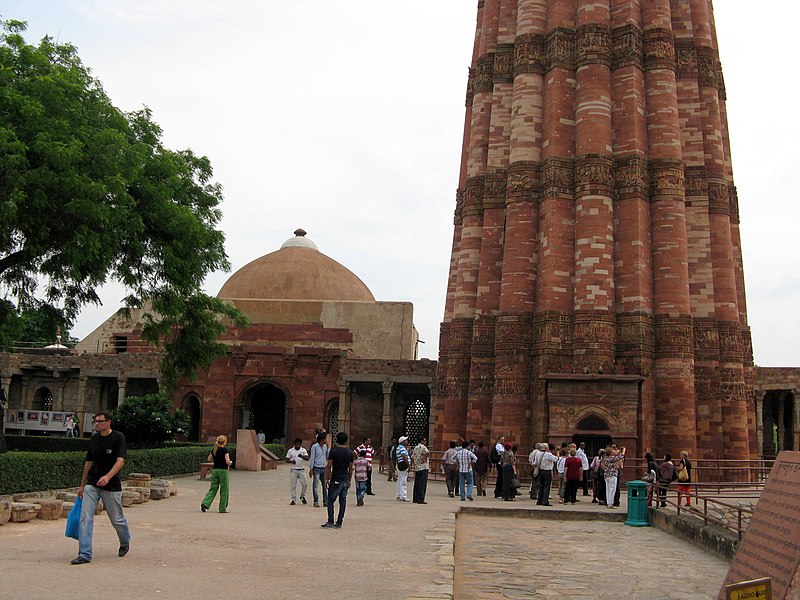
File:Qutub_minar_and_a_tomb.JPG · Wikimedia Commons · See Wikimedia Commons
Qutb Minar
Sign in to saveAlso known as Qutub Minar, Qutab Minar, Dhruv Stambh, Dhurva Stambha
minaret in the Mehrauli area of Delhi, India
Qutb Minar is a tall minaret (a tower attached to mosques) located in the Mehrauli area of Delhi, India. It is an important historical structure that reflects Delhi's medieval Islamic architecture and heritage.
AI-generated from the Wikipedia summary — may contain errors.
Wikidata facts
- Instance of
- minaret
- Part of
- Qutb complex
- Country
- India
- Located in
- Delhi
- Image
- A Potrait view of Qutub Minar.jpg
- Height
- 72.5
- Significant event
- lightning strike
Show 5 more facts
- native label
- ध्रुव स्तम्भ
- Commons category
- Qutb Minar
- architectural style
- Islamic architecture
- heritage designation
- World Heritage Site
- visitors per year
- 3439575
Sources (6)
via Wikidata · CC0
~15 min read
Encyclopedic overview
The Qutb Minar, also spelled Qutub Minar and Qutab Minar, is a minaret and victory tower, built during the Delhi sultanate, and comprising the Qutb complex, a UNESCO World Heritage Site in Mehrauli, South Delhi, India. It was mostly built between 1199 and 1220, contains 399 steps, and is one of the most-frequented heritage spots in the city. After defeating Prithviraj Chauhan, the last Hindu ruler of Delhi before the Ghurid conquest of the region, Qutab-ud-din Aibak initiated the construction of the victory tower, but only managed to finish the first level. It was to mark the beginning of Islamic rule in the region. Successive dynasties of the Delhi Sultanate continued the construction, and, in 1368, Firuz Shah Tughlaq rebuilt the top parts and added a cupola.
It can be compared to the 62-metre all-brick Minaret of Jam in Afghanistan, of c. 1190, which was constructed a decade or so before the probable start of the Delhi tower. The surfaces of both are elaborately decorated with inscriptions and geometric patterns. The Qutb Minar has a shaft that is fluted with "superb stalactite bracketing under the balconies" at the top of each stage. In general, minarets were slow to be used in India and are often detached from the main mosque where they exist.
Excerpted from Wikipedia’s “Qutb Minar” article, available under the CC BY-SA 4.0 licence.
Gallery (12)
On the map
Available in 69 languages
- Español
- Français
- Deutsch
- 中文
- 日本語
- Русский
- Português
- Italiano
- العربية
- हिन्दी
- Armenian
- Assamese
- Azerbaijani
- Bahasa Indonesia
- Bangla
- Basque
- Belarusian
- Bhojpuri
Show 50 more
- Bulgarian
- Catalan
- Cebuano
- Central Kurdish
- Czech
- Esperanto
- Estonian
- Finnish
- Galician
- Georgian
- Greek
- Gujarati
- Hebrew
- Hungarian
- hyw
- Kannada
- kge
- Lithuanian
- Maithili
- Malay
- Malayalam
- Maltese
- Marathi
- Nederlands
- Nepali
- Norwegian
- Odia
- Polski
- Punjabi
- Sanskrit
- Santali
- Scots
- Serbian (Latin)
- simple
- Slovak
- Slovenian
- Svenska
- Tajik
- Tamil
- Telugu
- Türkçe
- Ukrainian
- Urdu
- Uzbek
- Western Panjabi
- Wu Chinese
- zh_yue
- فارسی
- ไทย
- 한국어
via Wikidata sitelinks · CC0