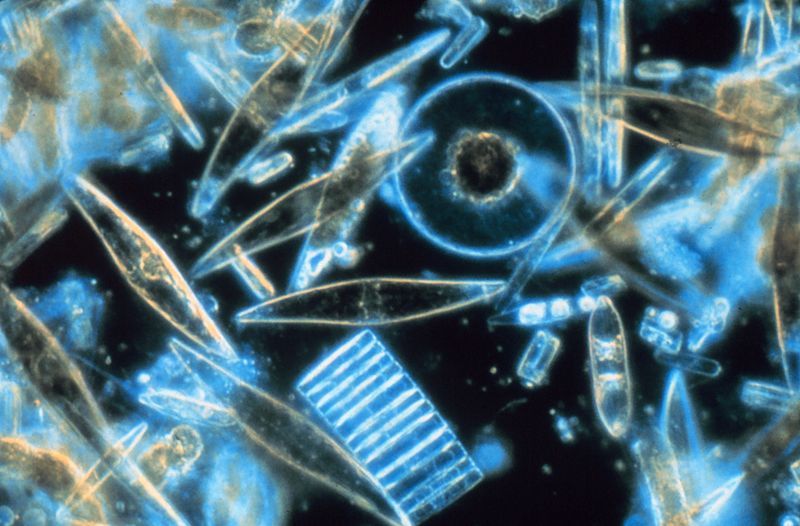
File:Diatoms_through_the_microscope.jpg · Wikimedia Commons · See Wikimedia Commons
Diatomea
Sign in to saveAlso known as diatom, diatoms
A diatom (Neo-Latin diatoma) is any member of a large group comprising several genera of algae, specifically microalgae, found in the oceans, waterways and soils of the world. Living diatoms make up a significant portion of Earth's biomass. They generate about 20 to 50 percent of the oxygen produced on the planet each year, take in over 6.7 billion tonnes of silicon each year from the waters in which they live, and constitute nearly half of the organic material found in the oceans. The shells of dead diatoms are a significant component of marine sediment, and the entire Amazon basin is fertili
OverviewAI-generated
Diatomea is a taxon associated with the family Fragilariaceae. It is categorized under the group known as diatoms. The name Diatomea has been referenced by 1,470 other encyclopedia articles.
Institutional records for this taxon are held by MNHN. There is one record associated with this entry, though no media files are currently available.
Synthesized by Vinony from 9 facts across 4 sources: Wikidata, PubMed, iDigBio, Vinony graph. Generated from structured data (not the Wikipedia text) and checked against those facts — may still contain errors.
Species
硅藻綱(學名:Bacillariophyceae)是真核藻類的一个主要类群,同时也是最常见的一种浮游藻類。多數為單細胞生物,尽管有些种类可以丝状或带状群体(如Fragilaria)、扇状群体(如Meridion)、锯齿状群体(如Tabellaria)以及星形群体(如Asterionella)形式存在。硅藻在食物链中属于生产者。硅藻的一个主要特点是硅藻细胞外覆硅质(主要是二氧化硅)的细胞壁。硅质细胞壁纹理和形态各异,但多呈对称排列。这种排列方式可作为分类命名的依据。但是这种对称并不是完全的对称,因为硅藻细胞壁的一侧比另一侧略大一点,这样才能嵌合在一起。化石遗迹显示,硅藻最迟起源于早侏罗纪时期。仅中心硅藻类的雄配子具鞭毛,可以游动。硅藻一直以来是一种重要的环境监测指示物种,常被用于水质研究。分類上歸為一綱,轄下有中心矽藻目及羽紋矽藻目。此外也是近海的优势类群。 载色体中有叶绿素a和叶绿素c,α-胡萝卜素和β-胡萝卜素,叶黄素类中主要含有墨角藻黄素,其次是硅藻黄素和硅甲黄素,由于墨角藻黄素和其他色素所占比例比叶绿素大,使载色体呈现橙黄色或黄褐色;细胞壁都是由果胶和二氧化硅组成的,没有纤维素,质地坚硬,硅质细胞壁上有呈辐射对称或左右对称排列的花纹。具有上下半壳套合而成的壳体。硅藻营养体中没有游动细胞,仅精子具鞭毛,电子显微镜下观察是茸鞭型,轴丝是9条,没有中央轴丝,这种构造是硅藻独有的。
via
Research
9,907 papers- Labyrinthula diatomea n. sp.-A Labyrinthulid Associated with Marine Diatoms.The Journal of eukaryotic microbiology · 2020Popova OV, Belevich TA, Golyshev SA et al.DOI: 10.1111/jeu.12789
- Chaetoceros.Current biology : CB · 2025Vincent F, Zwahlen S, Kooistra WHCFDOI: 10.1016/j.cub.2025.06.042
- Iron metabolism strategies in diatoms.ReviewJournal of experimental botany · 2021Gao X, Bowler C, Kazamia EDOI: 10.1093/jxb/eraa575
- Photosynthetic Pigments in Diatoms.ReviewMarine drugs · 2015Kuczynska P, Jemiola-Rzeminska M, Strzalka KDOI: 10.3390/md13095847
- Phytochromes: More Than Meets the Eye.ReviewTrends in plant science · 2016Rensing SA, Sheerin DJ, Hiltbrunner ADOI: 10.1016/j.tplants.2016.05.009
- Zeolitisation of diatoms.ReviewJournal of nanoscience and nanotechnology · 2005Anderson MW, Holmes SM, Mann R et al.DOI: 10.1166/jnn.2005.022
- Genetic and metabolic engineering in diatoms.ReviewPhilosophical transactions of the Royal Society of London. Series B, Biological sciences · 2017Huang W, Daboussi FDOI: 10.1098/rstb.2016.0411
- Interactions between diatoms and bacteria.ReviewMicrobiology and molecular biology reviews : MMBR · 2012Amin SA, Parker MS, Armbrust EVDOI: 10.1128/MMBR.00007-12
via PubMed
Wikidata facts
- Instance of
- taxon
- Parent taxon
- Heterokontophyta
- Image
- Detail, CSIRO ScienceImage 7632 SEM diatom (cropped).jpg
Show 10 more facts
- taxon name
- Diatomea
- topic's main category
- Category:Diatoms
- taxon rank
- class
- different from
- Bacillariophyta
- described by source
- Granat Encyclopedic Dictionary
- taxon synonym
- Bacillariophyta
- studied by
- phycology
- taxon common name
- kremenaste alge
- on focus list of Wikimedia project
- WikiProject Climate change
- Commons category
- Diatoms
via Wikidata · CC0
~62 min read
Encyclopedic overview
52 sectionsContents
- Overview
- Morphology
- Silicification
- Behaviour
- Phytochromes
- Life cycle
- Reproduction and cell size
- Cell division
- Sexual reproduction
- Sperm motility
- Degradation by microbes
- Ecology
- Distribution
- Growth
- Impact
- Reason for success
- Sources for collection
- Biogeochemistry
- Silica cycle
- Carbon cycle
- Urea cycle
- Other
- Taxonomy
- Genera and species
- Classes and orders
- Adl ''et al.'', 2019 treatment
- Evolution and fossil record
- Origin
- Earliest fossils
- Relation to grasslands
- Relation to climate
- Method of investigation
- Isotope records
- Diversification
- Turnover
- Genetics
- Expressed sequence tagging
- Genome sequencing
- Endosymbiotic gene transfer
- Horizontal gene transfer
- Genetic engineering
- Human uses
- Paleontology
- Industrial
- Nanotechnology
- Forensic
- History of discovery
- Gallery
- See also
- Notes
- References
- External links
A diatom (Neo-Latin diatoma) is any member of a large group comprising several genera of algae, specifically microalgae, found in the oceans, waterways and soils of the world. Living diatoms make up a significant portion of Earth's biomass. They generate about 20 to 50 percent of the oxygen produced on the planet each year, take in over 6.7 billion tonnes of silicon each year from the waters in which they live, and constitute nearly half of the organic material found in the oceans. The shells of dead diatoms are a significant component of marine sediment, and the entire Amazon basin is fertilized annually by 27 million tons of diatom shell dust transported by transatlantic winds from the African Sahara, much of it from the Bodélé Depression, which was once made up of a system of fresh-water lakes.
Diatoms are unicellular organisms: they occur either as solitary cells or in colonies, which can take the shape of ribbons, fans, zigzags, or stars. Individual cells range in size from 2 to 2000 micrometers. In the presence of adequate nutrients and sunlight, an assemblage of living diatoms doubles approximately every 24 hours by asexual multiple fission; the maximum life span of individual cells is about six days. Diatoms have two distinct shapes: a few (centric diatoms) are radially symmetric, while most (pennate diatoms) are broadly bilaterally symmetric.
Excerpted from Wikipedia’s “Diatomea” article, available under the CC BY-SA 4.0 licence.
Gallery (53)
Available in 75 languages
- Español
- Français
- Deutsch
- 中文
- 日本語
- Русский
- Português
- Italiano
- العربية
- हिन्दी
- Afrikaans
- Albanian
- Amharic
- Armenian
- Assamese
- Asturian
- Azerbaijani
- Bahasa Indonesia
Show 56 more
- Basque
- Belarusian
- Bosnian
- Bulgarian
- Catalan
- Croatian
- Czech
- Danish
- Egyptian Arabic
- Esperanto
- Estonian
- Filipino
- Finnish
- Galician
- Georgian
- Greek
- Hebrew
- Hungarian
- Icelandic
- Ido
- Interlingua
- Irish
- Kannada
- Kazakh
- Kyrgyz
- Latin
- Latvian
- Lithuanian
- Macedonian
- Malagasy
- Malayalam
- Mongolian
- Nederlands
- Northern Frisian
- Norwegian
- Norwegian Nynorsk
- Polski
- Romanian
- Scots
- Serbian
- Serbian (Latin)
- simple
- Sinhala
- Slovak
- Svenska
- Tamil
- Tiếng Việt
- Türkçe
- Ukrainian
- Uzbek
- Waray
- Wu Chinese
- zh_yue
- فارسی
- ไทย
- 한국어
via Wikidata sitelinks · CC0