Dictyocaryum · Kew POWO · Kew Plants of the World Online
Dictyocaryum
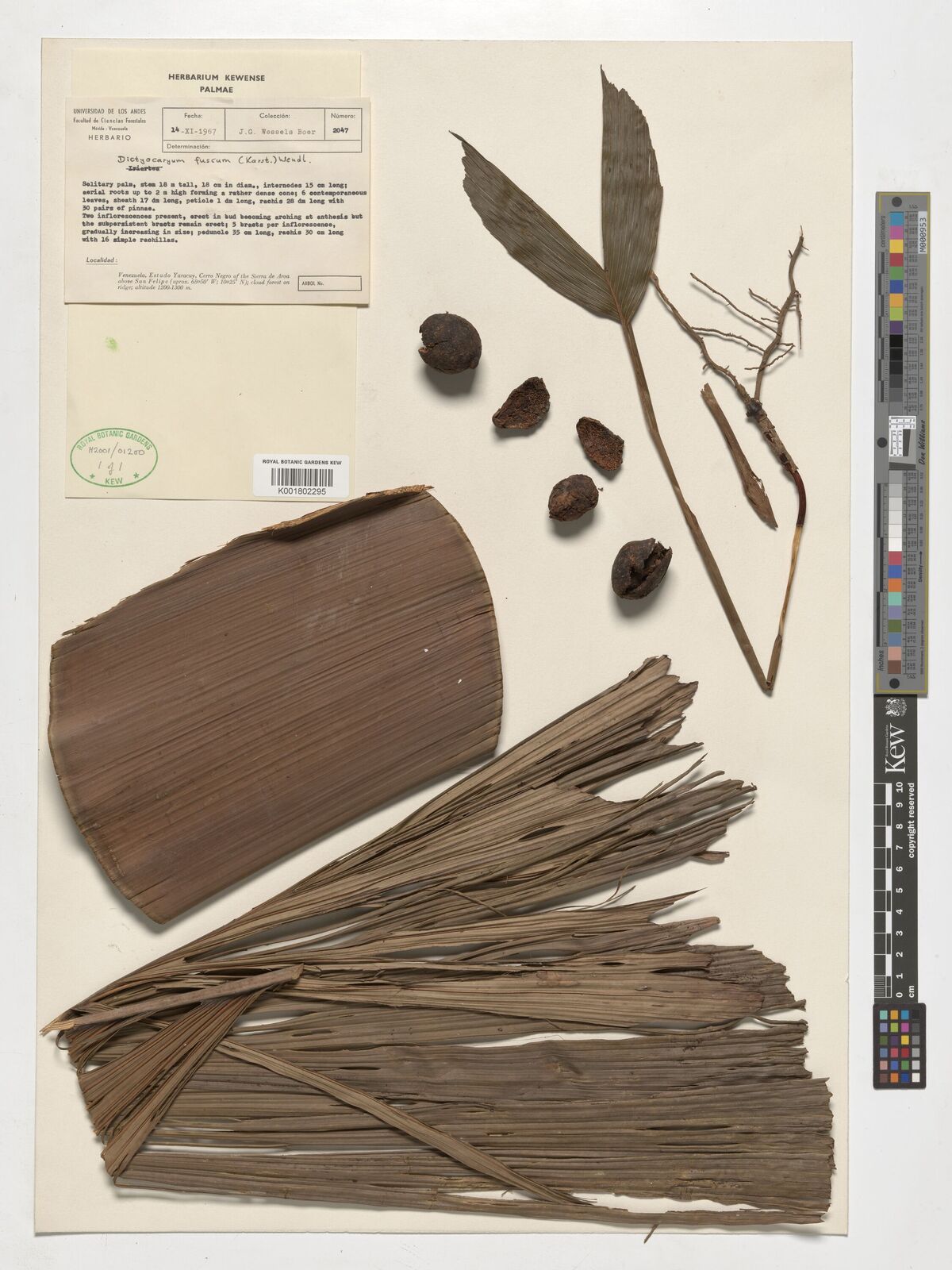
Sign in to saveDictyocaryum is a genus of monoecious flowering plants in the palm family found in South America. It is closely related to the genus Iriartea; they are commonly called araque or palma real. As many as eleven species have been described but this number is reduced to three in most current accounts. The genus name translates from two Greek words meaning "net" and "nut", describing the thick network of raphe fibers around the seed.
Species
GENUS
- KingdomPlantae
- PhylumTracheophyta
- ClassLiliopsida
- OrderArecales
- FamilyArecaceae
via GBIF · Kew POWO
Museum specimens
- Specimen records
- 60
- With media
- 79
- Family
- Arecaceae
- Collections
- NY, US, INSTITUTO NACIONAL DE PESQUISAS DA AMAZÔNIA (INPA)
- Recorded in
- Brazil, Venezuela, Guyana, Brasil, Colombia
Wikidata facts
- Instance of
- taxon
- Image
- Dictyocaryum Lamarckianum.jpg
Show 6 more facts
- taxon name
- Dictyocaryum
- taxon rank
- genus
- topic's main category
- Category:Dictyocaryum
- Commons category
- Dictyocaryum
- taxon common name
- 金椰属
Sources (1)
via Wikidata · CC0
~3 min read
Encyclopedic overview
5 sectionsContents
- Description
- Distribution and habitat
- Cultivation and uses
- References
- External links
Dictyocaryum is a genus of monoecious flowering plants in the palm family found in South America. It is closely related to the genus Iriartea; they are commonly called araque or palma real. As many as eleven species have been described but this number is reduced to three in most current accounts. The genus name translates from two Greek words meaning "net" and "nut", describing the thick network of raphe fibers around the seed.
==Description== Dictyocaryum palms are usually solitary in nature though D. ptarianum will occasionally cluster in habitat. All three plants have conical masses of stilt roots at the base which are armed with spines. These stilt roots, in the case of D. fuscum, can be up to four inches (ten centimeters) thick. The trunks are conspicuously ringed by leaf scars, to 30 cm wide, and in D. lamarckianum reach over 20 m in height. All have tall crownshafts and four to six large, plumose, pinnate leaves. The leaves may be sparsely to densely tomentose on the rachis and petiole, the leaflets are regularly and widely spaced, up to 60 cm long, dark green on top and glaucous on the underside.
Excerpted from Wikipedia’s “Dictyocaryum” article, available under the CC BY-SA 4.0 licence.