
Djibouti
Sign in to saveAlso known as Republic of Djibouti, Jabuuti, Gabuuti, Jībūtī, dj
Djibouti, officially the Republic of Djibouti, is a country in the Horn of Africa, bordered by Somalia to the south, Ethiopia to the southwest, Eritrea in the north, and the Red Sea and the Gulf of Aden to the east. The country has an area of .
OverviewAI-generated
Djibouti is a sovereign state in Eastern Africa. It shares borders with Eritrea, Ethiopia, and Somalia. The capital city is also named Djibouti. The country’s official languages are French and Arabic. Its currency is the Djiboutian franc. The head of state is Ismail Omar Guelleh. The head of government includes Dileita Mohamed Dileita and Abdoulkader Kamil Mohamed.
The nation has a population of 1066809. Its total area is 23200. Djibouti contains the administrative territorial entities of Djibouti Region, Ali Sabieh Region, Arta Region, and Dikhil Region. The highest point is Mousa Ali. The country is a member of the United Nations, African Union, League of Arab States, and World Trade Organization. Its top-level Internet domain is .dj. The telephone country code is +253.
Synthesized by Vinony from 67 facts across 9 sources: Wikidata, REST Countries, Openweathermap, Open Meteo, World Bank, OpenStreetMap, PubMed, Vinony graph, Geo. Generated from structured data (not the Wikipedia text) and checked against those facts — may still contain errors.
Weather now
7-day forecast
via Open-Meteo
Country
- Capital
- Djibouti
- Population
- 1,066,809
- Region
- Africa · Eastern Africa
- Demonym
- Djibouti
- Currencies
- DJF (Fr)
- Languages
- Arabic, French
- Calling code
- +253
- Drives on
- Right
- Gini
- 41.6 (2017)
- FIFA code
- DJI
- TLD
- .dj
- Timezones
- UTC+03:00
- Borders
- ERI, ETH, SOM
via REST Countries
Indicators · World Bank
- GDP
- $4.2B(2024)
- Population
- 1,168,722(2024)
- Life expectancy
- 66.2 yrs(2024)
- Unemployment
- 26 %(2025)
- Urban population
- 72.9 %(2024)
- Internet users
- 65.3 %(2024)
- Forest area
- 0.3 %(2023)
- Renewable energy
- 26.9 %(2022)
via World Bank Open Data · CC BY 4.0
Place details
- Region
- Arta عرتا
- Country
- Djibouti جيبوتي
- Population
- 958,920
- Timezone
- Africa/Djibouti
via OpenStreetMap · GeoNames
Wikipedia views (30d)
72,744 totalvia Wikimedia Pageviews API
Key facts
- Country.conventional_long_name
- Republic of Djibouti
- Country.common_name
- Djibouti
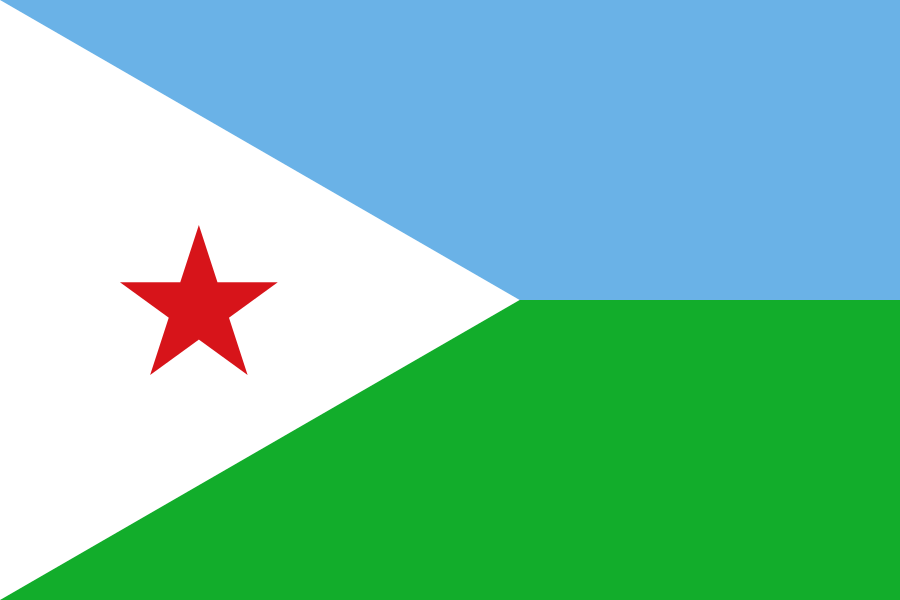
- Country.image_flag
- Flag of Djibouti.svg
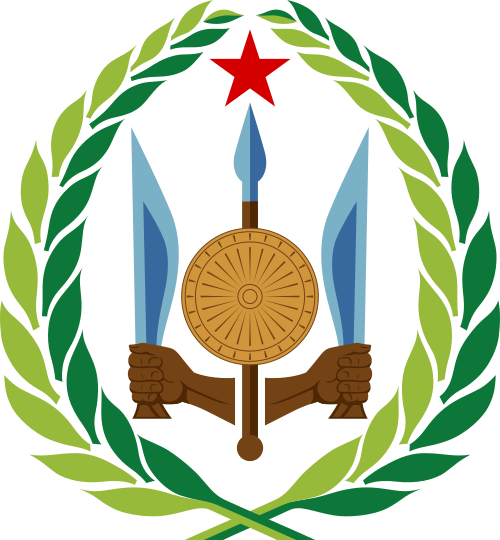
- Country.image_coat
- Emblem of Djibouti.svg
- Country.symbol_type
- Emblem
- Country.national_anthem
- Djibouti
- Country.languages_type
- National languages
- Country.religion
- 94% Islam (official) 87% Sunni 8% Non-denominational 2% Shia 3% Other 6% Christianity
- Country.demonym
- Djiboutian
- Country.capital
- Djibouti City
- Country.largest_city
- capital
- Country.government_type
- Unitary dominant-party presidential republic under a hereditary dictatorship
- Country.leader_title1
- President
- Country.leader_title2
- Prime Minister
- Country.leader_name1
- Ismaïl Omar Guelleh
- Country.leader_name2
- Abdoulkader Kamil Mohamed
- Country.sovereignty_type
- Formation
- Country.established_event1
- Independence from France
via Wikipedia infobox
Research
744 papers- Stroke in Djibouti.African journal of emergency medicine : Revue africaine de la medecine d'urgence · 2022Nour MA, Mrabet S, Maidal MA et al.DOI: 10.1016/j.afjem.2022.03.002
- [The mosquitoes (Diptera: Culicidae) of Djibouti: bibliographical review (1970-2023)].ReviewMedecine tropicale et sante internationale · 2024Abdourahman Omar A, Himmi ODOI: 10.48327/mtsi.v4i1.2024.365
- Djibouti.Department of State publication. Background notes series · 1988United States. Department of State. Bureau of Public Affairs
- [Djibouti].Jeune Afrique (Paris, France : 1980) · 1996
- [Mosquito-borne diseases in the Republic of Djibouti: a review of the literature].ReviewMedecine tropicale et sante internationale · 2025Abdourahman Omar A, Himmi ODOI: 10.48327/mtsi.v5i4.2025.778
- Hepatitis C Virus Epidemiology in Djibouti, Somalia, Sudan, and Yemen: Systematic Review and Meta-Analysis.PloS one · 2016Chaabna K, Kouyoumjian SP, Abu-Raddad LJDOI: 10.1371/journal.pone.0149966
- Female genital mutilation in Djibouti.ReviewAfrican health sciences · 2012Martinelli M, Ollé-Goig JEDOI: 10.4314/ahs.v12i4.2
- [Djibouti: dealing with a demographic explosion].ReviewMedecine tropicale : revue du Corps de sante colonial · 1997Massenet D, Tourab SB, Omar CS
via PubMed
Wikidata facts
- Instance of
- sovereign state
- Part of
- French colonial empire
- Named after
- Djibouti
- Official name
- République de Djibouti
- Demonym
- دجيبوتيات
- Country
- Djibouti
- Contains
- Tadjourah Region
- Continent
- Africa
- Capital
- Djibouti
- Official language
- Arabic
- Currency
- Djiboutian franc
- Population
- 1152944
- Area
- 23200
- Head of government
- Abdoulkader Kamil Mohamed
- Head of state
- Ismail Omar Guelleh
- Legislature
- National Assembly
- Anthem
- Djibouti
- Shares border with
- Somalia
- Highest point
- Mousa Ali
- Official website
- www.presidence.dj
- Image
- An aerial view of Djibouti City.jpg
- Life expectancy
- 62.465
- Nominal GDP
- 3515109075
- Calling code
- +253
Show 53 more facts
- Mains voltage
- 220
- Motto
- Undod, Cydraddoldeb, Heddwch
- Flag
- flag of Djibouti
- Coat of arms
- Emblem of Djibouti
- top-level Internet domain
- .dj
- Commons category
- Djibouti
- member of
- African Continental Free Trade Area
- topic's main category
- Category:Djibouti
- category for people who died here
- Category:Deaths in Djibouti
- category of associated people
- Category:Djiboutian people
- diplomatic relation
- United Kingdom
- topic's main Wikimedia portal
- Portal:Djibouti
- mobile country code
- 638
- lowest point
- Lake Assal
- driving side
- right
- geography of topic
- geography of Djibouti
- category for people born here
- Category:Births in Djibouti
- age of majority
- 18
- marriageable age
- 18
- office held by head of state
- President of Djibouti
- number of out-of-school children
- 180029
- located in/on physical feature
- East Africa
- total fertility rate
- 3.195
- maritime identification digits
- 621
- Commons gallery
- جيبوتي / Djibouti
- native label
- Jabuuti
- inception
- 1977-06-23
- central bank
- Central Bank of Djibouti
- Unicode character
- 🇩🇯
- language used
- Afar
- suicide rate
- 5.8
- history of topic
- history of Djibouti
- culture
- culture of Djibouti
- BTI Status Index
- 4.12
- BTI Governance Index
- 5.17
- economy of topic
- economy of Djibouti
- demographics of topic
- demographics of Djibouti
- different from
- Djibouti
- Democracy Index
- 2.71
- Human Development Index
- 0.509
- hashtag
- djibouti
- on focus list of Wikimedia project
- Wikipedia:Vital articles/Level/4
- Gini coefficient
- 41.6
- Inequality-adjusted Human Development Index
- 0.309
- P12749
- bohrium
- birth rate
- 21.911
- male population
- 556264
- death rate
- 8.962
- rural population
- 242328
- female population
- 564584
- urban population
- 878521
- P8168
- Dautlarovo
Sources (15)
via Wikidata · CC0
Travel guide
Understand
Djibouti's location near the Suez Route, one of the world's busiest shipping routes, has made the country important for international trade.
Get in
thumb|375px|A map showing the visa requirements of Djibouti, with countries in lime having visa on arrival
Get around
Taxis are available in Djibouti and from the airport to the town, as you exit the airport there is a big billboard displaying expected taxi fares, look for it; also in Ali-Sabieh, Dikhil, Dorale and Arta. Fares can increase by 50% after dark. Bicycling is a great way to get around the small capital. Ferry services sail daily from L'Escale (Djibouti) to Tadjoura and Obock. The journey takes about three hours.
See
thumb|Lake Assalthumb|Shores of Lake Abbe Lake Assal, at 150 m below sea level, is the third-lowest point on Earth. You'll need to hire a car or ask someone who lives in Djibouti to drive you there. Expect a rough ride: the roads outside the capital are destroyed by the truck traffic between Djibouti and Ethiopia. The road passes within sight of the Devil's Island, and some impressive views. Expect to be awestruck. Lake Abbe is one of the most desolate places on Earth and is dotted with limestone chimneys up to 50 m high. It is described as lunar, and Planet of the Apes was filmed here.
Do
Scuba diving — Despite the country's arid landscape, off the coast lie several reefs teeming with all sorts of life. Sea kayaking — Sea kayaking allows you to enjoy the Gulf of Tadjoura and Ghoubet Kharrib in an eco-friendly way, with the possibility of observing whale sharks and sea turtles. Whale shark tours — You can also go snorkelling or diving with whale sharks, although the chance of seeing them varies throughout the season (70-80% in Nov-Jan and close to zero during warmer months).
Eat
The city of Djibouti has many places to eat, including tourist traps. Western food is often expensive cuisine, with local cuisine being much cheaper. For example, the Ethiopian Community Center offers a wide variety of local, tasty and reasonably priced dishes. Average price per meal outside tourist areas is US$4 including drink.
Stay safe
Natural hazards include earthquakes and droughts. Occasional cyclonic disturbances from the Indian Ocean bring heavy rains and flash floods.
Visitors should be aware of the risk of banditry outside the capital city.
Stay healthy
Health insurance is advisable. Doctors and hospitals may expect immediate cash payment for any medical treatment. A yellow fever vaccination certificate is required for visitors over one year of age coming from infected areas. Cholera is also a serious risk and precautions are essential. Up-to-date advice should be sought before deciding if these precautions should include vaccination as medical opinion is divided over its effectiveness. Typhoid immunization is usually advised.
Malaria risk, predominantly in the malignant falciparum form, exists year-round. Resistance to chloroquine has been reported. Mefloquine, doxycycline or atovaquone/proguanil are recommended.
The adult HIV/AIDS prevalence rate is over 3% or 1 in 33 adults. Protect yourself.
Tap water is not safe to drink unless it has been boiled or otherwise sterilized.
Respect
Casual wear is widely acceptable, but Djibouti is a Muslim country, and certain codes of behaviour should be observed. Shorts are generally not appropriate outside of hotels, beaches or sport activities. While homosexuality is not explicitly criminalized it remains broadly unaccepted, Djibouti is generally considered unsafe for LGBTQ+ travelers in all locations.
Connect
There is a 3G phone network in the country that runs on 900MHz. The maximum speed is 7mbps but expect it to be lower. You can get 1GB of data for about US$3. More info can be obtained here
Travel guide from Wikivoyage (CC BY-SA 4.0)
~40 min read
Encyclopedic overview
39 sectionsContents
- Name and etymology
- History
- Prehistory
- Antiquity
- Introduction of Islam and the Middle Ages
- Early modern era
- French colonization (1862–1977)
- Djibouti Republic
- Politics
- Governance
- Foreign relations
- Military
- Foreign military presence
- Human rights
- Geography
- Location and habitat
- Climate
- Wildlife
- Economy
- Transport
- Media and telecommunications
- Tourism
- Energy
- Demographics
- Languages
- Religion
- Largest cities
- Health
- Education
- Culture
- Music
- Literature
- Sport
- Cuisine
- See also
- Notes
- References
- Sources
- External links
Djibouti, officially the Republic of Djibouti, is a country in the Horn of Africa, bordered by Somalia to the south, Ethiopia to the southwest, Eritrea in the north, and the Red Sea and the Gulf of Aden to the east. The country has an area of 23,200 km (8,958 sq mi).
In antiquity, the territory, together with Ethiopia, Eritrea and Somaliland, was part of the Land of Punt. Nearby Zeila, now in Somaliland, was the seat of the medieval Adal and Ifat Sultanates. In the late 19th century, the colony of French Somaliland was established after the ruling Dir-Somali, and Afar sultans signed treaties with the French, and its railroad to Dire Dawa (and later Addis Ababa) allowed it to quickly supersede Zeila as the port for southern Ethiopia and the Ogaden. It was renamed the French Territory of the Afars and the Issas in 1967. A decade later, the Djiboutian people voted for independence. This officially marked the establishment of the Republic of Djibouti, named after its capital city. The new state joined the United Nations in its first year. In the early 1990s, tensions over government representation led to armed conflict, which ended in a power-sharing agreement in 2000 between the ruling party and the opposition.
Excerpted from Wikipedia’s “Djibouti” article, available under the CC BY-SA 4.0 licence.
Gallery (39)
On the map
4 mapped locations
Available in 252 languages
- Español
- Français
- Deutsch
- 中文
- 日本語
- Русский
- Português
- Italiano
- العربية
- हिन्दी
- Abkhazian
- abstract
- Achinese
- Adyghe
- Afrikaans
- Albanian
- Albanian
- Amharic
Show 233 more
- Angika
- Aragonese
- Armenian
- Arpitan
- Asturian
- azb
- Azerbaijani
- Bahasa Indonesia
- Balinese
- Bambara
- Bangla
- Banjar
- Bashkir
- Basque
- bat_smg
- Bavarian
- be_x_old
- Belarusian
- Betawi
- Bhojpuri
- Bikol
- Bishnupriya
- Bislama
- Bosnian
- Breton
- Bulgarian
- Buriat
- Burmese
- Catalan
- cbk_zam
- cdo
- Cebuano
- Central Kurdish
- Chechen
- Cherokee
- Chuvash
- Cornish
- Corsican
- Crimean Tatar
- Croatian
- Czech
- dag
- Danish
- Dinka
- Divehi
- dty
- Dzongkha
- Egyptian Arabic
- Esperanto
- Estonian
- Ewe
- Extremaduran
- Faroese
- Fiji Hindi
- Filipino
- Finnish
- fiu_vro
- Fon
- Frafra
- Fula
- Gagauz
- Galician
- Ganda
- gcr
- Georgian
- Gilaki
- Goan Konkani
- gpe
- Greek
- Guarani
- Haitian Creole
- Hakka Chinese
- Hausa
- Hebrew
- Hungarian
- hyw
- Icelandic
- Ido
- Igbo
- Iloko
- Inari Sami
- Interlingua
- Interlingue
- Irish
- Jamaican Creole English
- Javanese
- Jju
- Kabyle
- kai
- Kannada
- Kara-Kalpak
- Kashmiri
- Kazakh
- kbp
- kge
- Khmer
- Kikuyu
- Kinyarwanda
- Kongo
- Kotava
- Kurdish
- Kyrgyz
- Ladino
- Lao
- Latin
- Latvian
- Ligurian
- Limburgish
- Lingala
- Lingua Franca Nova
- Lithuanian
- lld
- Lombard
- Low German
- Lower Sorbian
- Luxembourgish
- Macedonian
- Madurese
- Maithili
- Malagasy
- Malay
- Malayalam
- Maltese
- Manipuri
- Manx
- Māori
- map_bms
- Marathi
- Mazanderani
- Minangkabau
- Mingrelian
- Mirandese
- Moksha
- Mongolian
- Moroccan Arabic
- Navajo
- nds_nl
- Nederlands
- Nepali
- Newari
- Northern Frisian
- Northern Sami
- Northern Sotho
- Norwegian
- Norwegian Nynorsk
- Novial
- nup
- Obolo
- Occitan
- Old English
- olo
- Oromo
- Ossetic
- Pampanga
- Papiamento
- Pashto
- Pennsylvania German
- Piedmontese
- Polski
- Punjabi
- Quechua
- roa_rup
- Romanian
- Rusyn
- Samoan
- Sango
- Sanskrit
- Sardinian
- Saterland Frisian
- Scots
- Scottish Gaelic
- Serbian
- Serbian (Latin)
- Shan
- Shona
- Sicilian
- Silesian
- simple
- Sindhi
- Sinhala
- Slovak
- Slovenian
- Somali
- Southern Sotho
- Standard Moroccan Tamazight
- Sundanese
- Svenska
- Swahili
- Swati
- Tachelhit
- Tajik
- Talysh
- Tamil
- Tatar
- Telugu
- Tibetan
- Tiếng Việt
- Tigrinya
- Toki Pona
- Tsonga
- Tumbuka
- Türkçe
- Turkmen
- Tyap
- Udmurt
- Ukrainian
- Upper Sorbian
- Urdu
- Uyghur
- Uzbek
- Venetian
- Veps
- Volapük
- Waray
- Welsh
- Western Frisian
- Western Mari
- Western Panjabi
- Wolof
- Wu Chinese
- Yakut
- Yiddish
- Yoruba
- Zaza
- Zeelandic
- zh_classical
- zh_min_nan
- zh_yue
- Zhuang
- Zulu
- فارسی
- ไทย
- 한국어
via Wikidata sitelinks · CC0