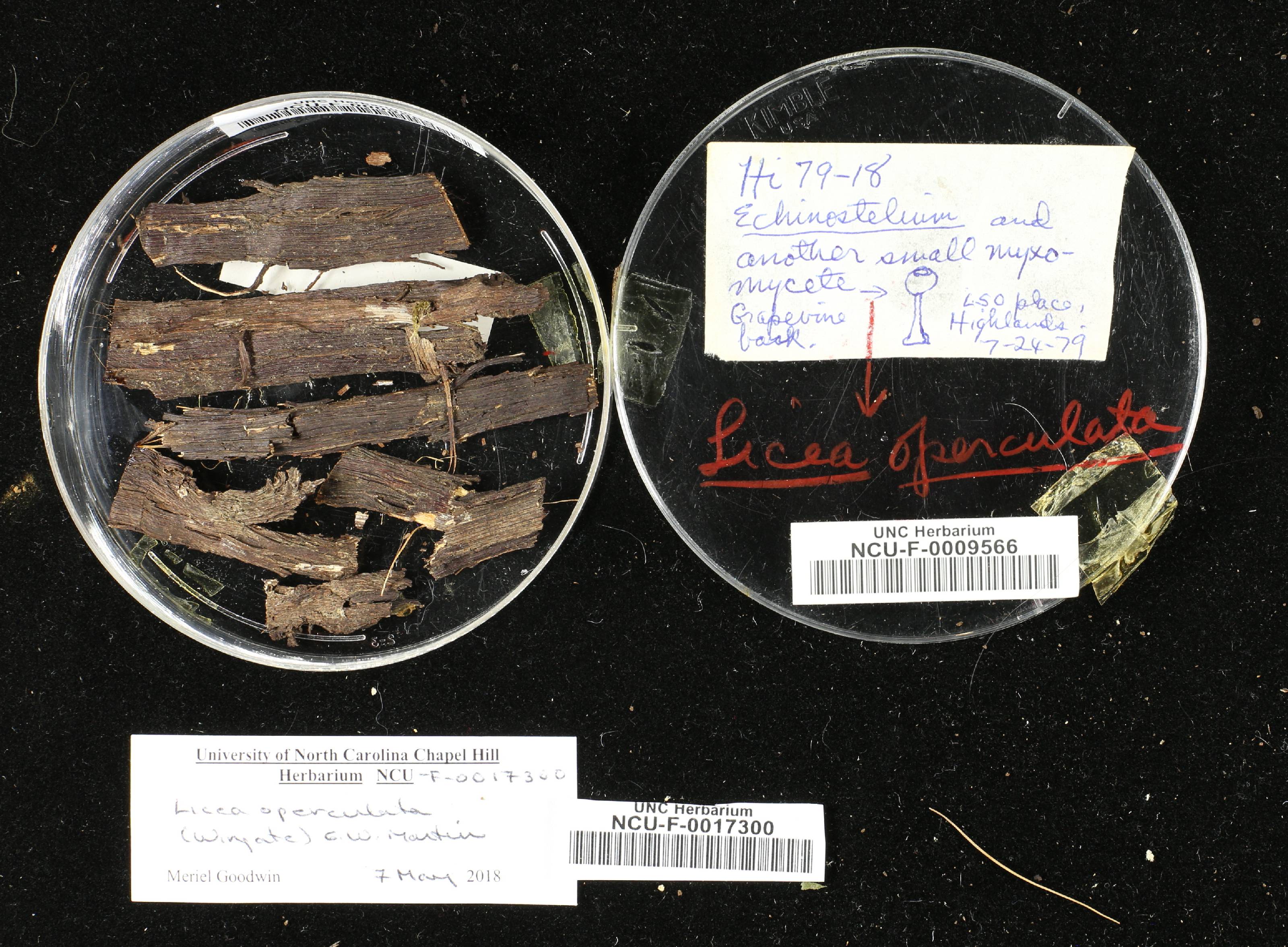
Specimen image via iDigBio · BY-NC-SA
Echinostelium
Sign in to saveEchinostelium is a genus of slime mould, and the only genus in the monotypic family Echinosteliaceae, or Echinosteliidae. It was discovered by Heinrich Anton de Bary in 1855, apparently near Frankfurt am Main. Some species of Echinostelium have a sexual life cycle; others have been shown to be asexual. The plasmodium can divide vegetatively, in a process called plasmotomy, to distinguish it from true cell division.
Species
GENUS
- KingdomProtozoa
- PhylumMycetozoa
- ClassMyxomycetes
- OrderEchinosteliales
- FamilyEchinosteliaceae
via GBIF
Museum specimens
- Specimen records
- 47
- With media
- 54
- Family
- Echinosteliaceae
- Collections
- DBG, NCU, BPI, ARIZ, O
- Recorded in
- United States, Guatemala, Colombia, Norway
~1 min read
Encyclopedic overview
2 sectionsContents
- Species
- References
Echinostelium is a genus of slime mould, and the only genus in the monotypic family Echinosteliaceae, or Echinosteliidae. It was discovered by Heinrich Anton de Bary in 1855, apparently near Frankfurt am Main. Some species of Echinostelium have a sexual life cycle; others have been shown to be asexual. The plasmodium can divide vegetatively, in a process called plasmotomy, to distinguish it from true cell division.
==Species== The genus Echinostelium comprises at least five species: Echinostelium apitectum K. D. Whitney, 1980 Echinostelium colliculosum K. D. Whitney & H. W. Keller, 1980 Echinostelium corynophorum K. D. Whitney, 1980 Echinostelium fragile Nannenga-Bremekamp, 1961 Echinostelium minutum De Bary in Rostafinsky, 1874
Excerpted from Wikipedia’s “Echinostelium” article, available under the CC BY-SA 4.0 licence.
Available in 7 languages
via Wikidata sitelinks · CC0